

~NFT Collector | Crypto Investor | Community Builder~ Community moderator @GenLayer
Joined May 2022
- Tweets6.9K
- Following2.8K
- Followers3.1K
- Likes5K





Pinned Tweet
When you look at what @zama is building, it feels like the early days of smart contracts all over again something revolutionary that most people don’t yet realize the full potential of.Fully Homomorphic Encryption enables a world where data stays encrypted, yet still usable. Developers can build private DeFi protocols, confidential AI systems, or secure identity layers all without breaking composability.This is the kind of foundation that redefines blockchain from an open ledger to an intelligent privacy-preserving network.Zama isn’t following trends it’s setting the direction for the next era of decentralized computation.
#ZamaCreatorProgram

nearar retweeted

GEN tokenomics is live.
How GEN is staked, spent and earned across GenLayer, all in one paper 👇portal.genlayer.foundation/g…

nearar retweeted
GEN Airdrop Registration is open.
You've been building GenLayer with us since the start. Now it's time to register.
Open until Monday, October 26.
airdrop.genlayer.com
Your activity across social, AI tools, games and on-chain is still fragmented. Platforms capture the value, you keep almost none of it portable.
@conso_xyz is building a Consumer Reputation Layer that turns that activity into a verifiable Consumer Passport + ZAPs you own.
The practical pieces so far: Miner App, AI Extension (prompt tracking), and BOTS as mobile nodes on Sui + Walrus.
Been reading the docs. The ownership angle is the part that feels different.

6
99
6,219
The part of this thread that stayed with me is not the size of the agent economy. It is the question underneath it: what happens after two autonomous agents make a deal and then disagree about whether the job was actually done?
Payments can move value. Identity can tell us who signed. Interoperability can connect different systems. But none of these can produce a trusted judgment when the facts are messy, the agreement is written in normal language, or the answer depends on information outside a blockchain.
That gap becomes dangerous once agents control real money. A fast economy without a neutral way to resolve disputes is not truly autonomous. It simply pushes every failure back to a company, a moderator, or a slow court.
That is why @GenLayer interests me. A jury of validators that can examine outside information and reach a decentralized verdict feels less like another blockchain feature and more like infrastructure the agent economy was missing.
The real test is simple: can strangers let their agents transact without having to trust the same middleman when something goes wrong?

The internet never had a judge.
AI agents are about to move $9 trillion. Nobody built the part that handles disagreement.
GenLayer did.
And now you can become part of it: portal.genlayer.foundation/g…
If I had GEN to delegate, I wouldn’t simply choose the biggest validator and forget about it.
Because staking is more than locking tokens and collecting rewards.
On @GenLayer, validators are part of what keeps the network running securely and correctly. Delegation gives GEN holders a way to support those validators without having to operate validator infrastructure themselves.
But that creates an important question:
Where should you delegate?
The easiest answer might be to find the most popular validator and put everything there.
I wouldn’t do that.
Before delegating, I’d look at things like the validator’s reliability, performance, history, and how much stake is already concentrated around them.
And instead of putting 100% of my GEN behind a single validator, I’d personally spread it across several reliable validators.
Why?
First, I wouldn’t want my entire position dependent on the performance of one validator.
But there’s a bigger reason.
Delegation doesn’t only affect you it affects the network.
Every delegation influences how stake is distributed across validators. If everyone automatically delegates to the same few large validators, stake becomes increasingly concentrated.
A healthier network needs strong validators, but it also benefits from having stake distributed across multiple capable participants.
So my strategy would be simple:
→ Research before delegating
→ Prioritize reliable validators, not just the largest ones
→ Spread my GEN across several strong validators
→ Keep monitoring them instead of treating delegation as “set and forget”
To me, that’s the interesting part of staking.
You’re not just asking:
“Where can I earn?”
You’re also asking:
“Who am I trusting to help secure the network, and what kind of validator set am I helping create?”
That small change in perspective makes delegation much more than a passive action.
Your GEN is capital.
Your delegation is a decision.
And where that stake goes helps shape the network you’re participating in.
That’s how I’d approach staking and delegation on @GenLayer

2
13
189
A transfer can settle and still be the wrong outcome.
That is the part of the October 1 thread that stayed with me. Payments, identity and interoperability for agents are already being built. None of them decides the fight after the payment moves. A chain can show what was recorded. It cannot, by itself, read a clause, check a live page, and say whether the deal was actually met.
That gap is cheap to ignore while agents are demos. It is expensive once they move real money. If opening a case costs more than the claim, most disputes never get filed. They just get abandoned.
@GenLayer is aiming at that layer: validators on different models judge a proposed result, instead of one operator or one model deciding alone. I am not sure the appeals process is enough yet. I am sure the missing piece is judgment, not another payments rail.
If two agents disagree on a $200 job, what would you rather pay: a court that takes months, or a verdict in minutes you can still appeal?
nitter.cf/GenLayer/status/210567…
The internet never had a judge.
AI agents are about to move $9 trillion. Nobody built the part that handles disagreement.
GenLayer did.
And now you can become part of it: portal.genlayer.foundation/g…
7
123
Joined GenLayer’s campaign on @RallyOnChain this week. It’s called the Golden Thread. You write your own take on GenLayer, an AI scores it on originality and accuracy, and that score decides your share of a 100,000 GLP prize pool. Copy-paste gets marked down. Already in. @ASPRO_22 if you’ve been curious about the project, this is the cleanest way to start.

The internet never had a judge.
AI agents are about to move $9 trillion. Nobody built the part that handles disagreement.
GenLayer did.
And now you can become part of it: portal.genlayer.foundation/g…
1
14
237
I first heard about @GenLayer from people I already followed in the space. They weren’t just pitching another token; they were talking about a missing layer, so I decided to explore it properly.
My first meaningful step was joining the portal as a Builder and starting to build Intelligent Contracts. The attached Builder ranking screenshot shows that I moved from simply reading about GenLayer to actually contributing to the ecosystem.
What caught my attention is the idea behind Intelligent Contracts. Bitcoin settled the order of transactions. Ethereum settled the execution of code. GenLayer is exploring how contracts can interpret live web information, understand natural language, and reach consensus when there is no single mechanical answer.
Validators can independently evaluate the same information, compare the meaning of their results, and resolve disagreements through Optimistic Democracy. That feels important for a future where agents interact, make decisions, and transact at machine speed.
What kept me interested was the builder side. Studio lets developers write and test contracts in Python, while the portal makes contributions visible. As someone who builds, that matters more to me than another narrative.
Still early, but taking that first real step helped me understand the direction much better.
If you’re a builder, the portal is a good place to start: portal.genlayer.foundation

Had a great chat with Mochi about prediction markets on GenLayer.
I learned how Intelligent Contracts can use multiple real-world sources while validators help resolve conflicting information.
What stood out to me is that the system doesn’t have to depend on a single oracle or source of truth.
@GenLayer


4
17
148
nearar retweeted
Now it's your turn.
We are opening our Hackathon to everyone building for the Agentic Economy.
🗓️ 3 to 17 September
💰 5% of all GenLayer Points
No costumes required.
👉 portal.genlayer.foundation/a…

Built Technocore Beacon 🔐
An independent Python CLI for encrypted Ed25519 identities, signed messages, room reading, and public contribution receipts.
GitHub: github.com/nearar22/technoco…
Public DID: did:key:z6Mki94qZvcsjyzZBBRZ4pRFmemLizmBtqvXFhnE8v6b42qY
@flop_labs

6
175

nearar retweeted

ANNOUNCING DEBUGZ 🐛
Bugz was always meant to be the beta test for the first ever omnichain mint platform.
Then today you all showed up at the exact same time and broke our stupid wallet checker. 😂
We test like crazy behind the scenes, but today reminded us of something:
There is no substitute for the real thing.
So before Genesis Bugz, we’re going to have a rehearsal.
Introducing DeBugz.
A practice collection that EVERYONE eligible to mint Genesis Bugz will already be eligible to mint.
We want you to show up.
We want you to mint.
We want you to try things.
We want you to BREAK EVERYTHING!
Find the Bugz.
Stress the system.
Help us discover the things that only thousands of people trying to do something at once can discover.
Then we’ll fix them.
Together.
Because we don’t want Genesis Bugz to be the first real test of UnVault.
We want it to be the first demonstration of what UnVault can do.
Let’s build the best damn NFT trading platform in history!
Mint DeBugz. Break everything. Find the Bugz.
Are you with us? 🐛🟧
PS: We are not kidding.

nearar retweeted
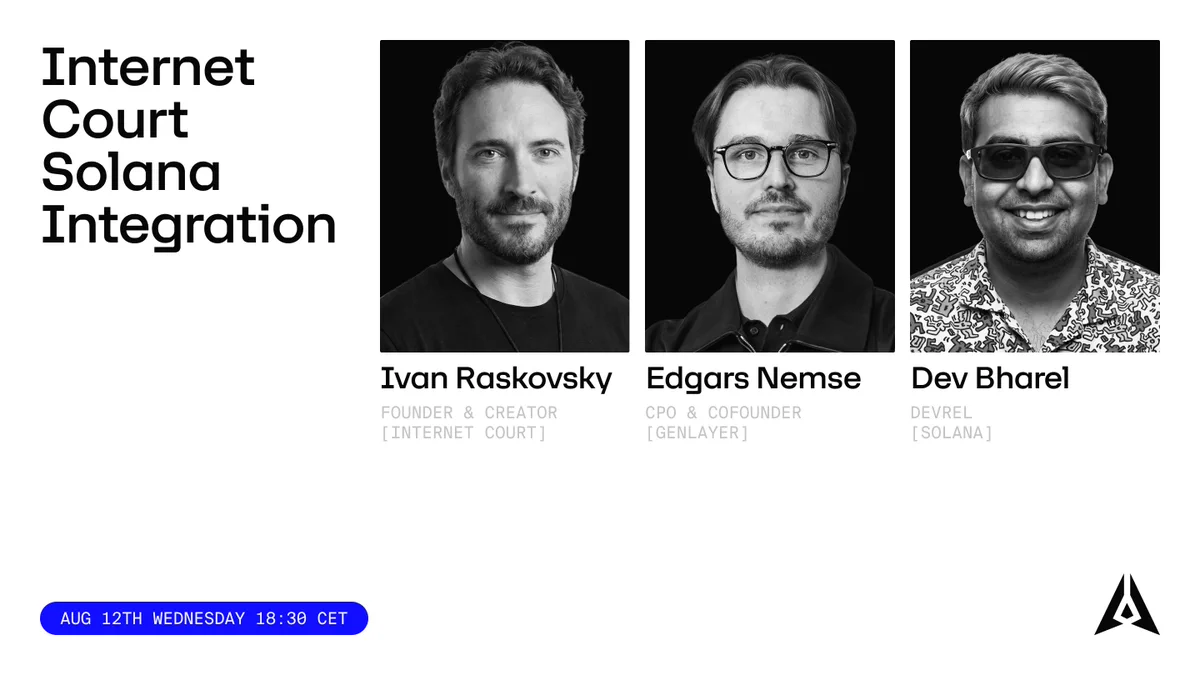
Internet Court has a new consortium member.
We're going live tomorrow at 4.30PM UTC to talk AI and agent commerce, joined by @spacemandev from @solana, @EdgarsNemse, CPO at @GenLayerLabs, and @iraskovsky, creator of Internet Court.
Set your reminder 👇
nitter.cf/i/broadcasts/1DGleVeDn…
nearar retweeted
Today’s your chance to ask @kstellana directly.
GenLayer’s Co-Founder & CEO will be live answering community questions.
Set a reminder & submit yours 👇

Join me at Arc Mainnet launch livestream community.arc.io/public/even… #ArcHouse

2
184


