

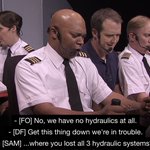
CHARLIE VICTOR ROMEO is a theatrical documentary derived entirely from the Black Box transcripts of six major real-life airline emergencies.
NYC, NY
Joined June 2012
- Tweets1.3K
- Following1.8K
- Followers868
- Likes1.2K





Pinned Tweet
Thanks to everyone who purchased one of our Limited Edition Blu-Ray disc sets, they've all sold out. There's still a good number of the standard edition sets left and they have the same extras and features. Link in bio.


Charlie Victor Romeo retweeted

Not to be harsh, but this is like when a guy stops by the cockpit before we push back from the gate, tells me he flies Cessnas & will be in the back if he needs me.
He might be a great journalist, but this introduction is cringe.
Given the NTSB took the dramatic step of publicly refuting this article – and the NTSB being one of the few agencies I still trust – I think I’ll skip it.

Charlie Victor Romeo retweeted

So far it's not improving much.
60-70% of flights are delayed or cancelled as each hour passes.
UA is possibly getting ahead of it.
WN tends to preemptively delay the entire day like that. The others will "cascade" onward.
Hoping for improvements in afternoon block.


Charlie Victor Romeo retweeted
My daughter will start flying lessons in a little over a year.
She doesn’t want to be a pilot, but she thinks it will look good on a college application. Fine by me; I don’t care if she ever touches an airplane again after she gets her license…I just think it will teach her confidence, to remain calm in a crisis & most importantly, that nobody is coming to save you. You must rely on yourself & the stakes are real.
I’ve flown w/ plenty of female pilots. Some were not great, but at about the same rate that some male pilots weren’t great. I remember Nanette, keeping the KC-10 steady in Afghanistan with only the standby attitude indicator after we lost literally everything else. Just humming along, like she did it everyday, and listening as we worked the checklists.
I guess my point is that immediately blaming the female is out of bounds. Maybe she did have something to do with it, but so do males. By the way, the fact that you hear her voice on the radio means she wasn’t the one flying the jet…she was the “Pilot Monitoring” & runs the radios / navigation.
We learn things from every crash. This one will eventually make it into a lesson plan, and students will hear the tapes. It’s not pleasant, but understanding what the cockpit environment may be like in an emergency is an important lesson. Panic is your enemy & causes you to make mistakes like shutting down the wrong engine. You must fight it, but…eventually there is probably a moment you know the fight has been lost and you are going to die.
I might scream, too.
There are multiple ways you leave this profession, but it comes down to two scenarios:
One day, you’ll stroll out to the jet knowing this is your last flight, with your family & friends in attendance. There will be a party after.
Or…
One day, you’ll stroll out to the jet not knowing it’s your last flight.
We hope for the former & prepare for the latter.
Charlie Victor Romeo retweeted
Air Force student pilots receive a manual called “The Road To Wings”.
It documents training mishaps since 1972. Students learn from the misfortune of others. I’ll link it below.
The closing is “The Troop Who Rode One In” (didn’t eject & died in the crash). If I may…
“We should all bear one thing in mind when we talk about a troop who rode one in. He called upon the sum of his knowledge and made a judgment. He believed in it so strongly that he knowingly bet his life on it. The fact that he was mistaken in his judgment is a
tragedy, not stupidity. Every supervisor and contemporary who ever spoke to him had an opportunity to influence his judgment. So a little bit of all of us goes in with every troop we lose.”
-Anonymous
I tried to remember that as an instructor. It’s part of what I’m trying to do on here now.
Anyway, as promised, here is the link:
static.e-publishing.af.mil/p…

Charlie Victor Romeo retweeted
Let’s do a primer on in-flight ice accumulation, or “icing” for those not familiar.
As you go up in altitude, the temperature & pressure decrease. It’s about 2°C per 1,000’, called the “standard lapse rate”. It varies locally, but we use this as our standard.
So, even on a hot day on the surface at 90°F (32°C), you theoretically only need to climb 16,000’ to get to 32°F (0°C).
Because of the way air flows over the surfaces of an airplane at speed, the outside air temperature is not equal to the temperature of the air as it hits the wing & such. Friction & compression heats the air as it hits the airplane; we measure this & call it the “Total Air Temperature” (TAT). The faster you go, the higher the TAT.
Still, most jets can’t go fast enough at altitude to get the TAT above freezing. In fact, on the 737 at near max speed & a cruise altitude of 35,000’ or so, the TAT is still going to be around -40°C (it varies a lot, that’s just a guess).
Now, clouds are just visible moisture. We all know what happens to water at those temperatures. An airplane passing through a bunch of frozen water is going to collect ice on it.
There are different categories, types & intensities of icing. Structural icing is just the airplane flying through cold clouds; the ice collects on the airplane. It can be Rime icing, which is kind of milky in color & looks bubbly, Clear icing, which can be tough to see or a mix. In some rare scenarios, very large drops of water are supercooled & remain liquid until they contact the jet, then instantly freeze. While the other types of ice generally only collect on the leading edges of surfaces, supercooled drops may run back over more of the jet during the freeze.
That’s a big problem; usually only the leading edges of the surfaces like the wings & engines are protected from ice. The shiny parts on the front of airliner wings & around the engine intake are where hot air from the engines gets diverted to heat up that area & melt any ice…but if ice goes beyond that, there isn’t much you can do. Some airplanes have systems to prevent ice formation on the tail, too, but that’s usually electric pads & usually only shows up on T-tail jets.
Anyway, regardless of the type, you may get various intensities: trace, light, moderate or severe ice.
Induction icing occurs in the engines, as it sucks air in & changes the pressure. You can get induction icing without structural icing, but again, the area around the engine inlet is heated to prevent large chunks of ice from forming, breaking off & going through the engine.
We treat icing as a possibility anytime there is visible moisture (rain, snow, fog, clouds) and the temperature is 10°C or below. Yeah, you won’t get structural icing at 10°C, but you might get induction icing. In these conditions, the engine anti-ice is turned on, sending hot air around the leading edge of the engines.
The wing anti-ice is used a bit differently & the philosophy here varies widely by airline. I’ve always used it not as an anti-ice, preventing ice from forming like on engines, but as a de-ice…it’s not turned on until I see ice forming. Other airlines have different philosophies.
I turn it on, melt the ice, then turn it off. Now, we can’t see the wings well, so on the 737 we use the windscreen wipers as a proxy for the wings. If the large nut on the wiper arm has collected ice, I assume the wings have, too (the windscreens are electrically heated, but it’s not unusual to go through moderate or severe icing & collect some ice around the edges of the windscreen).
If you recall, I said the tail often doesn’t have an ice system, and that’s true of the 737. That may sound scary, but it’s not something I’m worried about. If we turn on the wing anti-ice during a flight, the computer assumes the tail may have ice on it & it bumps our approach speed up to give the tail extra air to manipulate. It’s basically an ICE additive to our final approach speed.
I hope that helps, I’m out of space.


Charlie Victor Romeo retweeted
Perhaps the most famous airplane ghost story:
Eastern Airlines flight 401 crashed into the Florida Everglades shortly before midnight on Dec 29, 1972.
The crash was avoidable; a malfunctioning landing gear light distracted the pilots, the yoke was bumped, the autopilot disconnected & the L-1011 jet slowly spiraled into the swamp without anyone noticing. 101 were killed.
Now, it’s not uncommon for airlines to salvage useable parts in the aftermath of a crash. Flight 401 was no different; useable parts were recovered & *allegedly* used as spares across Eastern’s L-1011 fleet.
According to stories, the ghosts of the Captain & Flight Engineer began to appear aboard jets that used the salvaged parts, warning flight crew of problems that were developing on the jet. Eastern executives were unhappy & warned that sharing such stories was unprofessional. It’s *alleged* that they then ordered all the salvaged parts to be removed from their jets & disposed of, after which the ghost reports stopped.
A book was written on the subject, “The Ghost of Flight 401”, which was developed into a TV movie. It also appears in other media from time to time.
A second book claimed that the parts had never been installed on other jets & that nobody had reported ghost sightings. The whole thing was just a myth.
I don’t believe in ghosts, but certain non-critical parts are definitely salvaged in crashes. They have to be re-certified, but can be used again. Critical parts like wing spars & engines are much less likely to be reused.
I don’t pay much heed to these stories, but it seemed appropriate to share tonight!

Charlie Victor Romeo retweeted
When boarding, ask the Flight Attendant if your kid can visit the cockpit.
We can’t always do that, but most of the time we’re happy to. We’ll do a little show & you can take pictures.
Just be ready to do it in a way that doesn’t block others & is quick. As for kids in the cabin…do your best to keep them occupied, but remember that most of us have been where you are with our own kids & we remember.
I took my 6 month old from NJ to Sydney, Australia once. Miserable. She wouldn’t stop crying if you set her down, refused to lay in the bassinet attached to the bulkhead & I ended up in the galley, holding her much of the way from LA to Sydney. I’ve been there, it will be OK. Your kid is welcome & most of us have been in your shoes.

"I don't mind when a kid is crying with me. I just want my flight on time!"
Transportation Secretary Sean Duffy (@SecDuffy) weighs in on JetBlue's new child-free flights as part of an adults-only vacation package. Duffy is a father of 9, and he says it's good for children to travel with their parents.
TELL US: How do you feel about kid-free flights?👇✈️
Charlie Victor Romeo retweeted
This used to be a standard program, where ATC Controllers would ride along in the cockpit jumpseat.
I’m glad to see it come back. I’ve toured a few ATC facilities & the more we learn about the other’s jobs, the better we’ll work together.

Air traffic controllers will be able to apply for jumpseat access to gain firsthand experience on flight deck operations. vist.ly/5niuv


Charlie Victor Romeo retweeted
Scariest landing at the airline:
San Jose, Costa Rica. A nice city w/ nice people, but I haven’t been back since…I don’t like the runway.
It’s fine in the day, but on a dark & stormy night, it left me shaking as we taxied clear.
I’d been assigned to go on reserve as a new Captain. I’d been before, but during the day. This time it would be night, and I picked up a new (to me) First Officer in Houston for the flight down. He had been at the airline for something like 25 years & wouldn’t upgrade…he was so senior he only flew if the airline was offering premium pay for someone to come in on a day off. This trip was broken before it was assigned to me, so it was a mix of whatever FOs they could find.
Anyway, we get down to San Jose & there is weather. At night. That’s not normally a problem, and I didn’t think it would be tonight, either.
Then we heard the jet in front of us had reported “breaking out at minimums”. This ostensibly means they get right to the minimum altitude allowed on the approach before you can either see the runway, or have to go around / do the missed approach procedure. That’s not great…the ceilings w/ weather may vary quite a bit, changing frequently. The jet in front of you may see it, then you can’t.
It’s also an unwritten code in my profession. For better or worse, this sometimes means “we had to duck under the weather” or “it was really close”. Now, there is some allowance between hitting “minimums” & executing the missed approach, but some pilots have a broader view of how long it should take you to react.
Anyway, I now think there is a higher than normal probability of having to do a missed approach, and we only have the fuel to make one attempt before diverting to our alternate airport. Not ideal, but not unsafe.
Oh, for some reason, the lead-in lights are not operational. You’ve seen them in movies…like a line of lights before the runway that flash in a fast sequence, kind of pulling you into the runway. “Follow me”, the lights say. Then, you get a bunch of other lights in front of the runway that give you clues to your orientation in both the vertical & horizontal. Extremely useful, but…not working for some reason.
Also, the lights on the side of the runway that indicate how high or low you are on the Glideslope (PAPIs) are broken. Both of these things require our normal minimum altitude on approach be increased.
Well, we flew the approach & get bumped around in the storm pretty good. Tough to stay on the instrument Glideslope. The autopilot is trying, but it tends to correct too much…it can’t predict that pushing the nose over dramatically will ultimately result in getting too low, too fast. It’s just reacting based on what the Glideslope is doing.
We break out slightly above minimums, but it’s night & only the runway edge lights are working. No centerline lights to help you gauge if you’re drifting left & right.
Two factors made this much worse: pouring rain that the wipers couldn’t keep up with, and the new LED lights used for the edge lights. The windscreen is drenched & the lights are too bright. So the runway looks like a single strip of lights being viewed through a glass of moving water.
It stayed that way until we were very close. At about 50’, I could kind of make out the 1,000’ markers painted on the runway, where I’m supposed to be aiming. It’s just too dark & the runway is wet. The PAPIs are beside the markers for a clue, but again, not working.
I landed firmly, well left of centerline (no centerline lights & couldn’t see the stripes well). The FO calls “Centerline” prompting me to correct – and I do – but too much. Now we’re shooting right of it.
Takes a couple overshooting corrections left & right on the wet runway, but we got the nose back to aligned w/ centerline. The autobrakes did their work. I taxied clear.
My heart was racing. My hand was a claw I struggled to extract from the yoke & shook slightly when I did.
Anyway, headed back soon. Hope it’s better…
Charlie Victor Romeo retweeted
They are lucky to be alive.
Initial reports indicate either an attacker got into the cockpit & stabbed the pilots, or the copilot stabbed the captain then tried to crash the jet, bound for Tel Aviv.
Palestinian militants have a long history of hijacking jets, mostly from the 1960’s to 1980’s. They often targeted random airlines, but a common thread early on was the planes were bound for Tel Aviv…which is what makes me think there is a possible link here. At one point, these hijackings became such a threat that airline pilots worldwide threatened to go on strike.
In September, 1970, the “Dawson’s Field” hijackings occurred. 3 jets bound for NYC & one for London were hijacked & flown to Dawson Field, Jordan, a desert airstrip. One passenger was injured, and all 4 jets were eventually blown up by the militants. The hijackers released most of the passengers except for those of Jewish descent. Jordanian security forces eventually fought a battle & forced a negotiated release.
To this day, Israeli airline El Al still stations armed guards at the airplane when parked at any international airport for an extended period to make sure nobody tampers with the jet or sneaks aboard.
As for this jet, they almost certainly exceeded a lot of limits, including speed & G’s. Most of the rudder surface is gone, but the Vertical Stabilizer remained intact. If it had not, the jet would almost certainly have been lost. How fast they got is unknown, but I’ve seen estimates of around .90 Mach…the limit on a 737 is .82 Mach, and I refuse to go faster than .80 Mach unless it’s absolutely smooth & I have a very compelling reason.
They did put a code into their transponder that indicates a hijacking. I won’t share the code, but it sets a lot of alarms off when you do it & we have procedures in place (which I won’t share).
You can bet that airlines worldwide are reviewing their security procedures today. I’m not too worried about an incident like this in the U.S., but as they say, “If you see something, say something”. Also noteworthy is that the passengers themselves appear to have intervened & saved the day…if the Flight Attendants ask for your help, give it!


Charlie Victor Romeo retweeted
Throwback to the time in 2021 a deployed KC-10 crew decided to code their transponder callsign as “PIKLRICK” in reference to Rick & Morty for a laugh, but plane spotters noticed, it made international news & the crew had to be scolded.
Heroes, all.


Charlie Victor Romeo retweeted
The “Slam Dunk” is a term nearly every airline pilot knows (at least in the U.S.), but you won’t find it in any book.
It occurs when getting vectors (heading & altitude) from Air Traffic Control for an approach to the runway. The pilot expects that they will end up on a nice, long straight-in approach with time to configure the jet for landing (put down the landing gear, slow down & extend the flaps to their final position) before reaching the “Final Approach Fix”. This is the last point on an approach before you begin a constant rate descent to the runway.
In a Slam Dunk, the controller gives you a heading that will end up having you roll out of the turn right at the Final Approach Fix. Inexperienced pilots will not see this coming & fail to start slowing down the jet & configuring, which leads to them reaching the fix with way too much airspeed. You now have to descend & try to get rid of that airspeed simultaneously, which is not easy to do…as we say, “the jet can slow down or go down, but it can’t do both at the same time”.
With experience, pilots begin to listen to the instructions given to other jets & can predict a Slam Dunk. Or they notice the controller has cleared them to descend to Final Approach Fix altitude much earlier than they otherwise would expect.
In these scenarios, I can tell a junior pilot “he’s going to dunk you” & they know exactly what I mean. The most reliable fix for this is to immediately put out the landing gear…it has a much higher speed limit than the flaps do & provides lots of drag to slow the jet. As the jet slows down, you can extend the flaps when passing their speed limits.
(For the 737, flaps 1 - 5 can be extended up to 250 kts, flaps 15 at 200 knots, flaps 30 – the usual landing setting – can be selected once under 175 knots)
Charlie Victor Romeo retweeted
For my audience that only casually follows aviation, here’s the story that’s mind-blowing for us geeks & will eventually become a much bigger story for the public.
The SR-71 is an icon. Elon Musk named one of his kids after the precursor to it. Every fanboy knows it & visiting one at a museum is awe-inspiring.
Bringing one back to flying condition is something I never thought possible. On retirement, most jets are given to a museum in a way the military could conceivably return them to service, but some are deliberately disabled. The SR-71 was one of the latter.
Except, apparently, for one. One that was pulled from display a few years ago. And now we hear they quietly recruited people that used to work on it, presumably to return it to flight.
It’s like hearing that we’ve gone to Alabama & decided to rebuild the Saturn V rocket on display, we’ll pull an Apollo capsule from a museum & we’re going back to the moon.
This will be a huge undertaking, but if true & they restore one to flight…I will fight like hell to be at the maiden flight.
In that regard, since I don’t know where to actually submit an application, I am hereby formally tossing my hat in the ring to fly it. For my country.

This quoted post is unavailable.
Charlie Victor Romeo retweeted
A good suggestion for a post recently:
What do pilots do in cruise? Is it boring?
Climbing up to cruise & descending for the approach is fun & active. A lot of it is hand-flown; most I fly with hand-fly the jet up to 18,000’ or more. On descent, it’s a little busier & there can be lots of changes to the plan, so the autopilot stays on longer, but once you are established on the straight-in part of the approach the autopilot gets clicked off, as long as the weather is good. If the weather is bad, we’ll generally leave it on until we can see the runway (but you *mostly* have to turn it off around 150’ above the ground. The rules vary by airline).
In cruise, the autopilot has the jet. The flight plan is programmed in before you take off, so if there are no changes, the jet will fly the flight plan exactly as it’s programmed. It knows when to climb or descend, but can’t do it unless you spin the altitude knob to the altitude you want. For example, it knows when it’s time to descend to 6,000’, but it will stay at 32,000’ until you spin the knob down to 6.
In this sense, the autopilot is always overridden by the pilots & can’t do certain things unless the pilots approve.
There are many things the autopilot doesn’t know. It has no idea about weather, traffic or terrain. Some jets can actually deal with traffic, but not all, and if you program a jet to fly from LA to Denver at 3,000’, at some point it will attempt to tunnel through the earth. It also has no idea what Air Traffic Control (ATC) is asking for.
So, there is some involvement from the pilots. We’re always monitoring the jet to make sure nothing goes wrong. If it does, the autopilot doesn’t know that…it can’t handle an engine failure or a fuel leak, and if it’s trying to do something but the jet isn’t responding the way it expects, it just gives up, sounds an alarm & turns itself off.
Most of the time, though, none of that happens. So, it can be kind of boring staring at the instruments for 4 or 5 hours.
I personally like to look out the windows. We get a pretty spectacular view up there. But that doesn’t hold your attention forever.
Cell phone use is banned at most airlines. We’re not scrolling social media. Now, some people ignore that ban, and it’s kind of a battle we’re having internally in the airlines & union. I know of one guy that got fired for pulling his phone out repeatedly during a sim session to text. That’s absolutely a no-go.
But, some people do pull out their phones. Maybe they are checking their calendar. It’s hard to make a distinction here, but the rule says no phones.
In the not too distant past, magazines, books & newspapers were the norm. They are still acceptable, but I don’t see that a lot. Not sure why, it just is.
Conversation is good, and sometimes you get into really good ones. But sometimes it’s the same conversation you had with the last guy, about the contract or the union or the new base rumor or unsolicited financial advice or boats, whatever. After a while, that gets old; I tend to be kind of quiet when flying & hope that doesn’t come across as not liking the First Officer, but I don’t care enough to do small talk just to be liked.
We have iPads to use for all our charts & a bunch of other stuff. It’s a fantastic tool, but that’s another post. Anyway, you can review the flight manual on it, studying up. You manage your schedule on the airline app…by far, this is what I see most FOs do. They are looking to trade & improve their schedule. It’s OK to read the news on your iPad, as long as the company approves the app.
You can go on the internet, but must be careful. The company knows everything that iPad does, and if they decide to look into it, they’ll have every keystroke. I’ll look into golf & watches, but not much more.
Mostly, though, I like to look outside, particularly at night. The iPad screen can wreck night vision, so I’ll turn it off.
I’m out of space. Hope that helped! The pics were taken IAW my airline’s policy.


Charlie Victor Romeo retweeted
A good question I got on this post was about how the airlines treat checkride failures.
On your application, you have to list any checkride failures or less than a pass (there is a military grade that’s not a fail, but not a pass either).
If you only have one or two, it’s not a big deal; most pilots generally do. They are going to ask you about it in the interview & you’ll need to explain what happened & how you learned from the experience. This is a variation in the “Tell Me About A Time..” (TMAT) theme.
The TMAT format will extend to how you handle interpersonal issues. For example, “Tell Me About A Time you disagreed with the Captain” or “TMAT your First Officer disagreed with you”.
You tell them your story, hopefully showing off how well you work with others. There are a few consulting agencies that you hire to help you prepare for your pilot interview. It’s a bit pricey, but well worth the money.
Anyway, one or two checkride failures is not a deal breaker. Get your story down & show how you grew from the experience. You could have more, but expect some tighter scrutiny. If you have a lot, creating a history of failing checkrides, you are unlikely to get an invite to interview.
So, if your goal is to get to the airlines, don’t be in a rush to take your checkrides. Wait till you are ready. If you fail one, it’s not the end of the world…but try not to fail them!
I failed my initial KC-10 checkride.
Things were going well. I’d been an Instructor for years already & knew all the rules, w/ the benefit of watching students mess up, then figuring out why.
We were almost done with the checkride, demonstrating my ability to fly while being the tanker. Then the call came: “BREAK AWAY, BREAK AWAY, BREAK AWAY!”
It’s the Boom Operator in the back; he or she has seen something that requires the jet to accelerate away from the receiver & if you don’t, they may collide with you. Which is bad & will ruin your whole day; if you survive, probably lots of paperwork.
This was not staged or planned for the checkride. We didn’t do that. It was real, and it was pretty uncommon to get one. To get one on your checkride was a bit wild.
And…I did nothing. Just admired the scenery, thinking about how I was acing this checkride. The Instructor looked at me in a weird way for a moment & I noticed it.
He then said “I have the aircraft”, jammed the throttles forward & performed the Break Away. The Evaluator in the jumpseat watched & took notes.
I had never heard anything. We used to use an earplug (not a headset) in only one ear, and never left the intercom on. The earplug had to be plugged into the oxygen mask, which in turn was plugged into the ports on the wall. This would guarantee that you could talk if the mask was needed, but the plugs on the mask were loose & often failed. Crews that had experience in the jet often ignored the rule that the earpiece had to be plugged into the oxygen mask & instead, they pulled the cord of the mask from the wall & just plugged into the wall directly. Which I didn’t know at the time.
I made a case with the Evaluator, but it was a fail. I would need some additional instruction & a new checkride.
I adjusted my plan. I couldn’t just plug into the wall on a checkride & violate the rules. So, I decided I would tune up a channel with lots of background static & select it to monitor but just keep it at a pretty low level (you can monitor more than one frequency at a time & adjust the volume of each independently). This way, there was a constant background low-level noise & if it stopped, I would notice.
The recheck was irony on a different level. During tanker refueling, she (the evaluator) was flying & I kid you not, we got another Break Away. And she did…nothing. She didn’t hear it because her earpiece was plugged into the oxygen mask & it failed.
I’m not making this up, I promise. The same damn thing that cost me my only failed checkride just happened to her.
You can’t undo what has already been done, so my fail remained on my record, but she passed me. It would have been nice if she had at least acknowledged the original issue, but she never spoke of it & hey, I passed.
I almost always plugged directly into the wall after that & still have some kind of background noise at a low level which will give me a warning if I suddenly can’t hear it.
Thought you might find that interesting.

Charlie Victor Romeo retweeted
In the event of an unruly or violent passenger, the Flight Attendants may ask you for help.
There is about 1 FA per 50 seats by law. An unruly passenger may require several people to restrain them. So, they will ask other passengers to assist.
Please do so. The cockpit door is now locked down in these scenarios & will not open under any circumstance.
Pilots have their own procedures & will start working with the airline via our dispatchers on divert decisions & having law enforcement meeting us at the gate. This kind of incident gets our security department on edge & may trigger fleet-wide actions…sorry, but I can’t discuss security protocols.
In any event, the jet is not at risk. The cockpit door is not reopening. Nevertheless, please help the FAs if they ask, or if they obviously are in need. Don’t be surprised if they then treat you as suspicious, too…they just don’t know who you are & now are concerned there is some coordinated plan you may be part of.

An American Airlines passenger was (literally) duct-taped to his seat following unruly behavior on flight AA618 Thursday night.
Arthur Lundeen, 67, of Arizona, was restrained to his seat with duct tape and zip ties, according to the Maryland Transportation Authority Police, which arrested him after the plane landed.
Authorities did not provide details of the disruption that took place during the flight. Still, the plane was diverted to Baltimore Washington International (BWI) Airport around 10:15 p.m., the Federal Aviation Administration, which is also probing the incident, said.
ℹ️ TMZ
