

Médico Intensivista. Jefe Sección UCI Hospital Clínico Universitario Virgen de la Arrixaca. Cuidados Críticos Cardiológicos. ECMO Team. ELSO/EUROELSO. SEMICYUC.
Joined July 2010
- Tweets2K
- Following567
- Followers437
- Likes7.2K





Carlos Albacete retweeted
Impact of hospital #ECMO volume & its distribution across ICUs on patients' outcomes: is volume surrogate for experience??
🔍 analysis of the ELSO Registry including about 116K adults across 495 centers, 2012-2023
Higher annual hospital ECMO volume/hours associated with reduced mortality. Hospitals with more adult ICUs performing #ECLS may experience higher mortality (increased patient complexity??), but hospitals with four+ ICUs showed strongest association between higher ECMO volume and lower odds of
mortality.
@CritCareMed
🖇️ bit.ly/4zolRFd

Carlos Albacete retweeted
Heart #transplant for advanced heart failure, a review:
🩺 transplant referral and patient selection
⚙️ durable mechanical circulatory support
🩻 posttransplant effects
💉 induction/maintenance immunosuppression & its complications
🧫 infection
🩸acute rejection
🫀cardiac allograft vasculopathy
🔮 prognosis
📋 practical considerations
@JAMA_current
🖇️ bit.ly/4BYfJWp

Carlos Albacete retweeted

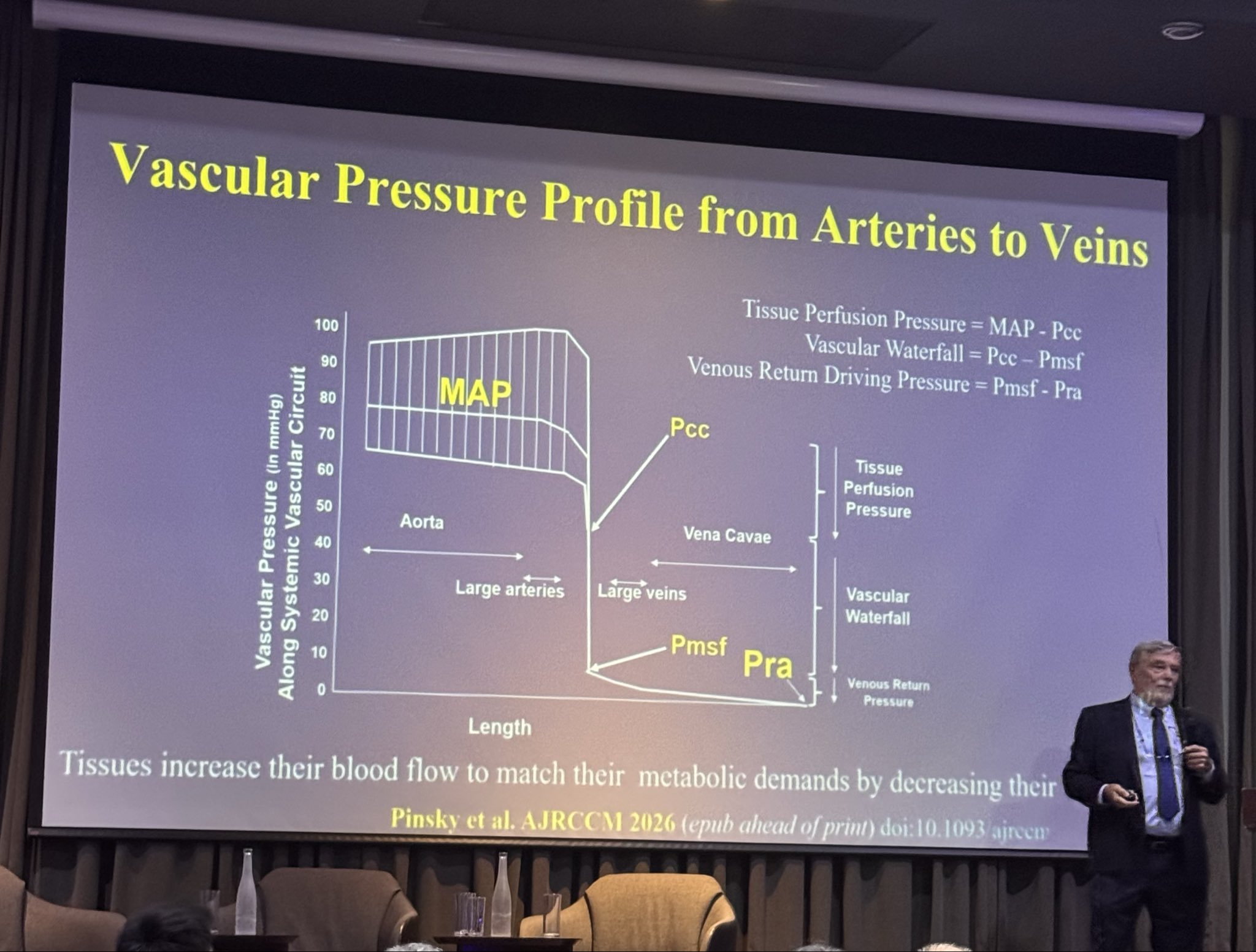
¿Por qué un paciente séptico con PAM de 70 puede seguir mal perfundido?
🏞️La teoría de la cascada 🌊💦💧
Piensen en una presa. El agua que cae depende de qué tan alto está el nivel de arriba y de la altura del borde. Lo que pase abajo no importa.
En la circulación pasa lo mismo:
• Arriba está la PAM. 🌊
• El borde de la presa es la presión crítica de cierre (Pcrit): la presión mínima que mantiene abierta una arteriola. La fija el tono vascular. 🦦
• Abajo está la presión venosa. 🏞️
📍La presión que de verdad perfunde el tejido no es PAM menos PVC. Es PAM menos Pcrit.
En el choque séptico la vasoplejía "derrumba" el borde de la presa: la Pcrit baja tanto que casi iguala la presión de llenado sistémico (Pmsf). Sin cascada, el tejido pierde su capacidad de autorregular el flujo.
Por eso la norepinefrina no sirve solo por subir la PAM. Sirve cuando sube la Pcrit.
Entonces:
1. La cifra de PAM es el medio, no la meta.
2. Evalúen la perfusión en cada paciente: llenado capilar, lactato, diuresis.
3. El mismo vasopresor puede funcionar en uno y fallar en otro.
Cómo saber si lo lograste, ya que la Pcrit no se mide de rutina:
⚪️Elastancia arterial dinámica (Eadyn): funciona como marcador indirecto del tono arterial y predice si la PAM responderá a la norepinefrina.
🔀Eadyn = VPP / VVS, es decir, la variación respiratoria de la presión de pulso (VPP) entre la variación respiratoria del volumen sistólico (VVS)
🟢Perfusión periférica: llenado capilar, lactato, delta pCO2 y diuresis. Si la PAM sube y estos no mejoran, probablemente no restauraste la cascada.
Rastrea!!!
💨Delta de CO2:
🔹Normal: menos de 6 mmHg.
🔺Mayor de 6 mmHg: el flujo sanguíneo no alcanza para lavar el CO2 que producen los tejidos. Sugiere gasto cardiaco o perfusión insuficientes, aunque la SvcO2 sea normal.
🔵Pausas inspiratorias: aún en investigación, se extrapola la relación PAM y gasto cardiaco durante las pausas para estimar la Pcrit y la Pmsf.
🔗doi.org/10.1016/j.jcrc.2026.…
Descarga:
t.me/DailyUrgencias/1612


Carlos Albacete retweeted

Consenso ESC 2026 de soporte circulatorio mecánico temporal en el shock cardiogénico: a quién, con qué y hasta cuándo
El consenso EAPCI/ACVC de la ESC de 2026 revisa el soporte circulatorio mecánico temporal en el shock cardiogénico. Elige el dispositivo según el estadio SCAI y el fenotipo del shock, y pide planificar la retirada desde el inicio. El artículo resume los estudios DanGer Shock y ECLS-SHOCK, en los que se apoya.
cardioteca.com/insuficiencia…
🫀 En el estudio DanGer Shock, la bomba de flujo microaxial redujo la mortalidad a 180 días del shock por IAMCEST (45,8% frente a 58,5%), con más complicaciones.
🫁 El ECMO venoarterial sistemático no redujo la mortalidad en el estudio ECLS-SHOCK: 47,8% frente a 49,0% a 30 días y 55,0% frente a 55,8% al año.
🧭 El consenso EAPCI/ACVC de la ESC elige el dispositivo según el estadio SCAI, el fenotipo SHARC y la necesidad de soporte dominante, con la retirada planificada desde el inicio.
🏥 Las decisiones se toman en un equipo de shock, dentro de una red de hospitales con criterios de traslado pactados.

Carlos Albacete retweeted

On VA-ECMO, the pump delivers flow, but it can't provide tone or contractility. Here's how to pick the medication for vasoplegia, cardiogenic shock, and weaning. 🎩 tip to the authors, including @pwierusz.
eddyjoemd.com/foamed

Carlos Albacete retweeted
Pharmacology of vasopressors & inotropes during #ECMO
🫀hemodynamic dysregulation
🩸unique considerations during #ECLS: in-parallel circulation + afterload mismatch, concomitant circulatory devices + unloading
💉 catecholamines & derivatives
💉 non-catecholamines
#FOAMcc #FOAMecmo
🔓 rdcu.be/MZ5Q1syp79Ua

Carlos Albacete retweeted
High-risk acute pulmonary embolism?? Veno-arterial #ECLS with early percutaneous or surgical embolectomy may provide a survival benefit over ECMO as stand-alone therapy
🔍 72 patients: #ECMO + embolectomy, ECMO + thrombolysis or ECMO alone
⏱️ similar complications & support time
🫀🫁 embolectomy associated with most favourable short/mid-term outcome: survival to discharge highest after ECMO + embolectomy lowest post ECMO alone
Optimal outcomes will likely be achieved through an integrated approach that combines circulatory support with prompt thrombus removal.
@asaiojournal
🖇️ bit.ly/4xof6lH

Carlos Albacete retweeted
LV unloading during VA #ECMO in refractory CS:
🔍 264 patients in 2 high-volume centers, 2019-2023
🫀 52.2% ECMO alone, 47.8% ECMO + LV unloading
⚖️ early LV unloading not associated with survival benefit, nor with improved ECMO weaning rates, despite an increased device-related complications
Non-selective approach to LV unloading may expose patients to unnecessary risks without improving outcomes; clinically meaningful benefits in carefully selected patient phenotypes cannot be excluded. Results of ongoing RCTs eagerly awaited to define optimal unloading strategies: indications, timing, modality.
#FOAMcc @Crit_Care
🔓 rdcu.be/gXGJHYxag6Da

Carlos Albacete retweeted

Initial Experience With the #Aeson #TotalArtificialHeart in Patients With #VentricularSeptalDefect After #AcuteMyocardialInfarction
👉tinyurl.com/mpnc5a35
@leipzig_heart 🇩🇪 | #ArtificialOrgans #MechanicalCirculatorySupport #HeartAttack #TAH

Carlos Albacete retweeted
Preoperative #ECMO stabilization before surgery in patients with cardiogenic shock secondary to valvular dysfunction: moving from traditional VA to LAVA #ECLS
🌋 pts w acute severe MVR or obstructive aortic stenosis
🔍 all survived to discharge, despite extreme predicted risk
In carefully selected patients with in acute valvular failure, LAVA-ECMO may be effective rescue strategy. Principal advantage of left atrial venoarterial ECMO may extend beyond circulatory support to include effective left-sided decompression, particularly when rapid stabilization is required as bridge to definitive surgical replacement.
@asaiojournal
🖇️ bit.ly/4wIaI0j

Carlos Albacete retweeted
Simple monitoring strategy to help recognizing readiness for weaning during peripheral VA-ECMO??
🖥️ bilateral radial A-lines: pressure concordance (left–right SBP difference < 10 mmHg, small MAP/DBP differences, similar waveform amplitude/morphology) + concordant ABG values = similar arterial blood source?
🖥️ strong association with LVOT VTI meeting threshold used for weaning assessment
Emergence of left radial pulsatility + bilateral radial pressure-gas concordance may serve as low-invasive, real-time bedside marker to facilitate early recognition of cardiac recovery, prompting formal #POCUS assessment (rather than stand-alone marker).
#FOAMcc #FOAMecmo @Crit_Care
🔓 rdcu.be/ftBoJ

Carlos Albacete retweeted
#ECMO for patients with obesity, evidence & practice
🩺 epidemiology and physiological considerations
🩸 pharmacology, anticoagulation, hemostasis
🫁 VV #ECLS for respiratory failure in patients with obesity: patient selection, timing of initiation + specific considerations for cannulation/management, outcomes
🫀 VA ECMO for circulatory failure & ECPR: patient selection, timing of initiation, challenges and outcomes
⚖️ ethical, logistical, and resource considerations
🩺 strategies to improve care and research gaps
#FOAMcc #FOAMecmo
🔓 rdcu.be/fq35I

Carlos Albacete retweeted

📖 Extracorporeal cardiopulmonary resuscitation: let's open the Blue Book, latest edition of the @ELSOOrg #ECMO specialist training manual! Chapter 18 is focused on extracorporeal support in patients experiencing cardiac arrest #ECPR
🛒 bit.ly/ELSObooks

📖 Chapter 18 #ECPR
🫀introduction
🔍 scientific evidence
⚖️ patient selection
⚙️ team and ECPR program organization
📦 materials
🚑 logistics
🎓 training and competencies
🩺 ECPR procedure: ALS optimization, cannulation, #ECMO initiation, treating CA cause, post #resuscitation care
🧠 neuroprognostication, outcomes and organ donation
📘 The Blue Book latest edition of the ELSO #ECMO Specialist Training Manual 🛒 bit.ly/ELSObooks

Carlos Albacete retweeted

🩸New in #CriticalCare:
Effect of femoro-axillary V-A ECMO flow on pulmonary capillary wedge pressure
doi.org/qwd5
#CritCare #ECMO #Capillary

Carlos Albacete retweeted
ELSO 2025 guideline on #ECMO training & continuing education
🎓 methodologies
📋 minimum standards for initial/ongoing training, simulation, case volume, developing instructors
📜 assessment /certification
🎓 becoming endorsed training center
🔓bit.ly/3NzTwdd

Carlos Albacete retweeted

NADIE te explica cómo usar Gemini Pro 3.1 bien.
Reuní +300 Prompts para convertirlo en una máquina de automatización.
(LISTA ACTUALIZADA)
Like + RT + sígueme
Comenta “IA” y te los envío por DM.

Carlos Albacete retweeted
Antimicrobial stewardship in #ECMO? Challenging & evolving discipline, with limited data available!
🧫 infections & 🧪 infection biomarkers during #ECLS
💉 PK/PD & appropriate antimicrobial dosing
💉 ABT prophylaxis in ECMO: yes or no?
🔮 empirical antimicrobials and circuit/cannula change
🩺 ABT and diagnostic stewardship in ECMO
🚧 infection control strategies
The prominent PK alterations induced by circuits + prolonged ICU stays + high infection risk make optimal ABT therapy complex. Evidence for use of stewardship in #ICU patients remains applicable to those receiving ECMO.
🔗 bit.ly/4cXVzlj

Carlos Albacete retweeted

💡Interpreting LVAD physiology with echo plus intracardiac pressure monitoring (RAP and LAP) is essential.
👉Key to distinguishing volume status, RV failure, elevated PVR, and inflow/outflow problems
@NMerke, #echofirst


#echofirst dealing with LVAD carriers isn't easy as it is evaluation in LVAD patients is technically demanding due to reduced good acoustic window
Therefore it is of upmost importance to follow a standardized and comprehensive approach
👉 mdpi.com/2308-3425/13/2/70
Carlos Albacete retweeted
Exploratory laparotomy in #ECMO:
🔍 > 1,3K #ECLS patients: 4% abdominal exploration to manage various complications as mesenteric ischemia, intra-abdominal hemorrhage, abdominal compartment syndrome, bowel perforation
🩺 indications included bowel pneumatosis, portal venous gas, free intraperitoneal air, mesenteric edema, or progressive abdominal distention + rapid Hb decrease, increasing vasopressor requirements, or rising ventilatory pressure
🔪 surgical procedures included resection of necrotic bowel, repair of bowel perforations, other
🪦 mortality 57%; higher disease severity scores, diagnosis of mesenteric ischemia, pre-ECMO lactate = significant factors influencing mortality
🩸 most ischemic injuries represented watershed hypoperfusion related to CS or ECMO physiology: thromboembolic occlusion uncommon
Early recognition, multidisciplinary care, aggressive management essential to improving outcomes
🔗 bit.ly/4alLSvB

Carlos Albacete retweeted
(Circuit) integration or separation approach in #ECMO patients requiring #CRRT? E-CRRT RCT
🔎 80 pts allocated to CRRT/ECMO circuits integration vs separation
⚖️ no significant difference in filter lifespan between integration/separation configurations
🪦 comparable mortality
🫧 no significant differences in serious adverse events, including air embolism
🚨 transmembrane pressure + CRRT machine alarm frequencies similar
#FOAMcc
🔓 rdcu.be/e2FyX
