

EP for Broadcast Amsterdam, sharing local stories for BRAM radio, podcasts & online, for all of Amsterdam. Moving to https://nitter.cf/t.co/KqD2AvmGu8 soon 🦋
Amsterdam, The Netherlands
Joined November 2008
- Tweets11.2K
- Following1.1K
- Followers565
- Likes15.8K




CathyCentral retweeted

Buckminster Fuller, who was wrong about a lot of things in a way that was usually more interesting than other people being right, noticed something in the 1930s that still holds true.
He noticed that technology does not primarily get bigger. It gets thinner.
The transatlantic cable got lighter per unit of message. The building got lighter per unit of enclosed volume. The engine got lighter per unit of horsepower. Each generation of a technology tends to accomplish the same function with less stuff, and then with less stuff again, until at the limit the stuff approaches zero and only the function remains.
He called this ephemeralization : doing more and more with less and less until eventually you can do everything with nothing.
And here were it gets interesting. What got eaten, in the first wave, was objects: my door key became a fingerprint.
What's happening today is the second wave: the AI paradigm shift. It’s our thought patterns, our decisions, our generative processes, our creativity, and our communication and coordination with each other that is being ephemerized.
And I think judgment abstraction has two consequences.
First, the output is not checkable at a lower cost than producing it. To verify a summary you must read the document. To verify a strategic recommendation you must do the strategy. The thing that made calculators safe (verification being orders of magnitude cheaper than generation) simply does not hold for the class of work being absorbed now. Which means verification won't happen because the economics forbid it. A check that costs as much as the work is not a check. It's a second attempt.
Second, the stairs are being removed as a consequence of using the lift. The way you stay able to judge a draft is by having written drafts. The capability is maintained by its own exercise and by nothing else. So the fallback and the thing it's a fallback for are the same muscle, and the system that replaces the muscle also stops the training.
This is Lisanne Bainbridge's irony of automation, which she wrote down in 1983 and which the aviation industry spent the next forty years rediscovering at great expense: automate the easy 99% and you have designed a job where a human with no recent practice must handle the hardest 1% with no warm-up, at the worst possible moment, on the basis of a mental model the automation has been maintaining on their behalf.
Airlines eventually responded by mandating hand-flying. No knowledge-work organization on earth currently mandates hand-thinking.
CathyCentral retweeted

I mean what do you even do after this?
De Minaur played the perfect point and lost it.
Damn.

CathyCentral retweeted

We put tech careers on a pedestal but my neighbor has a paid off farmhouse and multiple cars at 25 from a self-started construction business.
CathyCentral retweeted
Tried an app that pops up a live activity whenever there’s rain.
Now I have a 24 hour live activity.
CathyCentral retweeted

It pains me to say this, having devoted most of my working life to the trade, but far too often the news really sucks. And never more so than in this era of relentless 24-hour news cycles, rolling coverage and push notifications.
Let me illustrate this with a slightly odd example.
There’s a BBC News story today about Dame Judi Dench with the headline: ‘I can’t do a play, a film or read anymore.’
Sounds tragic, doesn’t it? One of Britain’s finest actresses, a national treasure, no longer able to pursue the art that has brought her, and us, so much joy.
But then you read the story and discover that Dench is 91.
Now, you could look at this another way. She’s still alive at 91. Still on her feet. Still giving interviews. Still capable of recounting wonderful stories and anecdotes from an extraordinary life and career.
I’m sure I’m not the only person who’s lost loved ones long before they reached 91, some of whom suffered the debilitating effects of illness or old age before they died.
And that’s not to diminish Dench’s difficulties or the sadness of losing her eyesight. It’s simply to recognise that there’s another, rather more uplifting way of looking at her circumstances.
A much-loved actress has lived into her tenth decade, enjoyed an extraordinary career and is still around to share her memories with us.
But that’s not the news line, is it?
The news line is that she can’t act or read anymore.
And I get it. I’ve been a journalist long enough to understand why. It’s a perfectly legitimate angle.
But it also illustrates something fundamentally depressing about the way we consume news. The industry is geared towards finding the tragedy, the misfortune, the conflict, the catastrophe. Even stories that contain much to celebrate are framed around what’s been lost rather than what’s been gained.
And now, thanks to the miracle of modern technology, we’re invited to immerse ourselves in this relentless procession of misery from the moment we wake up until the moment we go to bed.
So here’s a thought, from someone who’s spent most of his adult life working in news.
If you spend your days consuming it, don’t be surprised if your mental health suffers and your outlook on life becomes increasingly gloomy, cynical and bleak. So turn off those push notifications now and limit your exposure.
As for us journalists, it’s long overdue we reflected on the impact our craft has on people in the internet age, and perhaps made a conscious effort, just occasionally, to look for the positives.
👇🏻
Dame Judi Dench: 'I can't do a play, a film or read any more' bbc.co.uk/news/articles/c6ly…


CathyCentral retweeted

Pack it in everyone who was going to try to do their own version of this. I doubt this one will be equaled.

CathyCentral retweeted

Esto aplica a todo. La universidad, el trabajo, el deporte, la familia, etc.
Por defecto todo tiende al desorden y la mediocridad, porque para eso se necesita 0 esfuerzo. Si no hay alguien que organice la juntada de los domingos, la familia se distancia. Si no hay alguien que setee expectativas de la calidad de un laburo y cuánto tiene que tardar, el resultado va a ser malo y llegar tarde.
Todo lo que nos gusta, disfrutamos o idealizamos viene de gente que tiene estándares altos y mantiene las cosas funcionando bien.

CathyCentral retweeted

Every system decays toward mediocrity unless someone keeps the standards high. Your life is not exempt from this rule. Sometimes you have to imagine yourself as your own parent. That’s basically what growing up is.
CathyCentral retweeted

An alternative siren, what Amsterdam means to wellness founder, Steph, and an unreleased track from local music producer, Baba Lou and friends. broadcastamsterdam.nl/podcas…

CathyCentral retweeted

The free bottle of milk on every British school desk was put there by a 4ft 10 redhead from a Manchester slum, who was dead within 6 months of doing it.
Ellen Wilkinson grew up in Ardwick in the 1890s, in a house with no bath, and caught every illness going. She got out on scholarships. By 1935 she was MP for Jarrow, a shipbuilding town where the yard had shut and 7 men in 10 had no work.
She had seen what that did to the children. They were small, bow-legged and grey. In 1936 she walked with 200 of their fathers from Jarrow to London, nearly 300 miles, to hand in a petition. The Prime Minister would not see them.
In 1945 she was made Minister of Education. She had one thing she wanted above the rest. The Treasury told her the country was bankrupt and it could not be afforded.
In August 1946 a third of a pint of full cream milk became free for every schoolchild in Britain, every day, whatever their parents earned.
That winter was the worst of the century. Her ministry had no coal. She worked in her overcoat with bronchitis, and on 6 February 1947 she was found dead in her flat, aged 55.
She never saw a single class of those children grow up. They turned out the tallest and straightest generation the country had ever produced.
If you drank it, warm, through a paper straw, you were her life's work.

CathyCentral retweeted

Today, we're opening ElevenLabs Netherlands 🇳🇱!
We're building an incredible team here and opening an office in Amsterdam. If you're interested in working with us, get in touch!

CathyCentral retweeted

This entire story is disturbing.
I write a lot of letters of recommendation and some of my favorite students to write for were the 4 male students I had in China who stopped a rape. Two of them saw a European exchange student take an unconscious girl back to his room. They knocked on my door because they knew I lived on campus and would do something.
I went and knocked on his door. Loudly. Many times. He wouldn’t open. A 3rd male student heard this and woke up his roommate. That roommate was a martial arts expert who kicked in the door.
Somehow in this case FOUR young men saw that happening and intervened. They know they can do something. If they didn’t they are choosing not to.

CathyCentral retweeted

On paper, I’m in my 50’s & it’s really confusing…
In my head, I’m 35.
At a concert, I’m 25
After 10pm, I’m 72.
Getting up off the floor, I’m 93.
When someone makes me mad, I’m 2
BUT-
When an 80’s song comes on,
I’m 17, drunk in a field, & my mom thinks I’m at a sleepover
🤪
CathyCentral retweeted

Without a doubt, one of the best pieces of media in existence. Period.

Duncan Trussell recorded this conversation with his mother while she was facing terminal cancer.
What you’re hearing isn’t scripted. It isn’t performed. It’s a son sitting with his dying mother trying to hold onto every word before the words run out.
And she, the one facing the end, is the one doing the comforting.
That is what makes these conversations so extraordinary. Not the wisdom itself, as profound as it is. But who it’s coming from. A woman who had every reason to be consumed by her own fear choosing instead to spend what little time remained helping her son understand how to live without her.
These recordings became the heart of The Midnight Gospel. And I always go back to watch it again.
They remain some of the most honest conversations about death, love and what it means to be human ever put on screen…
CathyCentral retweeted

We’re not gonna have one fucking drop of drinkable water by 2028.

CathyCentral retweeted

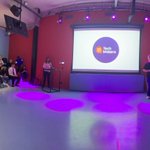
Disrupt is coming to Amsterdam this October.
If you are building something real and looking for a co-founder, or want to see how AI-native ventures get built from the ground up, this room is for you.
7 October · 6pm–9pm ·
@StartDockNL
· Amsterdam
RSVP →


