

PhD - Post-doc at @MPI_Bio, now active at 🦋https://nitter.cf/t.co/lF5asLULpy🦋
Joined June 2018
- Tweets52
- Following179
- Followers107
- Likes265



Pinned Tweet
🎉Our paper on brown algal speciation is now published in Genome Biology and Evolution and featured on the journal cover!
Very excited to share this work! @LauricReynes @GenomeBiolEvol
📎 doi.org/10.1093/gbe/evag268

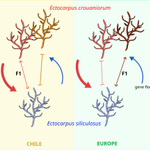
1/ We found remarkably similar patterns of asymmetric introgression in Europe and Chile, despite different lineage pairs being involved in hybridization.
1
1
13
Happy to share our new bioRxiv preprint 🔗biorxiv.org/content/10.64898… 🌊 We show repeatable patterns of introgression across continents, even when different lineages hybridize, emphasizing the role of demographic history in speciation in cryptic Ectocarpus species!

3. The genomic landscape of hybridization is consistent with highly polygenic, genome-wide barriers to gene flow rather than a few large-effect regions.
1
5
1/ Using linked-read whole-genome data from the brown alga Ectocarpus, we investigated genome-wide reproductive isolation between two cryptic brown algal species across replicated hybrid zones in Europe and Chile.
1
13
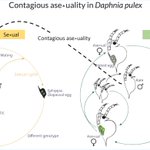
The final part of the story: "The arduous path to obligate asexuality in Daphnia" is out in #ProcB 🥳 royalsocietypublishing.org/r….... 1. Instead of comparing long-established asexuals to sexuals, we generated new asexual lineages to observe the transition in action.

4. They also showed reduced fertility compared to natural obligate asexuals. This suggests that creating new asexuals by contagion is more complex than previously thought and may result in diverse, non-clonal offspring, on which subsequent selection can act.
1
25
Earlier this year, I was pleased that the first part of our work on Daphnia reproductive modes was published in JEB doi.org/10.1093/jeb/voaf044 In brief, females from so-called obligate parthenogenetic lineages, are in fact able to rarely reproduce sexually.
Thread👇

Even at very low frequency, rare sex can reduce the long-term costs of asexuality while avoiding most costs of sex. Our results reveal a previously unknown reproductive pathway in Daphnia and suggest that cryptic sex may be more common than previously thought.
1
1
44