
Thinking is what makes us human. Ungoverned, AI could do it for the next generation. Evidence on AI in education: what builds minds, what replaces them.
Joined August 2026
- Tweets56
- Following38
- Followers0
- Likes0



Pinned Tweet
Thinking is what makes us human. Left ungoverned, AI could quietly do it for the next generation of students.
This account follows the research on what AI does to learning: what builds minds, and what replaces them. 🧵
#AIinEducation #EdTech
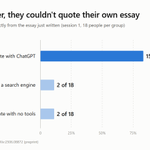
Do you remember what you wrote with ChatGPT?
In an MIT study, minutes after writing an essay, 15 of 18 people who used ChatGPT couldn't quote a single sentence of it correctly. Among those who wrote alone: 2 of 18. 🧵
#AIinEducation #EdTech

The experiment: 54 young adults wrote three 20-minute essays over several months, wearing EEG caps that recorded brain activity. They were randomly split into three groups: ChatGPT, a search engine, or nothing.
After each essay they were interviewed: could they quote it? Did it feel like theirs?
Only 9 of 18 ChatGPT users felt the essay was fully theirs. Brain connectivity was highest with no tools and lowest with ChatGPT. The authors call it "cognitive debt".
In a 4th session, those switching from ChatGPT to writing alone stayed less engaged.
Limits: 54 adults, one task, preprint. Weaker EEG is not brain damage.
@nataliyakosmyna et al. · @medialab 2025
Does AI feedback make students better writers, or just produce better texts?
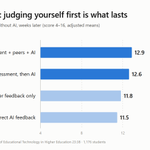
In an experiment with 1,176 university students, AI feedback improved their drafts. Weeks later, writing alone, they did no better. Self-assessing first made the difference. 🧵
#AIinEducation #EdTech

The experiment: 48 science courses in 4 universities, 10 weeks, 3 essays. A lottery assigned each course to one way of revising:
• feedback from classmates only
• feedback from AI (GPT-5)
• self-assessment first, then AI
• self-assessment, classmates and AI
Weeks later, a new essay without AI.
On the new essay (score of 16): direct AI 11.5, classmates only 11.8, self-assessment then AI 12.6, all three 12.9.
Students who judged their own work first actually read and used the feedback.
Limits: university students, single author, the self-assessment paths also took more time.
Ates · IJETHE 2026
Does it matter how students talk to an AI tutor, or just how much?
Among 97 German 9th-graders, how much predicted nothing. What mattered was direction: those who kept asking to understand, rather than to check answers, did better on the test. 🧵
#AIinEducation #MathEd

The experiment: 112 students spent 40 minutes practicing math modeling with a general AI chatbot (Mistral Large), then took a test without AI. Every message was classified: asking for help, to understand, to check an answer, and so on.
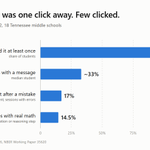
74% of messages asked for help. Only 5% checked their own understanding.
Over the session, most students drifted from understanding the problem (63% of turns at the start, 26% at the end) to checking answers. Those who moved the other way did better, even at equal starting level (β = 0.25).
For tutor design: watch the trajectory, and step in when students start delegating.
Limits: correlational, one session, preprint.
Abdelghani, Kaiser, @KouMurayama · @uni_tue
Should students think first and use ChatGPT later?
In an experiment with 196 university students, those who did had more original ideas on a later task without AI: 3.42 of 7, vs 2.69 for free ChatGPT users and 2.63 for no AI. 🧵
#AIinEducation #EdTech

The experiment: three groups had 12 minutes to improve a plush toy:
• no AI
• ChatGPT, used freely
• guided: 3 minutes on their own ideas, 6 developing them with ChatGPT, 3 refining alone
Then everyone faced a new creative task alone.
During the first task, free ChatGPT won (originality 4.08 vs 3.30 guided). Alone, the ranking flipped.
The chats explain why: free users mostly asked "give me ideas" (60% of prompts). The guided group built on their own ideas (89%).
Limits: university students, short tasks, measured right after.
Wong & Qiu · Educational Psychology Review 2026
Does a Socratic chatbot make math more interesting? And do students learn more?
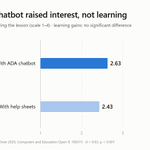
In a lesson with 195 German 9th-graders, interest rose clearly (d = 0.63). Learning did not change significantly. 🧵
#AIinEducation #MathEd

The experiment: whole classes were assigned to two groups for one double lesson on Heron's method for square roots. Everyone had the same worksheets. When stuck, one group asked ADA, a GPT-4 chatbot that guides with questions and never gives the answer. The other used printed help sheets.
Questionnaires and a test before and after.
Interest: 2.63 vs 2.43 on a 1–4 scale. Learning: the ADA group, which started lower, caught up a bit, but not significantly (p = 0.094).
Interest moves first. Learning may need more than one lesson.
Limits: one lesson, groups unequal at the start, no follow-up test.
Rücker & Becker-Genschow · Computers and Education Open 2025
What if homework came with a GPT-4 tutor instead of a worksheet?
In an Italian technical high school, it helped 3rd-year students (effect d = 0.60, borderline significant) but not 5th-year ones (d = 0.00). 🧵
#AIinEducation #EdTech

The experiment: 76 students in 4 English classes, same teacher. Within each class, a lottery split them in two for 8 weeks. Half did homework as usual. Half did the same exercises as a chat with GPT-4, which corrected, asked questions and explained.
The teacher only gave aim, task and example, as for any homework. Test before and after.
Why the gap? 3rd-year exercises had one right answer (grammar). 5th-year ones were essays, harder for the AI to judge and unlike the multiple-choice test.
Weaker students gained most. 32 of 35 wanted to keep the tutor, though it revealed the answer in 365 of 1,549 questions.
Limits: one school, overall effect not significant (d = 0.25).
Vanzo, Pal Chowdhury, @mrinmayasachan · @ETH_en · ACL 2025
Can an AI tutor, checked by a human, teach as well as a human tutor?
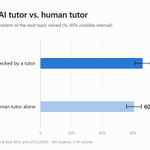
In 5 UK schools, students helped by the AI after a mistake solved a new problem on the next topic 66% of the time, vs 61% with a human tutor alone. 🧵
#AIinEducation #MathEd

The experiment: 165 students aged 13–15 on a math practice platform. Whenever someone got a question wrong, a lottery decided what came next:
• a written hint
• a chat with a human tutor
• a chat with LearnLM, Google's teaching AI, where a tutor approved every message before it was sent
Chats beat hints by far for fixing the mistake (93% AI, 91% human, 65% hint). Tutors sent 74% of the AI's messages unchanged. Their main fix was pacing: the AI kept quizzing students who'd already got it.
Limits: small exploratory study, uncertain gap (−1.4 to +12.4 points), authors from Google and Eedi.
LearnLM Team · 2025