




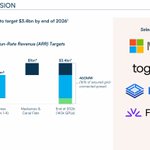



$IREN Dan gave color on the higher than expected $/MW buildout costs for the data centers for Microsoft in the earnings call:
They enhanced their original design, causing "incremental" costs, but in return, their rack density is flexible now (MSFT needs 130kW for GB300s, but it will be easy to switch to 200kW for the next GPU generation).
This way, the data center has a 20+ year asset life, supporting future GPUs.
(you may have missed this if you haven't paid close attention to what Dan said, as it was not on the slides, it was near the end of the slide discussion.)
The Microsoft deal is 5 years on average, so they basically get free completed Tier 3 data centers for the next 15+ years on top.
The higher costs were a point of contention for Chanos, and even Iren analysts on X were surprised, but I'd say the 15+ years of free Tier 3 data centers are worth it.
Iren still has a lot of lower cost data centers already built that they can fill with air-cooled GPUs.
As Dan said in the earnings call, the fact that Microsoft signed off on an original Tier 3 data center design by Iren also validates their design and construction capabilities for future clients.
Bonus detail from the Q&A: They talked to multiple hyperscalers for Childress which were implied to be of Microsoft's caliber.
@FransBakker9812 @moninvestor @jiahanjimliu @litigious_dulce @TheKamaHsutra etc. feel free to use this info if useful, I've learned a lot from all of you.

Civic108 retweeted

Another great @Strategy earnings call. Some observations and thoughts:
> $STRC is the iPhone moment and could have functionally unlimited capital raising capacity
I could not agree more. $STRC is Strategy going from investment bank to central bank. It was issuing yield bearing capital assets of various risk and return profiles. This is investment banking. Now it is issuing a fiat alternative. This is central banking.
$STRC is effectively an algorithmic stablecoin maintained by the most advanced securities issuance algorithms (Note: All ATMs are hooked up to algorithms so this is absolutely an algorithmically defined monetary policy).
Btw, with all the attention on the massive EPS thanks to FASB treatment kicking in, you might have missed that Strategy already filed for a $4.2 billion offering for STRC: assets.contentstack.io/v3/as…
And $STRC is quickly closing the distance to the $100 peg. This product had record volumes all week, as mentioned in the earnings call.
--
> No more $MSTR ATM below 2.5x mNAV. Aggressive issuance only at over 4x mNAV.
This is big. I am ambivalent about how much the common ATM impacts share price. I did a pretty thorough analysis on this a while ago and frankly I personally lean towards "yes it suppresses price, but not really by much": nitter.cf/stonychambers/status/1…
Either way, this new promise for $MSTR should be bullish for $MSTR and $STRK longs and very very bearish for the MSTR/BTC pair trade. My read is the @Strategy team is emboldened by the success of STRC and believes that it no longer needs to tap the common like before because of the development of the other offerings. The common has easily been the highest volume capital raise instrument (it can always draw a few hundred million each week it is used, which cannot be said for any of the prefs) and it is the only thing that de-levers the capital stack-- even though common has the lowest torque.
Management is guiding 30% YTD BTC Yield by EOY and $80 billion BTC $ Gain but also committing to holding off the common. (I'm assuming they are not assuming common will rocket to 3-5x mNAV).
--
> Medium duration corporate credit is the big opportunity. ie Macaulay durations of 1-10 years, priced off of the $STRC yield rate.
This is what is coming up next. This is gonna be confusing to lots of people, so I may dive into it in a future post. The tldr is that more variable rate prefs are likely coming and they will have a lot of interesting terms. It is very likely that entire sub-industries may spring up in financial services just to trade these instruments against each other and against bitcoin derivatives.
The great thing about collateral backed fixed income (and why it is superior) is that collateral risk always has a known price. You can always use derivatives to hedge out your risk with surgical precision. See more: nitter.cf/stonychambers/status/1…
--
> Phong Le's deadpan delivery of MSTR comps with the rest of the SP500 universe is hilarious. His well-timed tone inflections are great, all while effectively communicating the absurdity of the current valuation. I recommend watching the earnings call just for this section alone.
But seriously, MSTR is mispriced. Though it would be nicer if Andrew and Phong would buy more common rather than stick with prefs.
--
> Plan is to let the convertible bonds roll off entirely. Seems like there will be no more new ones.
This should not be surprising. Repayment creates path dependency risks and the convertible markets is small compared to the rest of the markets. They also create dampening effects on the stock via the gamma walls created by volatility arbitrage behavior. Lastly, convertibles are not liquid. Perpetual preferred is better in almost all ways.
The only way convertibles are better is that they can monetize equity volatility. More Bitcoin volatility also creates more risk for the prefs because it means BTC Rating goes down (this was also mentioned in the Q&A). So long term you're seeing Strategy go from a more volatility agnostic/ long volatility company to something that is more short volatility. I don't think there's anything wrong with that. It is likely supported by the secular tailwind of falling BTC volatility as the asset matures.
--
I saw this session as an affirmation for more disciplined cost of capital management and more creative products (securities offerings) coming in.

Here's a major unrecognized component of the @Strategy flywheel.
Quick post on $STRF $STRK $STRD vs $PFF $JNK $BND 🧵
Overcollateralized fixed income > Earnings-based fixed income
Why? Derivatives.
With something like $STRF, you can calculate the *exact* risk at any moment. You know the senior obligations, the bitcoin price, the treasury size, and the capital stack. That means you can compute the exact price of bitcoin when your income gets threatened. You can get insurance at those exact points, and therefore very precisely hedge out the risk via derivatives.
You obviously cannot do this with earnings-based fixed income. There are no direct "earnings derivatives". You might use the common stock's options, but these are a couple layers removed from your actual risk factor of earnings. Also, companies which issue preferred stock tend to have illiquid options, making the cost of hedging even higher.
In short: All overcollateralized fixed income risk is contained within the collateral. And the collateral's risk is known and transferrable. In contrast, all earnings-based fixed income risk is contained within the earnings. And this risk is unknown and untransferable.
That explains the benefit for the investor.
But the real benefit is for the issuer.
Because people can hedge overcollateralized fixed income, people can price it. And because people can price it, people can trade it. Liquidity and volume follows, and the asset becomes more attractive, even to folks who normally aren't interested in fixed income. What follows is a lower cost of capital and lower cost of future distribution. That's the benefit to the issuer.
One caveat: Capital structure changes require a reassessment of hedge. More senior issuances mean more risk. More junior issuances mean less risk. But adjustments can be managed within a tolerance band so they need not be made with every issuance. Any needed changes are still instantly computable, so its still much more straightforward than earnings-based fixed income.
Two observations / predictions to bookmark:
- I expect a more prominent IV skew on bitcoin to develop over time, partly due to increased adoption of such instruments.
- When options on the prefs appear, and post-repricing of overcollateralized fixed income, I expect there will be some interesting bitcoin tail hedge alpha in there. Think far OTM puts on $STRD after a few years trading just 200-400 bps above 30yr rate. Likely structured as a dispersion trade with $MSTR or $IBIT
Civic108 retweeted
Stretch will be the most accretive @Strategy preferred. The reason is simple:
Long term, the cost of capital on $STRC will approach 0. This automatically beats all other offerings, including the 0% coupon convertibles (remember dilution).
Let's start by valuing $STRC. We do that by setting an expectation of what yield to get. Remember that $STRC is basically an algorithmic stablecoin, so aside from the fixed price its only return is the yield it bears.
What will that yield be?
In the short term, it will look like the /BTC basis (CME futures) or the annualized perps funding rate on major centralized crypto exchanges.
Why? Because these are the only visible returns for delta neutral positions within the Bitcoin ecosystem. They're the only immediate reference points for valuation.
Currently both the CME futures basis and the annualized funding rates on Binance and Hyperliquid is about 9%.
9%... That number looks familiar.
In the long term, the $STRC yield will settle to the 1-3 month T-bill rate plus a spread based on market perception of risk. Yields determined monthly means that this is the most appropriate duration comparison. Currently short dated interest rates are 4.3%. $USFR and $TFLO both have SEC Yields at 4.3%. But these yields are heading (back) to 0% for several structural reasons:
- Yield curve generally slopes upwards. Either long term rates go up or short term goes down. No one wants long term going up.
- Fiscal dominance will likely cause the Fed to cut rates to 0.
- Term premium of US debt will likely expand as riskiness increases the further out you go (Can the US pay back its debt in 3 months? In 30 years?)
- Less people want the long term risk, so they will create more demand in the short end of the curve. This pushes short term rates lower.
- Fiat backed stablecoin issuers can only own the more liquid short term paper, so that is additional demand for the short end.
If $STRC is anchored to T-bills in the long run, and T-bill yields are heading to 0 in the long run, then it follows that STRC's cost of capital will approach 0 + spread. If this goes well, I wouldn't be surpised to see 1-3% yield on STRC within the next 10 years.
Let's return to the short term (next 12 months)
Core challenge I see is holding that $100 peg while setting a reasonable yield. This is never easy and it is actually impossible over a long period of time, due to the tradeoffs presented in the Impossible Trinity. But in a bull market, these things are easier because people aren't in a panicky mood.
Algorithmic stablecoins are prone to "death spirals" if there are liquidity or solvency issues during a depeg. Unfortunately, Strategy does not seem to have a provision in which it will buy back $STRC at $99 or lower. It only said that it WILL NOT hit the ATM and it WILL raise yields. The lack of a hard buyback-enforced price floor can add fuel to a depeg event. And it is that risk which could get priced into the yield. I wouldn't be surprised if the yield goes north of 12%.
$STRC is not gonna be easy at all. But if Strategy gets it right, it will have unlocked a private Cantillon spigot. If STRC becomes a go-to for folks to park their cash, then Strategy would have succeeded in inventing its own fiat money.
This is how @Strategy goes from investment bank to central bank.
BSTR presentation is out. (Adam Back)
mNAV around 1.87 right now?
$4.95 billion BTC holdings estimated at closing, SPAC (CEPO) owns 4.2% of the final company, CEPO market cap ~$390m, 390m / 0.042 = $9261m market cap vs $4950m BTC
so mNAV ~ 9261/4950 ~ 1.87
the wording is a bit unclear, early days, so take this with a grain of salt.
Link to investor presentation and press release below.

Fragbite shows how to do one of the most promising BTC treasury announcements recently:
Focus on BTC per share, concrete instruments like convertibles, 110% premium, hired a BTC maximalist treasury director.
I did some initial DD, see reply.
nitter.cf/btcNLNico/status/19395…

🚨JUST IN: 🇸🇪 Fragbite Group launches #Bitcoin Treasury and recruits a Treasury Director.
They are working on raising capital, starting with 0% convertible debt totalling SEK 5 million ($530k) presumably to buy BTC.


I did a little bit of digging. TL;DR: promising.
* Fragbite Group is a gaming conglomerate, their namesake business Fragbite is a long established esports news site and tournament organizer.
* They have about 6 more subsidiaries, most of which mobile game developers, which seem to be doing well.
* Fragbite Group Annual Report 2024 shows ~$22.5 million revenue and ~$0.8 million EBIT, but ~$-13 million net profit. Apparently gaming and esports was profitable, but not Web3.
* Subsidiary Playdigious also publishes some quite well known and successful indie games like Don't Starve Together and Spiritfarer.
* BTC treasury director Patrik von Bahr is also Lead Game Designer at FunRock, one of their subsidiaries (named Fun Rock & Prey Studio on the Fragbite Group website).
* FunRock currently has one published game MMA Manager 2, which seems to be doing well and has favorable ratings on Google Play (4.3/5 stars). They extended a development agreement for this game in Q1.
* Their portfolio lists another game, Capital War, which is apparently targeted at Arabian audiences (AppStore name is in Arabic), which appears to be offline on both Google and Play Stores. But it's common for mobile game developers to have some flops besides the hits, as development speed can be fast.
* Will have to do more digging and read the financial reports, but to me this looks promising. It seems like Patrik von Bahr, lead at one of their gaming subsidiaries, is a real BTC maxi, and could possibly have pushed for the group to adopt the strategy (this part is speculation).
As written in this comment, the announcement itself is great, with a focus on BTC per share:
1
133
mNAV does not need to increase for a BTC treasury company to keep outperforming BTC. I can prove that.
It's a common misconception, and an easy one to make.
(mNAV = multiplier on NAV, i.e. the premium a company has to its BTC holdings)
Here's a very simple proof by counter example:
Metaplanet performed about +464% YTD.
Yet, its mNAV only increased from ~6 to ~9 if we believe @StrategyTracker , a ~50% increase.
Even if the numbers are slightly off, they're not going to be THAT off (a factor of 464/50 = 9.28).
(And yes, this is just one data point, but if you paid attention in logic class, one counter example is enough to disprove a general statement)
Here's a proof by calculation:
Let's assume (Micro)Strategy has an mNAV of 2, 100 BTC, 100 shares, and a share price of 200$ (BTC = 100$ here, so they have 10k$ in BTC, 20k$ in shares).
They then use the ATM to sell 10 more shares for 200$ each and buy 2000$ of BTC (20 BTC).
They now have 120 BTC worth 12000$ on 110 shares worth 22000$. That's an mNAV of 1.83 (22000/12000). So, mNAV dropped by using the ATM. To get back to 2 mNAV, the market needs to price MSTR higher at 2 = 24000 / 12, which is 24000 / 110 = 218$ per share.
Just by using the ATM and the mNAV staying constant (readjusting to the previous level after the ATM), MSTR price went up relative to BTC.
And this ignores other easy methods of BTC yield, like offering dividends via preferred shares like STRF. This offers a ~10% dividend to the investor that MSTR invests into the ~30% CAGR of BTC. That's the arbitrage that MSTR profits from by issuing STRF and buying BTC with the proceeds.
This also answers the argument "Who will keep paying 2$ for 1$ of BTC?" - those that realize that MSTR keeps profiting from a 20% arbitrage. Those profits don't disappear into thin air. And this arbitrage makes them deserve a premium, which in turn makes the ATM accretive, which in turn deserves another premium.
@ActuallyClimber calculated this in more detail for Metaplanet's 555 million share program, which makes Metaplanet go up ~400% while mNAV drops from 6 to 3. The 6 mNAV is even a handicapped value, as other assumptions in the model, as Metaplanet is currently at 9 mNAV.
nitter.cf/ActuallyClimber/status…
I highly recommend watching Metaplanet Dojo Episode 2, which goes over this chart and the preceding ones that this one is based on:
youtube.com/live/dAI2ygPvZNM
And the 21 million limit of BTC is not a limitation, because instead of buying BTC, you can just buy your shares back, increasing BTC per share via another route.
(Share count is of course also not a limit because you can do stock splits)
Metaplanet BTC per share will increase by 7x while its mNAV drops by half and share price does +400%, in the sandbagged base case. Just watch.
Not financial advice.


Please use V2 now, it is much better:
docs.google.com/spreadsheets…

You can also substitute the argument using preferred shares with simply issuing fiat debt: Issuing fiat debt (~4% interest) to buy BTC (~30% CAGR) is a simple arbitrage that deserves an mNAV premium because you generate a profit.
And in contrast to Strategy, YOU probably can't issue 1 billion of (convertible or not) debt at 0% interest (or even 10%) to buy BTC with all of the proceeds.
175
Here I prove that mNAV does NOT need to keep increasing for a BTC treasury company to keep outperforming BTC.
Metaplanet mNAV can drop from 6 to 3 while the share price does +400% and BTC per share increases 7x.
Long post, but should silence mNAV bears.
nitter.cf/Civic108/status/193605…
mNAV does not need to increase for a BTC treasury company to keep outperforming BTC. I can prove that.
It's a common misconception, and an easy one to make.
(mNAV = multiplier on NAV, i.e. the premium a company has to its BTC holdings)
Here's a very simple proof by counter example:
Metaplanet performed about +464% YTD.
Yet, its mNAV only increased from ~6 to ~9 if we believe @StrategyTracker , a ~50% increase.
Even if the numbers are slightly off, they're not going to be THAT off (a factor of 464/50 = 9.28).
(And yes, this is just one data point, but if you paid attention in logic class, one counter example is enough to disprove a general statement)
Here's a proof by calculation:
Let's assume (Micro)Strategy has an mNAV of 2, 100 BTC, 100 shares, and a share price of 200$ (BTC = 100$ here, so they have 10k$ in BTC, 20k$ in shares).
They then use the ATM to sell 10 more shares for 200$ each and buy 2000$ of BTC (20 BTC).
They now have 120 BTC worth 12000$ on 110 shares worth 22000$. That's an mNAV of 1.83 (22000/12000). So, mNAV dropped by using the ATM. To get back to 2 mNAV, the market needs to price MSTR higher at 2 = 24000 / 12, which is 24000 / 110 = 218$ per share.
Just by using the ATM and the mNAV staying constant (readjusting to the previous level after the ATM), MSTR price went up relative to BTC.
And this ignores other easy methods of BTC yield, like offering dividends via preferred shares like STRF. This offers a ~10% dividend to the investor that MSTR invests into the ~30% CAGR of BTC. That's the arbitrage that MSTR profits from by issuing STRF and buying BTC with the proceeds.
This also answers the argument "Who will keep paying 2$ for 1$ of BTC?" - those that realize that MSTR keeps profiting from a 20% arbitrage. Those profits don't disappear into thin air. And this arbitrage makes them deserve a premium, which in turn makes the ATM accretive, which in turn deserves another premium.
@ActuallyClimber calculated this in more detail for Metaplanet's 555 million share program, which makes Metaplanet go up ~400% while mNAV drops from 6 to 3. The 6 mNAV is even a handicapped value, as other assumptions in the model, as Metaplanet is currently at 9 mNAV.
nitter.cf/ActuallyClimber/status…
I highly recommend watching Metaplanet Dojo Episode 2, which goes over this chart and the preceding ones that this one is based on:
youtube.com/live/dAI2ygPvZNM
And the 21 million limit of BTC is not a limitation, because instead of buying BTC, you can just buy your shares back, increasing BTC per share via another route.
(Share count is of course also not a limit because you can do stock splits)
Metaplanet BTC per share will increase by 7x while its mNAV drops by half and share price does +400%, in the sandbagged base case. Just watch.
Not financial advice.
2
3
688
Credit for the Metaplanet charts and stats of course goes to @ActuallyClimber and the Metaplanet Dojo.
My post is just a general proof both by example and by math that mNAV does not need to keep increasing, which is an argument that mNAV bears and mining stock people often use.
(this is not a diss, the math here is very counter intuitive)
1
93
Here I show how mNAV does NOT need to keep increasing for a BTC treasury company to keep outperforming BTC.
Metaplanet mNAV can drop from 6 to 3 while the share price does +400% and BTC per share increases 7x.
Long post, but should silence mNAV bears.
nitter.cf/Civic108/status/193605…
mNAV does not need to increase for a BTC treasury company to keep outperforming BTC. I can prove that.
It's a common misconception, and an easy one to make.
(mNAV = multiplier on NAV, i.e. the premium a company has to its BTC holdings)
Here's a very simple proof by counter example:
Metaplanet performed about +464% YTD.
Yet, its mNAV only increased from ~6 to ~9 if we believe @StrategyTracker , a ~50% increase.
Even if the numbers are slightly off, they're not going to be THAT off (a factor of 464/50 = 9.28).
(And yes, this is just one data point, but if you paid attention in logic class, one counter example is enough to disprove a general statement)
Here's a proof by calculation:
Let's assume (Micro)Strategy has an mNAV of 2, 100 BTC, 100 shares, and a share price of 200$ (BTC = 100$ here, so they have 10k$ in BTC, 20k$ in shares).
They then use the ATM to sell 10 more shares for 200$ each and buy 2000$ of BTC (20 BTC).
They now have 120 BTC worth 12000$ on 110 shares worth 22000$. That's an mNAV of 1.83 (22000/12000). So, mNAV dropped by using the ATM. To get back to 2 mNAV, the market needs to price MSTR higher at 2 = 24000 / 12, which is 24000 / 110 = 218$ per share.
Just by using the ATM and the mNAV staying constant (readjusting to the previous level after the ATM), MSTR price went up relative to BTC.
And this ignores other easy methods of BTC yield, like offering dividends via preferred shares like STRF. This offers a ~10% dividend to the investor that MSTR invests into the ~30% CAGR of BTC. That's the arbitrage that MSTR profits from by issuing STRF and buying BTC with the proceeds.
This also answers the argument "Who will keep paying 2$ for 1$ of BTC?" - those that realize that MSTR keeps profiting from a 20% arbitrage. Those profits don't disappear into thin air. And this arbitrage makes them deserve a premium, which in turn makes the ATM accretive, which in turn deserves another premium.
@ActuallyClimber calculated this in more detail for Metaplanet's 555 million share program, which makes Metaplanet go up ~400% while mNAV drops from 6 to 3. The 6 mNAV is even a handicapped value, as other assumptions in the model, as Metaplanet is currently at 9 mNAV.
nitter.cf/ActuallyClimber/status…
I highly recommend watching Metaplanet Dojo Episode 2, which goes over this chart and the preceding ones that this one is based on:
youtube.com/live/dAI2ygPvZNM
And the 21 million limit of BTC is not a limitation, because instead of buying BTC, you can just buy your shares back, increasing BTC per share via another route.
(Share count is of course also not a limit because you can do stock splits)
Metaplanet BTC per share will increase by 7x while its mNAV drops by half and share price does +400%, in the sandbagged base case. Just watch.
Not financial advice.
1
391
Total BTC will reach over 100K in the base case (while mNAV drops from 6 to 3 and BTC per share goes up 7x):

103


earlier discussion ranged between 0.8% and 4.9%.
nitter.cf/Civic108/status/192189…
KDLY: Is KDLY 4.9% of the final Nakamoto company? Grok said so from the 8-K. See section 2.1c Merger agreement (link in comments).
Rough napkin math: KDLY had about 6 million shares outstanding (from 8-K), at 20$ pre-market that's ~120m for KDLY. 120/0.049 = 2.45B for Nakamoto.
146
KDLY: Is KDLY 4.9% of the final Nakamoto company? Grok said so from the 8-K. See section 2.1c Merger agreement (link in comments).
Rough napkin math: KDLY had about 6 million shares outstanding (from 8-K), at 20$ pre-market that's ~120m for KDLY. 120/0.049 = 2.45B for Nakamoto.
update: looks like it's 1.2%.
(bamsec filing)
nitter.cf/Civic108/status/192192…