


Alan D Foreman retweeted

If you’ve missed it we have had over 50 researchers from our #SPP2299 members and other invited collaborators come together this week in Bremen, Germany to talk about thermal stress indicators in tropical corals. Follow along for updates on the meeting! @dfg_public

Alan D Foreman retweeted
Come past the our poster today at #egu2023! We will be talking about all the exciting projects within the programme. You can find us at poster station X3.86 from 10.45-12.30 🪸
This post is from an account that no longer exists. Learn more
Alan D Foreman retweeted

EXCITING DISCOVERY: #GalapagosDeep2023 have found the largest known Galapagos #reef in the #deepsea waters of the platform using #Alvin. And its beautiful 🤩 Unusually high % live coral (Madrepora), as far as the eye can see. Check video out: https://nitter.cf/t.co/rDqj13ge3B 1/2


Alan D Foreman retweeted

Why are some corals more resilient to climate change than others? Our @stri_panama dives into this question in the latest episode of their podcast, Biodiversa. striresearch.si.edu/biodiver…

ALT Diver in wet suit with purple head covering and blue goggles uses gloved hands to carefully study corals or the sea floor. In front of their face, light brown fish swim past.
Alan D Foreman retweeted

The Agulhas Current system is a fascinating place to study local and remote nitrogen cycling!
In our recently published @JGROceans paper, we use nitrate isotopes to their full potential!
agupubs.onlinelibrary.wiley.…

Alan D Foreman retweeted

New paper alert! In this study by lead author Tony Wang (together with @AMG_lab, @ChemClimatology, and others) we show the expansion of the Pacific oxygen deficient zones (ODZs) over the last 8 million years using foram-bound nitrogen isotopes in the SE Pacific. (1/3)

Alan D Foreman retweeted

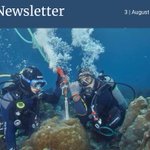
Alan Foreman + Nicolas Duprey @MaxPlanckChem, taking a coral core in Cocos/Costa Rica. They study reef-building corals whose skeletons contain important information on oceanic conditions. The observations can be used as a base for improving future climate models.@keithellenbogen
