

Every word is a number. I count them: Hebrew gematria, Greek isopsephy, Hermetic art and the sky overhead. A new plate every morning. ⛈️
Joined April 2020
- Tweets27.3K
- Following967
- Followers23.2K
- Likes85.6K


Pinned Tweet
Lucifer was the brightest of the Archangels, but he had a huge chip on his shoulder. He wasn’t on board with the idea of everything moving towards Unity and Oneness which is the plan of Divinity and overall destiny of the Multiverse, because he feared that this would lead to no individuality — He didn’t understand that he could be One with everything and also retain his uniqueness and I’m pretty sure that this is also due to the wound at the center of his creation.
What he actually feared was becoming one with his Creator because it would mean having to resolve his core trauma, something that’s scary for anyone. To be fair, Divinity didn’t understand at this point the responsibility it had in forming this trauma in the first place.

Artax sank. ARTEX swims.
One letter changed, and the horse became a machine. In The NeverEnding Story, Artax didn't go under in the Swamp of Sadness because he was weak. He sank because he stopped believing the ride mattered, and the swamp only takes what has already let go. Atreyu pulled at the bridle and begged him to move, and the mud kept rising.
Now the name returns with an E where the A was: a mind built to find every unlocked door faster than anyone can watch them all. The Nothing in that story was never a monster. It was the empty space left when people quit dreaming, and Gmork served it because hopeless people are the easiest to steer.
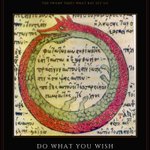
AURYN, two serpents swallowing each other's tails, carried three words on its back: Do What You Wish. The Hermetic reading is will, not whim. A tool has no will. You do.
The swamp is loud this year. Keep your head up, lock your doors, and keep riding. ⛈️

A tear in the air is called teruah. Count it.
In Hebrew, תרועה = 681. 6+8+1 = 15, and 15 returns to 6. In Greek the same horn is σάλπιγξ, and σάλπιγξ = 384: 3+8+4 = 15, and 15 returns to 6. Two tongues, one reduction. Spell the ram's horn, שופר, and shofar comes to 586, which falls to 19, then 10, then 1.
Today's date counts too. 11/17 adds to 10, and 10 returns to 1: seven trumpets, one sound.
The seventh angel sounds in Revelation 11:15, and great voices in heaven say the kingdom has changed hands. Joshua's name in Hebrew, יהושע, is 391, the same count as ἕβδομος, the Greek for seventh: the man who walked seven days around Jericho already carried the last horn's number. On the Day of Trumpets the shofar is not blown for battle. It is blown for those who can still hear.
Seven angels lift one breath. The walls already know the number. Do you? ⛈️ 🎺

Tonight the crossroads have a keeper. Count her name.
In Greek, Ἑκάτη = 334. 3+3+4 = 10, and 10 returns to 1: three faces, one goddess. Spell her in Hebrew, הקאטה, and she comes to 120, and 1+2+0 = 3. In English, HEKATE = 50, the number of the Gates of Understanding in Kabbalah, and the gate is where she stands.
Tonight's date counts too. 11/16 adds to 9: three times three.
November 16 is the Night of Hekate. Hesiod says Zeus honored her above all others. She carries the torches and the keys to every threshold, and where three roads meet, the oldest rite asks one thing of you: leave your offering and walk away without looking back.
White, red and black, she faces all three roads at once.
Which road are you leaving behind tonight? 🔓🗝️
⛈️

In Greek, the end is telos. τέλος = 605. 6+0+5 = 11.
In Hebrew, the end is ha-ketz. הקץ = 195. 1+9+5 = 15.
Two tongues, one end. Read them together: 11 · 15.
Telos never meant a wall. It means the goal, the thing a life is aimed at. The last card of the tarot is XXI, The World: the dancer in the wreath, finished and beginning again… ⛈️


A word square that reads the same in every direction was scratched into a wall at Pompeii before the ash fell in 79 AD.
SATOR AREPO TENET OPERA ROTAS.
Forward, backward, up, down: the same five words. TENET crosses at the center. Rearrange every letter and you get PATER NOSTER twice, crossing at the N, with two letters left over: A and O. The beginning and the end.
This February, Human Design says the Sleeping Phoenix begins to wake. It's the start of a new era, a bird that burns down and rises from its own ashes. The old Christians called the phoenix resurrection, and February has always been the month of purification, the thaw before spring.
A square that survived the ash. A bird that rises from it in February. The cross inside both. ⛈️

Eleven is "El even": level with God.
EL is the old Semitic word for God, strength and might. EVEN comes from Old English efen, flat and equal, and LEVEL from Latin libella, the little balance of Libra. Put them together and eleven reads El even. Then 11:11 is eleven mirroring itself. (Wordplay, not etymology: the real word comes from Old English for "one left" after ten.) Do you hear El in eleven? ⛈️

White and black both come out to 11.
WHITE adds to 65 and BLACK to 29, and each one reduces to 11 (6+5, 2+9). Two opposite colors, one master number. The High Priestess sits between her pillars, Boaz in black and Jachin in white, with a veil behind her that is the door between them. ⛈️


Soundtrack: Dark All Day, GUNSHIP (feat. Tim Cappello & Indiana).
youtu.be/60ruvzfXQoE?is=Jvsc…


A Tri-Dent in the fold.
“Let us recognize here that it is a pantacle, and consequently a concrete and absolute sign of an entire doctrine that was that of an immense magnetic circle, as much for ancient philosophers as for the adepts of the Middle Ages. In restoring to it, in our time, its primitive value through the intelligence of its mysteries, could one not restore to it all its miraculous virtue and all its efficacy against human infirmities?”
By calling the pantacle of the trident a concrete and absolute sign, Lévi deliberately draws on the Latin concretus (meaning condensed, grown together, or hardened from fluid state) to signal that abstract metaphysical doctrines must literally crystallize into physical geometry before they can exert power over the material plane. The pantacle acts as the frozen footprint of a living law, an anchor that pins the vast, ethereal machinery of the invisible world directly to the terrestrial floor.
That immense magnetic circle Lévi evokes is nothing less than the Astral Light itself, the universal fluidic medium that 19th century occultists viewed as the great conductor of all life, magic, and intention. By tracing this doctrine continuously from the ancient Neoplatonic philosophers down through the medieval alchemists and grimoire-writers, Lévi presents magic not as a series of disparate, superstitious outbursts, but as a unbroken subterranean lineage of esoteric physics. The phrase magnetic circle carries a double weight, borrowing from mesmerist terminology to describe a closed, circulating current of vital force that can be magnetized, directed, or pool within specific focal points. A pantacle, in this framework, functions like an inductor coil inside a circuit. It captures the wild, unpolarized ocean of the astral light and shapes it into a controlled, coherent vortex.
When Lévi speaks of restoring this object to its primitive value through the intelligence of its mysteries, his choice of words exposes his core philosophy. Primitive comes straight from the Latin primitivus, meaning the original, uncorrupted, first-formed state. He is arguing that symbols lose their power not because time wears them out, but because human ignorance (and human progress) reduces them to hollow superstition. Intelligence (from inter-legere, meaning to read between the lines or choose from within) is the vital catalyst that reactivates the dormant tool. Without conscious understanding of the underlying geometry and cosmic correspondences, a ritual instrument is merely cold metal. But when the magician's intellect illuminates those hidden mysteries, the dormant graphic blueprint instantly connects back to the universal magnetic stream, reclaiming its active virtue.
That word virtue itself carries a heavy Latinate lineage (virtus, denoting intrinsic potency, raw power, and moral character), which directly connects to Lévi's rhetorical question about curing human infirmities. To the 19th-century mind, an infirmity was not merely a physical disease, but a structural imbalance in the vital fluid, a spiritual weakness or lack of poise within the human soul. By posing his conclusion as an evocative question, Lévi isn't expressing doubt, but issuing a quiet challenge to his reader. He suggests that if the modern operator can master the ancient hermetic keys, magic ceases to be a dusty historical curiosity and becomes an active, therapeutic technology capable of restoring harmony, health, and equilibrium to a fractured world.


In Roman mythology, Mars was the god of war, courage, strength, and protection, as well as an ancient deity associated with agriculture and fertility. His Greek counterpart was Ares, although Mars held a more honoured position in Roman religion.
He was the lover of Venus, the goddess of love and beauty, and their union symbolised the meeting of opposing forces: passion and desire, conflict and harmony, masculine strength and feminine attraction.
In the traditional planetary system, Mars governs Tuesday, known in Latin as Dies Martis, or the Day of Mars. In traditional astrology, it rules Aries and Scorpio, expressing itself through the initiative and courage of Aries and the intensity, determination, and transformative power of Scorpio. Classified as a hot and dry planet in ancient astrological doctrine, Mars symbolised energy, assertion, struggle, and the will to overcome resistance.


"The cabalistic tetragram Jodheva expresses God in humanity and humanity in God."
When Éliphas Lévi wrote this short sentence in mid-nineteenth-century Paris, he performed a quiet stroke of linguistic genius. To the casual reader, Jodheva looks like an obscure theological error. In truth, Lévi fused the four Hebrew letters of the Divine Name (the Tetragrammaton) with Hava, the Hebrew name for Eve. By placing the maternal principle directly inside the divine name, he built a bridge between the absolute and the earthly. The word springs from the Hebrew root hayah, which means to exist or to become. Lévi was not describing a distant deity on a high throne. He was describing an ongoing process of active becoming where divinity and human flesh continuously forge one another.
This mutual reflection replaces traditional theological submission with a clear law of co-dependence. Divinity requires a human vessel to achieve concrete form, and humanity requires the internal spark to rise above simple animal instinct. Whenever a man acts with aligned will and clear imagination, he is not praying to a distant force; he operates as the physical hands of the divine on earth. The infinite macrocosm folds itself down into the human microcosm, making individual human agency the indispensable engine of life.
Lévi constructed this formula on the intellectual battlegrounds of Paris. Born Alphonse-Louis Constant, he was a former deacon, radical socialist, and prisoner who watched the French Revolution consume itself. He drew from Joseph de Maistre, who taught that unseen spiritual laws govern society, and Louis-Claude de Saint-Martin, who held that man is a fallen king capable of re-ascending through self-regeneration. Lévi saw his generation torn between rigid dogma and cold, mechanical materialism. Jodheva was his answer. By placing the divine name inside human nature, he reclaimed spiritual authority for the individual without throwing away ancient tradition.
This single line serves as a blueprint for direct psychological responsibility. When you realize that the creative force of the universe is mirrored inside your own mind, living becomes an ongoing work of self-creation. The divine name is not a magic word to summon angels. It is a description of your own dual nature: you are simultaneously the finite worker in the mud and the steady awareness watching the journey. Lévi's system rests on this paradox, reminding us that we do not need to scale the heavens to find the sacred when the entire architecture is already pulsing inside our own veins.
