

CLA is dedicated to seeking customers who have the passion and mindset of practicing non-traditional ways with their farming operation and having fun with it.
Cherokee, OK
Joined February 2022
- Tweets548
- Following909
- Followers1.1K
- Likes2K






Correction Line Ag retweeted

We apply $100 worth of phosphorus. Why can't we get that $100 back into the plant? 🤔
Most growers get between $10 and $30 of it back that year. We think that could be $70–$80, just by maintaining better microbial levels, and allowing the plant to ask for it.
#phosphorus #soilhealth #agronomy #farming #soilbiology #fertilizer
Correction Line Ag retweeted

Fertilizer Over-Application is Associated with Increased Grid Size
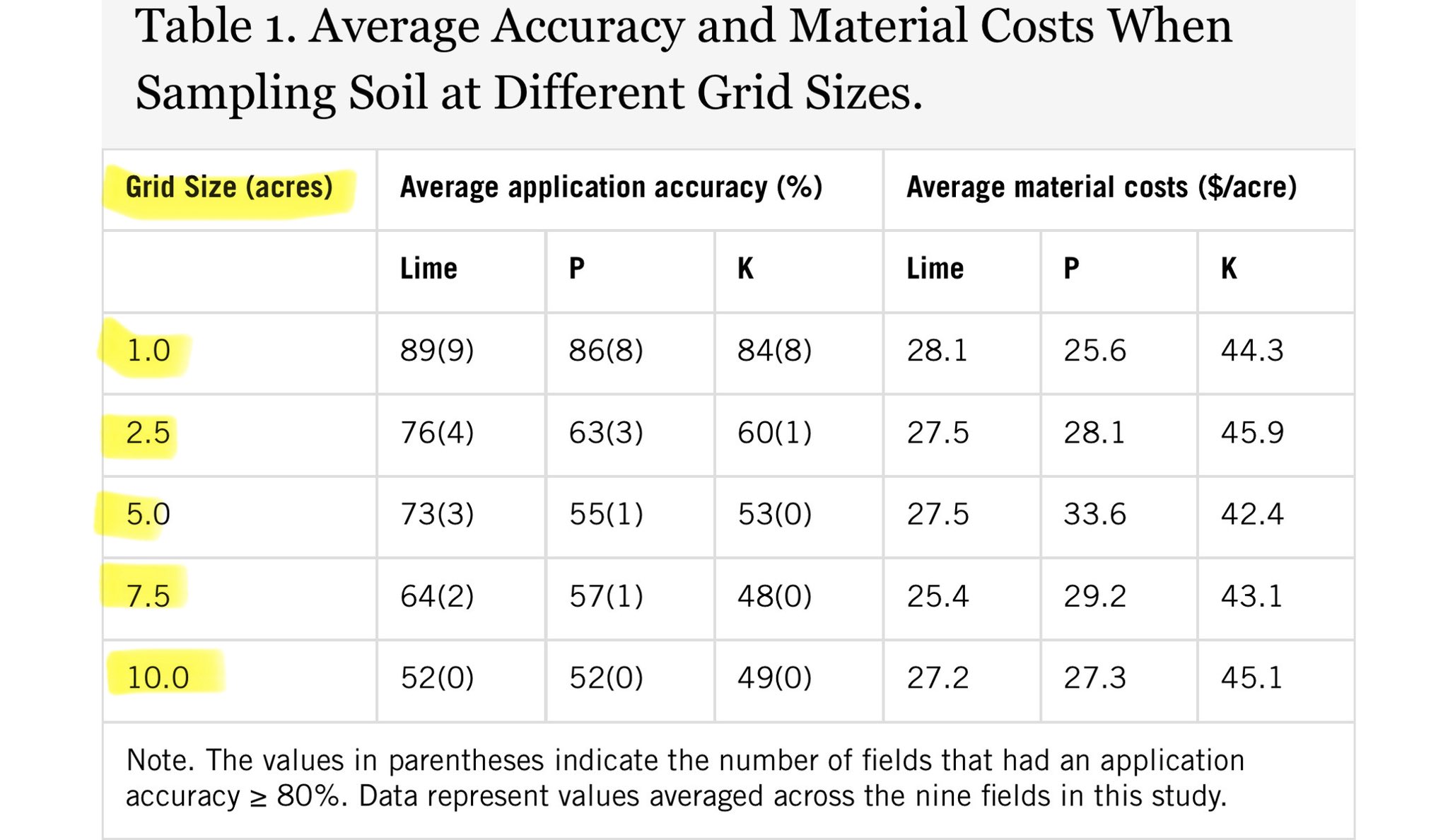
There was a study done by the University of Georgia CAES in 2022 where they looked at how grid sizes affected fertilizer application accuracy.
They looked at 1, 2.5, 5, 7.5, and 10 acre grids. Variable-rate prescription maps were made according to the grid sizes and soil sample results from those grids.
The paper states that, “the Rx maps were spatially analyzed and compared to assess the application accuracy (%) of different grid sizes compared to reference Rx maps.”
The study found that the 1 acre grids had an application accuracy of 80%+ for Lime, P, and K.
The 2.5 acre grid fields were all under 80% for Lime, P, and K.
5 acre grids were lower than that, and 7.5 were even lower. At 10 acre grids, accuracy was just above 50% across the board. The lower the percentage, the lower the effectiveness in representing spatial nutrient availability.
It is understandable to think that larger grids allow for a reduced cost associated with soil samples and the sampling cost. However, this doesn’t factor in how grid size and application accuracy affects the cost of Lime, P, and K.
What looked to be cheaper on the front end was actually more expensive when things were all said and done.
There tends to be an increase in overapplication with an increase in grid size.
Now you might be thinking, “that is in Georgia, so what?” That is beside the point.
The point is that there are costs associated with grids (even 2.5 acre grids) that are not accounted for.
There are costs associated with only using standard soil tests on those grids as well. This will affect recommendations and variable rate scripts drastically.
Correction Line Ag retweeted
A Quick History of Grid Sampling
Soil sampling and recommendations based on those samples have come a long way since the early 1900s in some ways. But in other ways, they have not.
Consider the first recorded field that got recommendations based on soil samples. This was published by Linsley and Bauer in 1929. It was:
• A 30.89 acre field that was broken down into ≈1 acre grids.
• There were soil samples taken at roughly 6 inch and 12 inch depths.
• Based on those soil samples, the recommendation for Lime was about a half ton per acre. The lime would’ve been shoveled onto the field by hand (Franzen & Mulla, 2015).
• The areas that didn’t need lime based off of the soil tests saved both labor and money.
All of this was a huge advancement in agriculture at the time. But it is hard to believe that we are still using grids (especially larger than the ones used in 1929) in the year 2026.
We have learned so much about soil since then, but our soil mapping, testing, and sampling techniques haven’t always kept up with the pace of learning.
So What?
Everything in agriculture is variable.
Fields aren’t always square, soil is dynamic, and weather throws a wrinkle into everything. This makes measuring anything difficult. What we do measure isn’t always black and white.
However, we try to treat something as dynamic as the relationship between plants and soils as static. This is what grid sampling and industry standard soil tests do. Grids treat the field as if it works in 2.5 acre (or more) squares. And coupled with standard chemical tests, we shoot for ppm values within those perfect squares. Seems simple right?
But soil is not simple. We might know 0.1% about it, actually. Yet we do know that it is alive and that it cycles. Grids and chemical extractions alone do not really account for that. Consider this justification for 2.5 acre grids:
“Although most researchers that have sampled whole fields at small spatial scale (less than 0.4 ha (≈1 acre) sampling density) have found that 0.4 ha is a minimum density to sample if nutrient variability is in a range where variable-rate fertilizer application would make a positive difference to the farmer, most grid soil sampling today is conducted in a 1 sample ha grid (2.5 acre grid). The reason that this is acceptable in the central Corn Belt of the United States today is that most fields and areas within those fields have P and K levels in the high range. Although there is considerable variability of P and K levels within the field, most of the field, regardless of soil test level, will result in the same P and K fertilizer recommendation. Therefore, a less dense grid is acceptable, because failure to represent the P and K nutrient level still results in the proper recommendation as provided by university soil fertility experts (Bullock, 2002; Wittry and Mallarino, 2004).”
This is from A History of Precision Agriculture (Franzen & Mulla, 2015).
That quote works for a system that is static and that has perfect edges. The reason why the 1 acre or less grids were preferred is because they picked up variability that the 2.5+ acre grids could not. Often times, you don’t have the same elevation, water flow accumulation, or topography within that 2.5 acre grid.
This leads to differences in soil structure, carbon, biology, and nutrition within that one grid (reference the picture attached that overlays 2.5 acre grids over Baseline Rx zones). And while the quote above references P and K levels to justify 2.5 acre grids, is that enough? This considers chemical P (Bray, Mehlich, Olsen) and chemical K (AA) and that’s it. This is especially concerning if that P and K will have recommendations to spread in the fall which allows for tie-ups of these nutrients. What about Nitrogen, Calcium, or Carbon?

Correction Line Ag retweeted
Most of the N your crop uses never came from the bag.
We’ve been trained to think “I applied it, so the plant used it.” The isotope work (15N) says otherwise. A lot of systems show plants pull roughly 55 to 60% of their nitrogen from the soil organic pool, not that season’s fertilizer. And crop recovery of applied N is often only around 40%.
Here’s the part most people miss. Microbes grab that applied N first.
Kuzyakov’s 2013 meta-analysis (41 labeling studies) showed soil microbes take most of the added N in the short term. When you hear “microbes have higher affinity at low concentrations,” all that means is they have a lower Km. They can lock N up when it’s still scarce. Plants need higher concentrations to compete. That’s why microbes win those first hours.
Then it’s not “gone.” It’s stored in microbial biomass and necromass. As microbes turn over, it mineralizes back to plant-available N. One grassland 15N tracer study showed about 45% got locked up in 24 hours. That’s a big deal because it can cut leaching and volatilization losses.
Second-order effect. Higher carbon soils tend to recover more fertilizer and lose less. Global average recovery is about 48%, but good management can push it toward 78%.
Microbes are a temporary bank. Dead soil loses N. Living soil holds it, then pays it back.
When you think about N Stabilizers - I bet most don’t think about activating the microbes.

Correction Line Ag retweeted
We spend billions on fertilizer, yet debate supporting biology to help crops actually access it.
Research shows phosphorus use efficiency is often below 25% in the year of application, with massive legacy P buildup instead. Root exudates and microbes solubilize bound nutrients that ppm-chasing alone leaves locked up — while adding salts and degrading structure/gas exchange. As general statement the Industry is broken, we complain about it but keep doing the same thing over and over again.
Correction Line Ag retweeted

More than just a field. A field with a story. A field with purpose.
In March it was a crazy idea, a prescription map, and a planter. Now the Route 66 logo is growing row by row in Miami, OK — honoring 100 years of the Mother Road.
Read more>> fourstateshomepage.com/news/…
#Route66 #BWFusion #LeadersInTheField

Correction Line Ag retweeted
When the weather opens up, Dusty Skaggs doesn't just send advice. He shows up and does the spraying himself for a grower who's become a close friend. That's the BW Fusion difference. Because when you truly have someone's best interests at heart, trust gets built in the field. 🌱 AmiNo and Relax with herbicide. Job done.
#LeadersInTheField #CropNutrition


Correction Line Ag retweeted

Some absolutely gorgeous corn. Dryland Kansas. Lord I’m not asking for much but just enough moisture through the growing season to be able to see what this corn can do! 🔥


Correction Line Ag retweeted

Soil sample from a native grass pasture in north central OK that, in my 40 years on earth, has not been fertilized.
You’re not mining your soil of nutrients, you’re mining your soil of biological life by over fertilizing.
@CorrectionAg
@bw_fusion


Correction Line Ag retweeted
Universities have proven growers get 20–40 cents back on every fertility dollar spent. Over-application isn't the answer. It makes the system worse. Jason Schley broke down the fix at Commodity Classic 2026.
30 minutes. Worth every one of them.
youtu.be/SEpe15Hbe2w
Correction Line Ag retweeted
Stress in my opinion impacts nutrient uptake > then ppm levels do. I’ll take it a step further, you can pour the fertilizer on and if your plants don’t have extra energy to drive the exudation it won’t matter, as the plant still can’t eat efficiently.
I personally believe plant nutrition & stress management are tied together and need to be when creating a fertilizer plan/budget.

Correction Line Ag retweeted

Most fields don’t suffer from a true nutrient shortage, they suffer from a nutrient access problem. Decades of fertilizer application have built large nutrient reserves in the soil, but without energy, those nutrients stay locked up. That energy starts with plant-created sugar, which is the currency of the plant. Through photosynthesis, plants produce sugar and spend it through their roots to power nutrient uptake and biological activity. In the soil, that energy shows up as WEOC (water-extractable organic carbon) — the currency of the soil that feeds microbes and drives nutrient exchange.
This message isn’t about eliminating fertilizer or ignoring crop removal. It’s about a systems approach that improves how nutrients cycle and move. When sugar production increases and WEOC is present, biology becomes active, enzymes function, and stored nutrients begin to flow into plant-available forms. That’s how fertilizer efficiency improves over time. Growers don’t simply decide to use less fertilizer, they EARN the right by building a system where nutrients are unlocked, not wasted, and every input works harder.

Correction Line Ag retweeted
Get ahead of the 2026 growing season and join us on the road for an agronomy event you won't want to miss!
📍 January 26th: Noblesville, IN
📍 February 3rd: Sioux Falls, SD
📍 February 5th: Manhattan, KS
Get insights from agronomists, microbiologists, and farmers who are doing more with fewer inputs and seeing the payoff in a bigger ROI.
Register today! bit.ly/3YF3D2g

Correction Line Ag retweeted

Fertilizer is guaranteed to work, season long availability is not
1/4 in rainfall will solubilize 150 lbs MAP+KCl at the wrong time if the crop isn’t growing
Only 20-50% of fertilizer gets in the plant, the rest is tied up
If you’re not managing mineralization you’re guessing

Correction Line Ag retweeted
Probability matters more than potential
Farming is all about predictive outcomes. You need to increase your odds of a yield response to fertilizer
Fertilizer has a large opportunity to help and hurt profit
Hold your fertilizer to a higher standard and improve profit potential.

Correction Line Ag retweeted
We apply $100 of phosphorus—so why can’t the crop get $100 back?
Because phosphorus is constantly cycling, not sitting “available.” Soil P exists in three pools: total P (large reserves that are mostly insoluble or organic), active P (what Bray and Olsen soil tests measure), and solution P (the very small fraction roots can actually take up). Even active P is often fixed—tied to iron and aluminum in low-pH soils or calcium in high-pH soils… making it temporarily unavailable. The movement between these pools happens every minute of the day and goes both directions. What drives that movement is soil biology. Microbes produce enzymes that mineralize organic P and release fixed P back into plant-available forms. Healthy plants fuel this system by feeding microbes sugars through root exudates. When plants are stressed or late in the season, exudation slows, microbes back off, and phosphorus refixes. True P efficiency comes from managing the cycle, not just the rate.

Correction Line Ag retweeted

Every biological and chemical reaction in your soil traces back to one thing: carbon. Join the conversation with
@sean_nettleton, @JasonSchley, and @Bkitch1Bodie on how WEOC shapes stress, mineralization, nitrogen management, and yield potential. 👇
bit.ly/48Nufmb

Correction Line Ag retweeted
Thanks John, look forward to watching the you tube video you provided.
It’s interesting that the majority think along the lines of more is always better but very very few people actually audit any part of the fertilizer program, and if they do we tend to look at the low end and assume the high rates are the best.

Very well articulated.
The yield drag effect of nitrogen is our most viewed webinar on @AdvancingEcoAg channel on YouTube.
youtu.be/A5QQz51bWGA?si=kPho…
Correction Line Ag retweeted
This is not talked about enough in ag production. I feel if people know the truth we will focus on the things that can make an impact. The subject line is much deeper than what I recorded but want to get people to think outside the box without confusion. These are facts. Dig deeper, we can’t afford not to focus on carbon. If you want to call me out go ahead, but the industry isn’t telling the truth to be efficient in what we all risk it all for. And this is the truth.
