






Miles Foster retweeted

$VRT delivered strong results, but the stock has performed well below my expectations.
I still think this is a very good company. I’m just not buying it at this stage.
I recently went back through $VRT, and one change stands out clearly:
AI rack power keeps moving higher, which means the entire power architecture has to evolve with it.
As Rubin racks move toward 240kW, traditional 415V AC starts running into more limitations, and 800V HVDC becomes a much more practical architecture.
Looking further ahead, HVDC, liquid cooling, busways, and batteries are really part of the same infrastructure upgrade.
What I like most about $VRT right now is that the operating leverage is already showing up in the numbers:
Revenue +24%
Operating Profit +51%
EPS +60%
FCF +234%
Revenue grew 24%, while profit and cash flow grew much faster.
That tells me incremental orders are converting into earnings more efficiently.
This is a great phase for the business.
Fixed costs are being spread across a larger revenue base, so every additional dollar of revenue can generate more profit.
The market usually rewards that kind of operating leverage with a higher valuation.
But that is also exactly why I’m not rushing to buy here.
Operating leverage feels great on the way up.
It can hurt just as much on the way down.
If AI data center order growth slows at some point, labor, factories, R&D, and other fixed costs do not disappear.
Profit growth could then slow much faster than revenue.
So for $VRT, the next thing I’m watching is simple:
Can Operating Profit, EPS, and FCF keep outgrowing Revenue?
If that structure holds, I’ll continue to view $VRT as a high-quality AI infrastructure company.
$VRT $HVDC $NVDA


The AI trade is getting more selective. Strong balance sheets and visible earnings matter more now.
This Post is from a suspended account. Learn more
1
26
Yesterday’s 14.52% drop made Wall Street price targets nearly useless.
$TSLA closed at $319.69 and is at $322.50 premarket, up 0.88%. I’m not using $400 or $500 targets to feel better. The only price that matters now is where buyers will trade it. I expect a weak session.

1
1
61
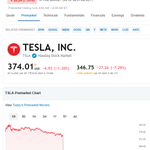
$TSLA is down 7.29% premarket, beyond the roughly 5.8% move options had priced for earnings.
The first bounce may mix short covering, dip buying, and exits, so the first few minutes mean little.
I’ll watch how much of this 7% drop is still there by the closing bell today.

33
TSLA’s daytime move is only the warm-up.
Tonight’s earnings will set the real direction.
Shares closed at $378.93, up 2.53%, and are at $376.41, down 0.66%.
I’m not reading that as a real signal yet.
Today is about positioning before margins, capex, and guidance arrive.

10
$MU is near $920 premarket, up 6.23% after gaining 1.94% yesterday.
The memory trade is heating up fast.
I’m watching $900 after the open: hold it and MU can keep lifting semis; lose it quickly and this gap turns into profit-taking.
Keeping the gain matters more than the open.

32
Earnings risk is already controlling $TSLA with only two sessions left before the report. Shares lost 6.6% last week and closed Friday at $380.84.
I expect $390 to cap today's upside while $380 stays contested. High volatility remains, and a sustained breakout is not my call.
1
75
Money did not leave the market this week; it rotated. Tech fell 3.61%, energy gained 4.85%, and financials and property stayed green.
With Alphabet, Tesla and Intel reporting next week, I’m watching whether leadership spreads beyond mega caps.
That shift may set the next trend.

12
$TSLA is back near its weekly lows at 383.5, down almost 2% premarket.
Today’s key is whether it can trade on its own while tech risk appetite weakens.
I’m watching for an independent rhythm; staying tied to the Nasdaq keeps Tesla framed as a high-beta risk proxy for now.

46
$TSLA is near 392 as the earnings bar keeps rising.
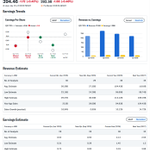
Revenue and EPS estimates rose, leaving less room for disappointment.
What worries me most is the thinner margin for error: auto margins, cash flow and AI spending all need clear progress.
Which number changes the story?

37
$TSLA is facing a valuation check on prepaid growth before the open.
Robotaxi, FSD and Optimus still support imagination, yet the market wants proof.
Buyers did not stay above 400 yesterday, so I use 400 as a sentiment gauge, not the verdict.
Active chasing has to return first.

400 remains the line $TSLA cannot turn into support.
It touched 400.18 after the open, then slipped near 397, showing the test came without enough demand behind it.
I read this as another valuation-patience fight. Sentiment repair needs buyers to stay near 400.
37
The longer $TSLA stays below 400, the more its AI premium gets discounted.
Robotaxi, FSD and Optimus still give the market imagination, but near 395 money is focused on execution speed and valuation patience.
I’m watching whether buyers can reclaim 400, not just repeat the story.

35

SK Hynix flow puts $MU on the valuation stage. U.S. manufacturing, supply-chain safety and AI memory demand brought MU back; today the market compares who deserves richer premium.
I care whether MU defends 950 and retests 1000. Hold it, thesis lives; fail it, cashout risk rises.

86
The real split in ORCL is still RPO.
A $638B order backlog proves demand is not weak, but the stock stayed under pressure because the market wants conversion speed, margins, and cash flow.
My judgment: RPO gives bulls support, but not automatic valuation upside.
Still bullish?

This is the sharpest debate around $ORCL now.
A massive backlog gives demand visibility, but the market is no longer rewarding size alone. It wants conversion speed, margin proof and cash flow strong enough to reduce customer-funding risk.

Oracle $ORCL just had its worst week in the stock market since 2001.
25 years.
Market knows OpenAI won’t pay their obligations. 🤣
Their backlog is bigger than their market cap but there is a reason for it.
