

prev @Anchorage @MessariCrypto | Crypto Markets/DeFi/Neobanks | Views are my own
Joined December 2020
- Tweets38.8K
- Following1.1K
- Followers6.3K
- Likes109K
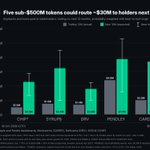








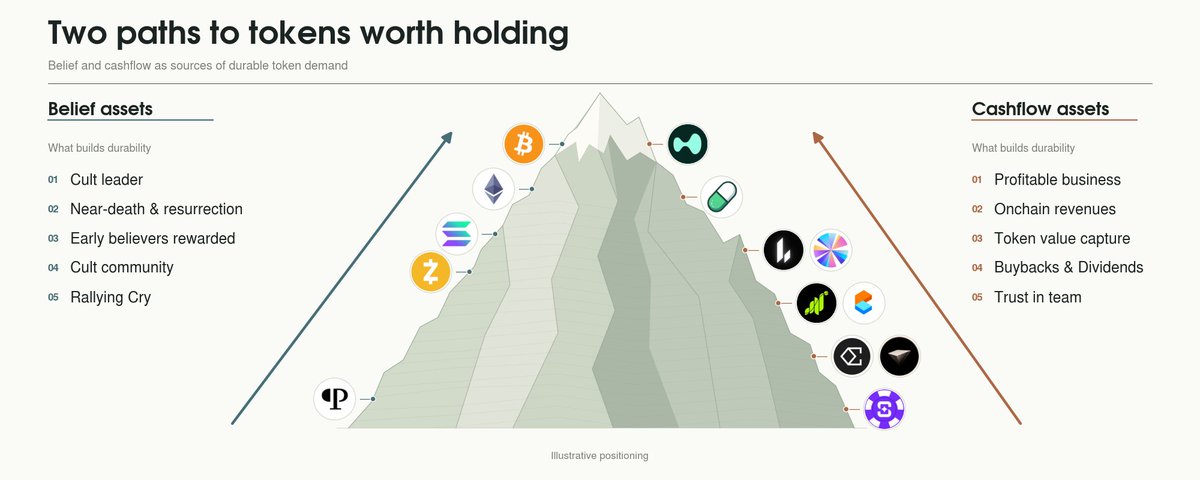
Tokens with revenue-funded buybacks have a structural bid, because the protocol itself is the marginal buyer and the size of that bid grows with the fees it earns. US regulation is opening the door for a much wider set of investors to allocate to crypto, and when that capital arrives it will favor tokens that actually accrue value from the protocols behind them.
I screened tokens under $500M in market cap and ranked five on projected buyback spend relative to market cap, growth in the revenue funding it, and how much supply is still left to unlock. Probability-weighted across bear, base and bull cases, these five could deploy roughly $30M into buybacks of their own tokens over the next 12 months, with a range of $12M to $41M.
• $CHIP - USD.AI is a private credit protocol that finances GPU purchases for data center operators, with the hardware as collateral. A proposal now on the table would send all sUSDai net interest margin, net of Foundation costs, to programmatic CHIP purchases, and USDai margin is expected to become the largest source of buybacks as credit outstanding grows. Gross profit grew 5.3x QoQ in Q2, Permian Labs has already bought back about 3.7% of supply since TGE, and if the proposal passes, expected buyback spend is about 4.7% of market cap, the highest of the five. The stated goal is a net deflationary CHIP, with protocol purchases exceeding new issuance, which matters because investor unlocks begin in April 2027.
• $SYRUP - Maple is an onchain asset manager running institutional credit, with $22M in protocol revenue over the last 12 months. MIP-021 hardcodes the buyback at 10% of monthly revenue below $1.5M, 20% up to $2M and 30% above that, and September revenue of $1.57M pushed Maple into the 20% tier, more than doubling its buyback from August. There is minimal supply overhang to absorb future buyback bids.
• $DRV - Derive is an onchain options venue that now also runs perps and spot after its V3 launch. A fixed share of trading fees across all three markets goes to buying DRV, and holder revenue is up nearly 3x YoY. The upside depends on onchain options taking volume from Deribit, which still dominates crypto options trading.
• $PENDLE - Pendle is the yield-trading layer for yield-bearing and tokenized assets. Since the switch to sPENDLE in January, Pendle has spent $4.8M of protocol revenue buying roughly 3M PENDLE for stakers, on top of partner airdrops. Revenue is down sharply from last year’s peak, which makes PENDLE the highest-beta name on this list to a recovery in demand for trading yield on RWAs and other yield-bearing collateral.
• $CARDS - Collector Crypt runs an onchain gacha for graded trading cards backed by vaulted physical inventory. Revenue has grown about 4x YoY to roughly $19M a month, and the protocol has returned about $2M to holders over the past year through buybacks, support buys and LP-fee burns, yet that is still only around 1% of revenue at the team’s discretion. As tokens compete for incoming flows, pressure to raise that share toward 2.5% to 5% could lift CARDS buybacks to $5M to $12M a year, though trading card cyclicality remains the main risk since a correction would cut both pack sales and the buyback.

Shortly thereafter we see the largest hack in crypto history with Binance losses of up $3 billion flushing the market.
As the dust settles, this will probably the opportunity I was talking about.

Truly believe the market is going to open the door for active participants to identify and start allocating to altcoins because of a flush in the markets due to the FUD of the whole entire internet being hacked.
I need to dial in and share where the opportunity lies, because there is a ton. Protocols are doing fantastic things to align tokenholders to their investments and they will be great again.
We shall rise
Eric Manoukian retweeted

HR isn’t your friend ….. they are your enemy

Eric Manoukian retweeted

[Really Good Video] I've been sitting on this archival footage for over a year now. Here is me explaining in pure-rant form how we will secure Bitcoin with the energy of stars & Gold will become an industrial biproduct. Dream Big. Bitcoin

Last month, we demonstrated high-rate alchemy: turning mercury into real, stable gold, beating CERN’s record by a factor of 10.
Last week, we enriched isotopes in the world’s most powerful plasma centrifuge, beating the Soviet record that stood for 40 years.
Now, we’re building a fusion reactor in San Francisco to achieve record power density.
The airdrop meta died in crypto with Hyperliquid, but it moved to the equity markets, and this weekend Elon Musk used it to front-run Anthropic on its own announcement. Anthropic said Sunday it would put 5% of its shares into a public benefit LLC it controls, one that might someday explore “direct distributions to specific populations.” Musk replied that they should give the shares directly to the public, and within a day he had pledged one of his own SpaceX shares to every kid in America.
Nobody needs a poll to know what the public thinks of AI right now because they’re living it. Every layoff memo cites it, every town council has a data center fight on the agenda, “slop” became a household word, the power bill went up, and the people whose jobs it’s coming for were told to learn to code about three years too late. Anthropic’s own CEO said it could wipe out half of entry-level white-collar jobs. The country isn’t against the technology so much as the terms, which at the moment are that it takes your job and you get a chatbot.
Anthropic is a few weeks from a roughly trillion-dollar IPO, and that’s the opening, because 5% of a trillion is about $48B, roughly $140 for every American or $670 for every kid if it lands in their accounts before the listing. The people showing up to block your data center start checking your stock price instead, and tens of millions of first-time shareholders become a constituency no lobbying budget could buy, which matters since the fund isn’t allowed to lobby anyway.
In crypto the airdrop was how a project turned users into owners before anyone could call it extractive, and the ones that got it right are still defended by their holders years later while the ones that got it wrong got dumped at TGE. Anthropic has the same shot with the entire country as its user base, and the gap between an IPO morning with tens of millions of kids refreshing their Trump Accounts and one with protesters outside the NYSE comes down to a decision the board can make.

This is bullish Pudgy Penguins. Luca Netz will have the bandwidth to continue growing the distribution for the largest IP in the NFT market.




Today, I was affected by the recent news that @Anchorage reduced their workforce by 20%.
Being a part of two major crypto companies in 2026 to have gone through major transitions like this have had a drastic effect on how I view this industry, but will not let this moment slow me down.
We have only seen a sliver of what this industry is able to accomplish and the job is not finished. My closest friends and peers ask why i would stay after dealing with what i dealt with this year and it’s because there is no other place id rather be.
We are truly redefining the way the world views finance, from stablecoins to tokenization, and hell even memecoins, we are building the future of finance and bringing the world closer together.
This is just a minor setback for a major comeback. Upwards and onwards.
I am predicting the bottom on the Robinhood Chain ecosystem, and that includes robinhood:0xca9c78dd337a67f6e0077f65f5e9218719d30edf . It's very misunderstood, and I think most people write it off as another OHM fork with tokenized stocks bolted on.
Robinhood Chain is focused on the proliferation of tokenized equities with developers building unique defi experiences around them. What better application for crypto native degens than bringing them to the casino? NetNet Capital Management has built a library of casino games where prizes are paid in tokenized equities.
Underneath the games, the treasury has grown past $26M, and a separate manager sleeve has used bond proceeds and forfeited game positions to buy roughly $4M of tokenized equities, so the casino is quite literally accumulating stock.
The NetNet DeFi mechanics are exactly that of Olympus DAO, but where it differentiates is the ecosystem built around NET. The endstate appears to be an RPG that brings all the different desks, credit facilities, and games of the NetNet ecosystem into one world. It almost resembles an evolved version of what DeFi Kingdoms was.
An OHM fork, with a game like DeFi Kingdoms, utilizing tokenized equities on the hottest network release of 2026. People know each of these pieces on their own, but few have noticed them coming together in one place.

Ethereum will be the world computer, and ethereum:native will be the quantum-resistant, private store of value securing the network where most of the world's assets end up living.

The cryptographic world computer:
vitalik.eth.limo/general/202…
My attempt to express in somewhat concise terms the true meaning of basically everything planned to happen to Ethereum starting from the fork after Hegota. It's really not just a blockchain anymore. It's a hybrid architecture that combines together blockchains and modern cryptography, to enable much more powerful properties.
FOCIL, EIP-8288, Lean consensus, state management, formal verification, advanced mempool improvements (including privacy), and the longer-term specter of obfuscation all mentioned.
The market is waking up to the purest equity representation of the tokenization supercycle 😉
I think the market is mispricing @Securitize $SECZ.
Tokenized RWAs sit around $33B onchain today. Roland Berger's conservative model puts the market at $10T+ by 2030. Securitize is the first pure-play equity on that gap.
The SPAC priced the company at $1.25B pre-money. The deal added roughly $400M in cash. Two weeks after the NYSE debut, the market cap is back to $1.24B. At current prices you're paying deal value and getting the cash raise for free.
Meanwhile, the business:
> $5.2B in tokenized assets, the #1 RWA platform (runs BlackRock's BUIDL)
> Clients include BlackRock, Apollo, KKR, Hamilton Lane, VanEck
> $69M revenue in 2025, guiding $110M for 2026. That's ~11x forward revenue
> Announced recently: a partnership with Cantor, the #1 US IPO bank of 2025, to run onchain IPOs and follow-on offerings
The 40% selloff since debut looks like classic post-SPAC turnover: redemption arb funds rotating out while insiders (who rolled 100% of their equity) sit locked up. Thin float, forced sellers, no fundamental news.

So you're telling me:
> Geopolitics are rumbling the beginnings of WWIII
> The 10-year treasury hit 5%
> Clarity Act failed
> AI is going to take over the world and steal everyone's jobs
> FED hikes for the first time in 3 years
> Oil is over $100
and the crypto markets are ripping? and you think it is a local top?
We are just getting started.
Crazy how ZEC already hit my Q2 2027 price target from this tweet.
It could literally be $10k by next year.
My base case for crypto over the next 12 months 👇
Summer: Choppy majors. Most majors range with the occasional breakout and drawdown. But this gets remembered as Hyperliquid Summer: $HYPE rips past $150 on the back of the largest IPOs in history including SpaceX, Anthropic, OpenAI, and HIP-4 captures significant attention. Privacy coins and decentralized AI catch a bid. But attention and flows stay glued to HYPE as institutions pile in.
Fall: TradFi tops out on a Democratic midterm sweep. The AI bubble starts cracking as Warren & her cronies wage a war on AI that makes the crypto crackdown look miniscule. Capital rotates out of AI stocks → back into majors. Real fundamentals and growing revenues get rewarded. BTC, ETH, ZEC “bottom” in October and grind up. HYPE cools.
Q4: The supercycle begins. Zombie chains fall out of the top 100. Tokenization, stablecoins, and RWAs lead. Revenue-generating protocols dominate. HYPE resurges.
Q1 2027: The Clarity Act gets signed. The inflows CT has coped about for years finally hit. A hard-to-miss market, but the best R/R sits in tokens actually aligned with their protocols and paying real revenue back to holders. A small batch soaks up all the flows.
Q2 2027 targets:
🔹BTC: $165K
🔹ETH: $6.5K
🔹ZEC: $1,500
🔹HYPE: $300
What do you think?

Much of the FUD around Robinhood Chain comes down to one number: network revenue is down 94% from the 9/4 peak. That framing misconstrues what really occurred. On 9/4 the chain did $8.3M in REV at an average fee of $0.59 per transaction, a congestion premium from a memecoin surge that no high-throughput L2 can sustain on a longer timeframe. Arbitrum-style pricing climbs exponentially once gas demand clears the throughput target, so a memecoin cooldown that cut gas demand in half cut the gas price by 88%.
The fee per transaction has kept compressing, to $0.045 on Sunday, and it still sits 4x above the chain's 0.02 gwei floor. Daily REV has run under $1M since 9/11. If the gas price finishes decaying at current usage, REV settles around $40-50M a year, in line with expectations from the Blockworks pre-launch forecast. The chain is landing where it was expected to before the spike, with more users than it had.
Underneath the fee, usage is holding: daily active wallets are up 18% since the peak, unique DEX traders up 16%, transactions steady in a 10-14M band, $930M in TVL, and the highest throughput of any L2 at 28 Mgas/s.
Arc mainnet goes live Wednesday with BlackRock, DTCC, Visa and Mastercard as validators and Aave, Morpho and Uniswap at launch. If anything rotates, it's the DeFi side of Robinhood Chain, about $1B in stablecoins. There's no retail brokerage or stock-token product on Arc's launch list, which is why I expect Vlad to keep leaning on the tokenized-stocks framing to hold that capital on Robinhood.
