

MIND Labs - A Venture Innovation labs bridging the Web2 and Web3 ecosystems through regional alignment
APAC
Joined June 2022
- Tweets138
- Following123
- Followers465
- Likes20







Following the 2026 US midterm elections, Democrats have secured control of both chambers of Congress.
Bitcoin initially rebounded toward $80.5K after the results, but the rally has since faded, with BTC trading around $65K.
So what does a Democratic Congress actually mean for crypto markets? Here's our breakdown 🧵👇

4/ Base rates say less than headlines do
Historically, the S&P 500 has risen in the 12 months after every midterm since 1950, about 15% on average.
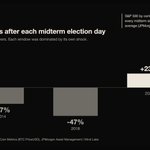
Bitcoin has three midterms of data and three answers: -27% (2014), -47% (2018) and +23% (2022) at 90 days after election day.
Each window was dominated by its own shock.
This week is a live example: the shock was an AI selloff, not a bill. Three points is not a signal.
So we split the outlook by durability. GENIUS is statute and takes effect January 18 regardless.
Agency rulemaking is exposed: analysts say it “will likely slow dramatically” if Democratic commissioners are appointed.
The test is sticking power through an administration change.
Stablecoins and tokenization are the insulated layer.
Market structure is the exposed one.
The regime-change binary moves from this week to the 2028 election.

1
1
7
5/ The Jurisdiction Question
Grayscale estimates 80% to 85% of global crypto activity is outside the US.
If Washington stalls, Asia and Europe, including Thailand, Singapore and the EU under AMLR (July 2027), could set the rules.
What would change our mind: ETF flows turning positive after last week’s $1.28B outflow and Bitcoin reclaiming $76K to $78K.
Two dates matter too: Tuesday’s CPI and the December FOMC.
Binance’s $6.3B hot-wallet hack, which the FBI attributes to North Korea, is the other live variable.
If US rules are priced by ethics and elections, which regulator writes the baseline first?
20
We're excited to be an official Media Partner for AI Meets RWA: The Real-World Shift @ Bangkok 2026!
Web3 is bridging with the real world. Connect with us on Nov 28 during Binance Blockchain Week Bangkok for an exclusive summit & evening mixer on Web3, AI, RWA, & PayFi.
🔥 What to Expect:
• Deep dives into AI Agents, compliant RWA tokenization & cross-border PayFi
• 300+ founders, builders, institutional investors & policymakers
• Keynotes, panels & 2.5h+ networking with drinks & vibes 🍺🍴
📅 Nov 28, 2026 | 16:00 - 21:00 GMT+7
📍 Bangkok (ZillaSpace @ FYI Center)
Hosts & Partners:
Host: @Web3Labs_Club
Co-Hosts: @Microsoft | @Envo_Official
Gold Sponsors: @RWAI_Delivery | @OpencheckAI
Partner: @0xCregis
🎟 RSVP NOW (Limited Spots): luma.com/0x7ox8tl

2
63


1/ STRC-Backed Stablecoin: High Yield, Fast Growth, and the Risks That Come With It
If you ask which stablecoins offer the highest yields, STRC-backed stablecoins from @Strategy (MicroStrategy) will always make the list.
Right now, stablecoins like USDat and BUCK are using STRC as collateral and offering yields as high as 7-11.5% per year.
6/ The Risks of STRC Backed Stablecoins
As we know, Strategy has made a significant bet on Bitcoin as its treasury reserve.
If BTC drops hard and stay down, it could weaken confidence in the company’s balance sheet and its ability to maintain dividend payments.
This risk exists even with a $2.25B cash reserve, which can cover dividends for around 28 months.
And Strategy has the legal right to defer dividend payments. If that happens, every STRC-backed stablecoin feels it immediately.
1
75
7/ Summary
STRC-backed stablecoins are not the UST/Luna of this cycle.
But they are not USDT or USDC either.
Yields of 7–11.5% per year come attached to real risks and genuinely complex structures.
It remains to be seen just how long stablecoins offering this level of return can sustain themselves.
83

