

Engineer and founder, 18 years in. Building with AI where it meets real hardware. I post what I measure.
Dnipro
Joined January 2009
- Tweets2.5K
- Following347
- Followers540
- Likes1.5K







Pinned Tweet
A 2.1 GB file on my laptop writes code, answers history questions and speaks a dozen languages. No internet.
Where does it keep all that?
"In the weights" is the usual answer, and it explains nothing. Here's what is actually in the file.
Got curious how clean the test split of an open gauge-reading dataset is.
101 of its 302 test rows point at a training image, and in train that image has a different reading. The right images sit in the repo unused, as _ds6 twins.
2.8K downloads. Fix PR is up. Checked yours?
10
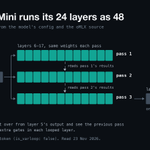
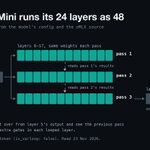
The difference from the 2021 ladder I find most interesting: Inkling 2 Mini's config loops only the middle 12 of its 24 layers, three passes. The first and last 6 run once. Ladder repeated the whole stack.
Did the edge layers resist weight sharing back then?

The loop is complete! 🔁
In 2021 we introduced looped transformers (called "ladder attention") [& compared to universal transformers, looped is much better] with @stephenroller – he's now at Thinky where they've released a looped Inkling 2.
Classical blog post: github.com/facebookresearch/…
Classical paper: arxiv.org/abs/2106.04279


1
48

Tried running Claude Code on a local Inkling 2 Mini on my 2021 MacBook.
With my usual setup the first request was 74,775 tokens. 11 minutes in, the model had read half. I gave up.
Even "hi" from an empty folder is 18,904 tokens. With six tools: 6,129.
What do you cut first?

3
2
94
Everyone posts Inkling 2 Mini numbers from an M5 Max. Mine is a 2021 M1 Pro, so I tried it there.
One prompt: a night highway racing game in a single HTML file.
265 lines in 4.5 minutes, about 20 tok/s. It ran on the first try, demo mode included.
Got curious how much of a local model's wait is just re-reading the same prompt.
Almost all of it. Same 11K-token context, same question, on my M1 Pro:
cache off: 46.3 s to first word
cache on: 1.8 s
oMLX keeps what it has read on the SSD, even across a restart. Side by side:
Because it keeps the skill and not the facts, it can't look anything up. It reconstructs.
Usually right. Sometimes wrong with a straight face. I showed two small models a table and asked how many columns it had. One said 7, the other 5. It had 8.
1
16
Most AI talk assumes a datacenter.
The interesting engineering starts when the model has to live somewhere small: a few GB of memory, a few watts, an answer due in milliseconds, no retry.
I've put vision models on single-board computers. Now I'm measuring language models on a laptop.
What's the smallest thing you've run a model on?
36
This month an AI model built 948 Linux root exploits in one run.
I asked two models that fit on my laptop to find one known WordPress bug.
Qwen3-4B: sees nothing, 0 of 18. Then flags the patch.
Ministral 3B: flags everything, the patched code too.
That gap is the story.
42
Gave two small local models a 25k-token prompt with a table in it and asked one thing: how many columns does the table have?
Qwen3-4B: 7.
Ministral 3B: 5.
The table has 8.
One try each, so not a benchmark. What's the simplest thing your local model gets wrong?
1
37
Automattic's Spacefast is WordPress you never see.
Tell Claude "publish this" and get a live link: database, logins, uploads, email and spam checks built in. No account to start.
Matt says he'd like to host Lovable's apps for less than they pay now.
nitter.cf/photomatt/status/21028…

We had a soft launch of @SpacefastHQ yesterday before our board meeting, @batuhan (and now a team!) have been cooking what I think is the future of @WordPress and AI. You don't have to know or think WordPress, but this leverages wp.cloud to give you a Real Database, auth, uploads, email, @akismet / @automattic spam protection, and soon stats.
The architecture is amazing I'd actually love to talk to @Lovable et al see if we can host things for them for less than they spend now.
Datacenter space and components are getting pricey... So we might have to limit signups to prioritize our @WordPressVIP customers but get in while you can!

2
1
72
What an online store can put on it today, and why the free plan won't do: wpwp.bz/spacefast-automattic…

1
60