
I am in consulting now. Only here for the scrolling
Joined December 2010
- Tweets179
- Following350
- Followers165
- Likes301




Daan Wesselink retweeted

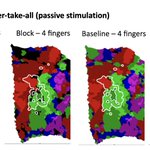
So, we've been temporarily 'amputating' peoples' fingers with anaesthetic to examine brain plasticity...
We now show that while some analyses suggest brain reorganisation after 'amputation', new methods reveal the original representation persists science.org/doi/10.1126/scia…

Have you grown up with textbook animal work from the 80s, stating an amputated finger's 'cortical territory' gets invaded by its neighbours? Confused by human amputee research mainly showing stability, and want a direct face-off? Our new paper's out: science.org/doi/10.1126/scia…. 1/🧵
I'd like to thank my co-authors who made this paper who have made this multi-faceted paper possible. @ZeenaSanders @lauraredmondson @DrHarryDJ Paulina Kieliba @sanne_kikkert Andreas Themistocleous @uzemye @diedrichsenlab @SuperHannes and of course Tamar Makin! 9/N
1
7
Thank you for bearing with me as I moved across the pond. Also, thanks to @plasticity_lab and @OxfordWIN for being such a supportive and fun bunch of scholars. 10/10
1
Daan Wesselink retweeted

After several months of work, happy to share our last #preprint on @biorxiv_neursci entitled "A modality independent proto-organization of human multisensory areas” biorxiv.org/cgi/content/shor… - a collaboration between @MoMiLab_IMT @ManibusLab @IMTLucca @unito
Daan Wesselink retweeted

Very happy to announce our latest paper is out in @CellReports! Bringing a new perspective over the somatosensory Homunculus.
What if we could read information about our hand or face from the leg region?
@vick_root @DaniClode @plasticity_lab @UCL_ICN
doi.org/10.1016/j.celrep.202…
1/5
Daan Wesselink retweeted

Check out our new eLife publication showing that somatotopic representations can be preserved after a complete loss of peripheral inputs through tetraplegia but deteriorate over time after injury. With @NCMLabETH and @MRIatBalgrist.
elifesciences.org/articles/6…

Daan Wesselink retweeted

My favorite study from the PhD is now out in @eLife!
What can artificial-arms 🦾 teach us about neural plasticity and sensorimotor development?
With: @HunterSchone
@AnalogAldo
@PlasticityUCL
Paper: elifesciences.org/articles/6…
🧵 1/6

Daan Wesselink retweeted

New preprint!
Precise topology of adjacent domain-general and sensory-biased regions in the human brain
Can you tell which "fronto-parietal" activation is visual working memory and which is auditory? Check figure 3 and tell me it doesn't shock you.
doi.org/10.1101/2021.02.21.4…

Daan Wesselink retweeted

Can I “pick” your brain 🧠 about our new research findings?!
We studied London litter pickers to test whether their brains have adapted to represent their litter picker like a hand/body-part 🖐.
Check out the full paper: ow.ly/Abhb50Dx4UH
(thread below) 1/6
Daan Wesselink retweeted

Happy to share a preprint with @seygreena, Xiaoying Wang, Elissa Newport and @YanchaoBi about a strange phenomenon we noticed: V1 is activated by (auditory) language comprehension, in sighted people!
biorxiv.org/content/10.1101/…
(1/8)

Daan Wesselink retweeted
Our new paper is out! Taking a different approach to testing embodiment. Looking at how amputees gesture with their artificial-arms to communicate meaning.
sciencedirect.com/science/ar…
Daan Wesselink retweeted

Sharing from Frank, who doesn't Tweet: "In a new pre-print, we demonstrate a BCI that can decode imagined handwriting movements in real-time". 1/2

ALT Panel A shows a sketch of a participant imagining handwriting a word, while neural activity is read out with electrode arrays in his brain's "hand knob" area of motor cortex. The same word ("hello") appears on a computer screen. Panel B shows a plot of performance (characters per minute) on five consecutive days. It starts at ~62 cpm on Day 1 and reaches 99 cpm on Day 5. Panel C shows character error rate (%) for these same days. Raw error rates are between 5 and 15%, while error rates after applying a language model are <1%.