

Europe macro. Opinions my own. All of them.
Joined February 2013
- Tweets7.7K
- Following3.6K
- Followers17.8K
- Likes7.8K
Half of Eurozone's growth in Q3 down to Ireland (4% of the bloc). French economy stuttering and may get worse; Germany accelerating as fiscal stimulus and widening deficit translate into higher spending. Italy back to its norm: stagnation. Spain and the Netherlands racing ahead.


Euro area #GDP up by 0.4% in Q3 2026, +1.3% compared with Q3 2025: preliminary flash estimate from #Eurostat ec.europa.eu/eurostat/en/web…

ALT GDP growth rates over the previous quarter - % change, based on seasonally adjusted data
Still early days but based on @BirthGauge data for this year, the EU's fertility rate may have bottomed out in 2025. Let's see if it holds in coming months and years.
@JesusFerna7026

Ireland's Q3 GDP came in at +5.5% q/q, will thus add over 0.2ppts to Eurozone headline quarterly growth (out tomorrow). Forget France crisis, Euroboom goes on.

Many argue low gas storages and constrained supply not a problem since 🇪🇺 consumption is ~20% lower than before 2022. Two main issues:
- A cold spell will eliminate all savings (🇩🇪 in late 2025 & 2026)
- Gas still the backstop in power sector (🇮🇹 guzzling gas for 🔌 now)


EU gas prices breached €100/MWh not because of scramble to refill storages but due to supply constraints. Gas storages are historically low.
With no resolution in sight for Hormuz (& risk of escalation after US mid-terms), dialogue with Russia is back on. A tough winter ahead.


European natural gas hit €100 a megawatt-hour for the first time in almost four years, fueling worries about a renewed energy crisis as the region enters its peak demand season bloomberg.com/news/articles/…

Markets demand a credible medium-term fiscal consolidation plan from France (cutting pensions / increasing pension age, all else is window dressing).
The problem is that previous plans hoped for the best but turned out as always. In France, a credible fiscal plan is an oxymoron.

Key problem in France is that its large fiscal deficits (primary deficit since 2010 averaged 2.9% of GDP) have not funded growth-enhancing investments but regressive transfers. Hence, apart from the post-pandemic rebound, nominal growth was not high enough to offset the deficit.

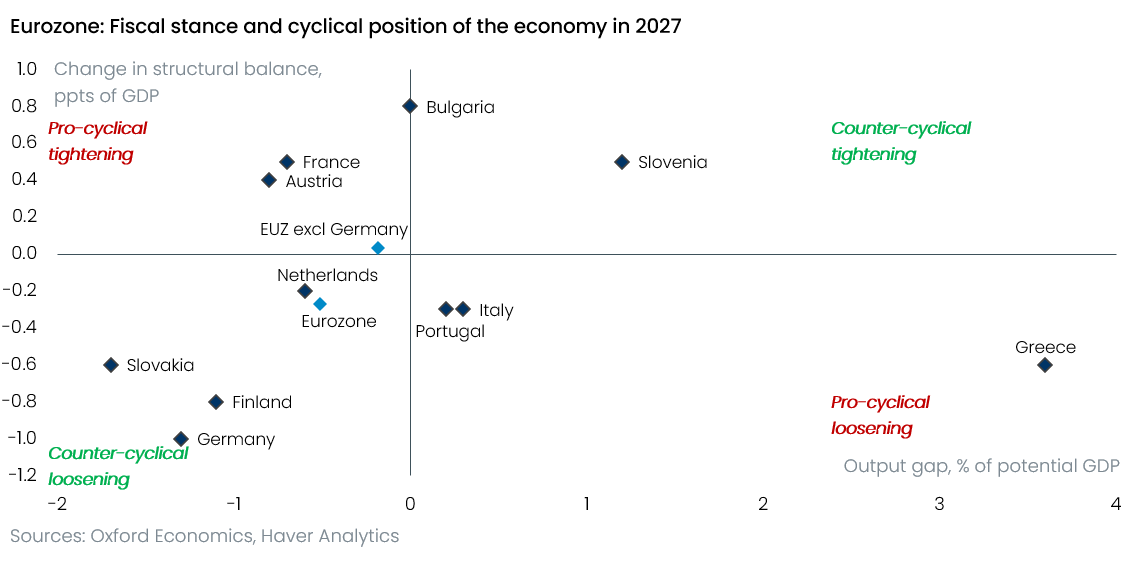
Draft govt budgets imply €zone fiscal loosening of 0.4ppts of GDP next year (thanks to 🇩🇪). But 7 countries (🇫🇷🇮🇹🇪🇸🇬🇷🇫🇮🇸🇰🇪🇪 or 50% of € GDP) have elections, so take with a big pinch of salt. 14 were granted the escape clause - the bond market, not EU, will be main constraint.
Eurozone bank credit flow to the private sector has turned and banks report a tightening of lending standards as well as lower demand in Q4. Not surprising, but still a headwind for growth in the near-term.

EU wholesale gas prices are a whisker away from €100/MWh, the highest since end-2022 and a key psychological threshold.
Energy prices pushed up Eurozone inflation to almost 4% in September. It will peak much higher with price pressures broadening out. A difficult winter ahead.

Small South European economies are undergoing the largest and fastest public debt reduction episodes in recent history based on sound fiscal policies and strong growth, not financial repression or inflation. One for the history books. 🇬🇷🇵🇹🇨🇾🇭🇷

A rare W for Eastern Europe and L for the Nordics
(Sine 2021 the EU has a tax on unrecycled plastic packaging)
In 2024, the EU recycled 42.4% of all the generated plastic packaging waste. 🛍️♻️
Highest recycling rate in:
🇱🇻Latvia 71.0%
🇧🇪Belgium (58.2%)
🇵🇱Poland (56.0%)
Lowest in:
🇩🇰Denmark (22.5%)
🇫🇮Finland (26.9%)
🇫🇷France (27.4%)
Read more 👉link.europa.eu/77DrkP

ALT Recycling rate for plastic packaging waste, 2024 (%), EU and EFTA countries
Govt debt-to-GDP ratios 2020 -> 2026 (% of GDP):
🇬🇷 213% -> 137%
🇮🇹 158% -> 138%
🇵🇹 137% -> 87%
🇫🇷 118% -> 120%
🇨🇾 118% -> 49% (among the lowest)
🇧🇪 115% -> 112%
🇸🇮 85% -> 65%
🇫🇮 73% -> 90%
🇸🇰 58% -> 65%
🇭🇷 88% -> 54%
Same currency and fiscal rules. Very different outcomes.

Finland stands out as having the worst debt-to-GDP dynamics. But most of this is due to its unique pension system. It also has a long history of running large primary surpluses. Markets remain sanguine - borrowing costs have risen little and are close to par with the Netherlands.

Lost in all the Franco-doomerism is an even more problematic country - Belgium. It has a wider primary & overall deficit with both moving in the wrong direction (former has improved in France) & still no budget. No wonder its yields rose the most after France in current sell-off.

🇪🇺 govt debt-to-GDP ratio is rising again, masking diverging dynamics. 🇫🇷🇧🇪🇫🇮 and increasingly 🇩🇪 are pulling it up. Conversely, 🇬🇷🇵🇹🇭🇷🇨🇾 and to a small extent 🇪🇸 pull in the opposite direction.
Markets are attentive to this, hence different levels of contagion from 🇫🇷 sell-off.

Euro area government #debt at 88.8% of GDP in Q2 2026 (compared with 88.4% in Q1 2026) ec.europa.eu/eurostat/en/web…

ALT General government debt to GDP ratio, Q1 2026 – in percentage
After an initial broad sell-off, markets have started to differentiate among 🇪🇺 govts. Spreads widened again in 🇫🇷 & 🇧🇪, which has a weak backdrop, fractious politics and large consolidation needs, but shrank in South Europe. Bond market is back as the key constraint for govts.


Worth adding that the IMF expects this consolidation to happen fully on the revenues side - ie. taxes going up. By the end of this decade, govt revenue is expected to be over 6ppts of GDP higher than in 2019 - an unprecedented peacetime rise without much to show for it.


The hybrid car deal is an important precedent - the EU got a major concession from China on a key industry without retaliation. But it's just one of many facing clear import surges - the EU will seek to extend the blueprint to other sectors. It may not go so smoothly.


NEW: Emboldened by hybrid car deal, Europe coalesces around a tougher China stance
The mood in Brussels has hardened this week. The place is awash with the notion that standing up to China might actually work
A long read from me ahead of today's EUCO
scmp.com/news/china/diplomac…

No surprises on the use of AI by EU companies at the very top and bottom, but some surprises in between. Based on latest @EurobarometerEU.
