Data Desk (@DataDeskHQ) header
Data Desk (@DataDeskHQ) profile picture

Learn to not suck at marketing. @elonmusk* endorses this account. (*@ elonmusk is my dog's name )

In Your Mind
Joined August 2024
Photo by Data Desk (@DataDeskHQ)Photo by Data Desk (@DataDeskHQ)Photo by Data Desk (@DataDeskHQ)Photo by Data Desk (@DataDeskHQ)Photo by Data Desk (@DataDeskHQ)Photo by Data Desk (@DataDeskHQ)Photo by Data Desk (@DataDeskHQ)Photo by Data Desk (@DataDeskHQ)Photo by Data Desk (@DataDeskHQ)Photo by Data Desk (@DataDeskHQ)
Luana Lopes Lara, Kalshi co-founder and the world's youngest self-made female billionaire, was told by experts she had a 0% chance of succeeding
Kalshi just raised an additional $1B, valuing the company at $40B. This will help us expand into stocks, compute, indices, and institutional. Tomorrow marks 8 years since we got accepted into YC and the journey began. The odds of a kid from Lebanon getting here were pretty low. Growing up there was great, but very challenging. We went through war. We had bombs explode in front of my house. I watched brilliant people’s lives destroyed for reasons beyond their control. Lebanon is an unpredictable country. That unpredictability made it hard to plan for success. And yet despite it all, my mom sacrificed everything to give me and my brother the chance to go back to the US. I found my refuge in two things: anime and math. Especially math. I loved math because it calmed me. It was the opposite of unpredictable: clear, deterministic, orderly, and consistent. The proof is either right or wrong. I find that elegant and beautiful. I was lucky. I made it to my dream school, MIT (largely thanks to my mom), and my love for math quickly translated to a love for statistics, probability, and markets. I love markets for a lot of the same reasons. Their incentives are clear: you get rewarded for being right and for pursuing knowledge. They are effective weighting machines for people’s opinions. They provide an incentive to be truthful, because they separate good information from bad information. They let people challenge the consensus and be rewarded for being right. IMO, Hayek, Surowiecki, Hanson, Tetlock were the founding fathers of prediction markets. The more I read them, the more obsessed I got with the idea of applying market-based pricing to more things. Markets bring rigor and critical thinking to more questions. And in an increasingly polarized and information-positioned word, I believe we need that more than ever. Markets would also let people predict and manage more things outside of their control. And the world was becoming increasingly more unpredictable, and more like Lebanon, not less. That love for markets got Luana and me to build Kalshi. At first, it was mostly an idea we couldn’t stop talking about. We didn’t have much money. Luana’s sister bought the Kalshi domain name for us (for ~$1.7k). We moved to SF to get started, and embarked on a long, uncertain journey to build a regulated exchange. The paranoia and anxiety from my childhood never left me. Even when things are going well, I think about what could go wrong. When people trust you with their money, that instinct serves a purpose. I wanted us to build something that would hold up under pressure. The first principle we defined at the company: regulatory-first. We worked with regulators for years before we listed a single market. We took every step to do things the right way and always asked for approval before proceeding. It was very hard at times, especially when we were being overtaken by competitors, but we believe doing things the right way matters. Luana and I aren’t the only ones. Our team put years of their lives into something far from certain. That’s especially true of Lior, Brandon, Rainer, Luis, Xavier, and Josef, who stuck with us for years. They believed when there was little to point to. And they stuck with us no matter how long it took. Kalshi is the result of an arduous journey through a long desert where, at times, most people didn’t understand why we were making the walk. Many people still don’t understand what we’re doing and some disagree with us. Markets have historically taken time to be understood and accepted by some. But while not always obvious, their benefits are vast: capital markets help allocate capital and derivative markets help predict and manage uncertainty. I firmly believe in these benefits, and that’s why I am dedicating my life to building this market. Markets have caused issues many times in the past, and they certainly can present harms (manipulation, insiders, and addictive behaviors). These harms are more acute for certain types of markets (sports, short-term options, etc.) than others. It’s why I believe that guardrails need to exist and why we have taken the approach we have taken. We have consistently prioritized thinking critically about the risks and building the appropriate safeguards, sometimes beyond what the regulators require us to do. Many believe more needs to be done, and that’s a conversation I welcome. Over time, I believe more people will see what we see: markets can help us get smarter and manage the future with more rigor, more precision, and more certainty than we have today. To our tens of millions of users: you have made Kalshi bigger than anything Luana and I could have possibly imagined. Thank you for trusting us and thank you for coming along on the journey. I feel a strong responsibility to build a company worthy of that trust. I am so lucky to spend my life building something I love. I hope everyone finds something they care about that much. Something that keeps you curious. Something that pushes you to your limits. Something that may put you at odds with the status quo. Something worth the hard days. For me, it’s still markets. The more I learn, the more I want to understand.
3
26
1
376
25,563
Data Desk retweeted
Wow, one of the wildest charts ahead of the Anthropic IPO @nottombrown and the @claudeai team bought compute for Anthropic 12 to 18 months ahead, and revenue still outgrew it. Compute and infrastructure expense fell from 251% of revenue in the March 2025 quarter to 48% in the June 2026 quarter, per the S-1
3
10
489
Wanted to see if AI could do slapstick comedy Introducing: D*ckhead Huge thanks to @NicooSvane and @tvnxty for helping get this over the line
139
157
20
1,354
120,879
As of September 2026, US job postings for physicians and surgeons sit 99.8% above their pre-pandemic level on Indeed's index, while data and analytics postings sit 37.9% below it
199
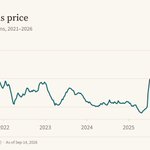
$100 in regular gas: 2021: 31.5 gallons at $3.175 a gallon 2026: 23.2 gallons at $4.319 a gallon *average US retail price
199
$100 in white pan bread: 2016: 75.2 pounds at $1.33 a pound 2026: 54.9 pounds at $1.82 a pound *average US retail price, bread (white, pan), BLS via FRED
169
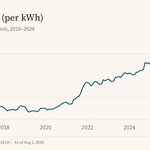
In 2016 the average US price of electricity was $0.139 a kilowatt-hour. Adjusted for inflation, that would be $0.19 today. As of August 2026 it actually costs $0.196
200
In September 2016 a dozen large eggs cost $1.47. Adjusted for inflation, that would be $2.04 today. As of August 2026 they actually cost $2.27
196
The average US private-sector wage was $25.77 an hour in September 2016. Adjusted for inflation, that would be $35.70 today. As of August 2026 it's actually $37.75
175
Groceries cost 2.1% more than they did a year ago
176
In September 2016 a pound of white pan bread cost $1.33. Adjusted for inflation, that would be $1.84 today. As of August 2026 the average US price is $1.82, so bread has done nothing more than keep pace with everything else
1
178
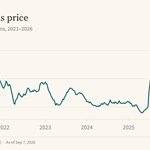
In September 2021 a gallon of regular gas cost $3.18. Adjusted for inflation, that would be $3.88 today. As of August 2026 it actually costs $4.07, so gas has outrun inflation itself
170
In September 2021 a gallon of regular gas cost $3.18. Adjusted for inflation, that would be $3.87 today. As of July 2026 it actually costs $4.10
205
$100 in gas: 2021: 31.4 gallons at $3.184 a gallon 2026: 24.1 gallons at $4.157 a gallon *US regular all formulations gas price, EIA via FRED, week of Sep 20 2021 vs week of Sep 7 2026
177
As of August 2026, physician and surgeon job postings on Indeed sit 83.5% above their pre-pandemic level, while data and analytics postings sit 40% below it, a 3.1x gap between the two
168
What an hour of work pays in America: 2025: $36.62 2026: $37.75 A 3.1% raise for the average private-sector worker *average hourly earnings, all private employees, August observations, BLS via FRED
1
161
In September 2016 the average private-sector job in America paid $25.77 an hour. Adjusted for inflation, that would be $35.56 today. As of July 2026 it actually pays $37.65
1
189
$100 in white bread: 2016: 74.6 pounds at $1.341 a pound 2026: 54.9 pounds at $1.82 a pound *average US retail price, bread, white, pan, BLS via FRED (Aug 2016 vs Jul 2026)
152
$100 in electricity: 2016: 719.4 kWh at $0.139 a kWh 2026: 507.6 kWh at $0.197 a kWh *average US retail price per kilowatt-hour, FRED series APU000072610, Aug 2016 vs Jul 2026
164
US housing starts ran at an annual rate of 1,239,000 homes in July 2026, 31.4% below the April 2022 pace of 1,807,000, which leaves homebuilding closer to its April 2020 level of 936,000 than to that peak
126