

Professor researching why we age & how to reverse it. Author & host of Lifespan. Mission: Extend healthy life for all. Views are entirely his own. @joinlifespan
Harvard
Joined March 2012
- Tweets11.2K
- Following1.2K
- Followers665K
- Likes9.5K







Pinned Tweet
Breaking
lifespan.com/blogs/magazine/…

Have you read Lifespan News & Magazine: Try the free versions & don't miss out on breakthroughs, health tips, new trends, longevity protocols & investor info
Memberships help support longevity research 🧬 Win-win.
lifespan.com/pages/membershi…


David Sinclair retweeted

Congratulations to the seven members of the Longevity Science Caucus who won re-election yesterday!
Rep. Gus Bilirakis (FL-12), Rep. Paul Tonko (NY-20), Rep. Ro Khanna (CA-17), Rep. Scott Peters (CA-50), Rep. Sam Liccardo (CA-16), Rep. Glenn Grothman (WI-6), and Rep. Lori Trahan (MA-3) will all return to Congress in January.
This bipartisan group has championed the idea that aging research is one of the best investments we can make in America's health and economy. We look forward to working with them in the 120th Congress to help more Americans live longer, healthier lives.

ALS NEWS: Small molecule screen identifies SIRT1 as a key therapeutic target in ALS. SIRT1 activators hopeaphenol & SRT2104 (a SIRT1 activator with brain permeability & tolerability in humans) reduced motor neuron cell death, degeneration, and firing rates @NaturePortfolio

David Sinclair retweeted

Very useful overview of aging and longevity. Starts with the Life Biosciences trial and the great @davidasinclair.
Anyone following this field should watch:
youtube.com/watch?v=hhJw_X6p…

A future dictator’s dream: ubiquitous cameras and robots. My ancestors fled Europe 60 years ago to escape persecution, prison & death for protesting injustices. Be warned

🇺🇸 Flock cameras are popping up in thousands of towns with barely any public review... and the data could become AI’s next training ground.
Chris Martenson ties the spread of Flock Safety’s license plate cameras to big tech venture money, with backers like Andreessen Horowitz helping push the company to an $8.3 billion valuation.
As AI models run out of internet text to learn from, he says tracking how people physically move becomes the next frontier.
A growing list of cities is already pulling the plug, and local pushback is the only real check on it so far.
@chrismartenson
EGCG, abundant in matcha 🍵

The Dietary Polyphenol Epigallocatechin Gallate Delays Biological Aging by Activating Peroxisome Biogenesis and Peroxisomal Fatty Acid β-Oxidation
onlinelibrary.wiley.com/doi/…


The “proteasome appears to regulate NAD+, the cellular machinery that breaks down damaged proteins. When inhibited, NAD+ levels rose in muscle and liver cells to a degree comparable to NAD+ precursor supplements.”
A new route to understanding NAD+ decline?

Most exercise and aging studies can't answer a basic question: is muscle deterioration from aging itself, or just from decades of moving less? A new Nature Aging study solved this by recruiting older adults who moved as much as people in their twenties.
The researchers from Amsterdam UMC and Maastricht University recruited four distinct groups: young adults in their twenties, older adults whose daily step counts and high-intensity activity matched the young group, older adults who had trained consistently for years (three structured hour-long sessions per week for over a year), and older adults with early physical impairment.
They took muscle biopsies before and after a one-hour cycling session, then measured over 24,000 gene transcripts, 135 metabolites, and 1,383 lipid species.
By matching activity levels between young and older groups, any molecular differences couldn't be blamed on the older adults simply moving less. This isolated aging from inactivity for the first time at this molecular depth.
Key findings:
• The defining molecular signature of muscle aging is an energy crisis. Comparing young adults to activity-matched older adults, 1,106 genes were downregulated with age. These genes build the mitochondrial machinery that produces cellular energy: ATP synthase, cytochrome c oxidase, and NADH dehydrogenase subunits. Mitochondria are the power plants of cells, converting nutrients into ATP, the energy currency cells use to function. When these genes decline, cells lose their ability to generate energy efficiently.
• NAD+ levels declined and triglycerides accumulated inside aging muscle. NAD+ is a molecule required for energy production and cellular repair. Lower NAD+ means less capacity to convert fuel into usable energy. Triglycerides are stored fats, their accumulation inside muscle indicates unburned fuel piling up as the tissue loses its ability to process it.
• More than half the molecular signature of muscle aging was absent in trained older adults. Specifically, 57.1% of age-related gene downregulation and 55.9% of upregulation were missing in the trained group. Their muscle resembled young adults far more than their chronological age would predict.
• The changes training preserved were specifically the energy metabolism ones. Genes like NDUFS1 and COX5A, which were depleted in normally active and impaired older adults, sat at youthful levels in the trained group across all five mitochondrial respiratory complexes. The single most prominent feature of muscle aging turned out to be the single most preventable.
• Being generally active was not enough. Structured training was the difference. The normally active older adults walked as much as young adults, and their energy metabolism genes declined anyway. What preserved the youthful molecular profile was structured, sustained training. Filling a step counter and being genuinely trained are not equivalent at the molecular level.
• Roughly half of muscle aging persisted regardless of training. Changes in genes controlling synaptic transmission (how nerves communicate with muscle) and WNT signaling (a pathway regulating tissue maintenance and stem cell function) appeared in all older adults, trained or not. This unavoidable half is where drugs will have to work.
• The fittest muscle mounted the largest inflammatory response to exercise. All groups activated stress and immune genes after exercise, including IL6, IL1B, and TNF. But the magnitude scaled with fitness. Trained older adults most closely resembled young adults in their response, followed by normally active, with impaired older adults showing the most blunted response. The stress response to exercise appears to be the mechanism of adaptation, not damage to be minimized.
This raises a concern about anti-inflammatory longevity strategies. If the inflammatory stress response is how exercise produces its benefits, chronically suppressing inflammation may blunt the adaptation that exercise depends on. It doesn't mean inflammation is beneficial in general, but the timing and context matter.
A separate discovery: the proteasome appears to regulate NAD+. The proteasome is the cellular machinery that breaks down damaged proteins. When researchers inhibited it, NAD+ levels rose in both muscle and liver cells to a degree comparable to NAD+ precursor supplements. This opens a new route to understanding NAD+ decline that operates through protein turnover rather than just supplying more raw material.
The study draws a clear line between what lifestyle can address and what will require therapeutics. The energy metabolism decline, mitochondrial deterioration, and NAD+ depletion that define muscle aging are largely preventable through structured training. The synaptic and signaling changes that persist in all older adults represent the unavoidable half where drugs will need to work.
The decisions made about structured training in midlife determine which molecular trajectory muscle follows in later decades. Half of muscle aging is optional. The other half isn't. Knowing which changes belong to each category is knowing where behavior ends and biology takes over.

Thank you for showing us the glorious future ahead 👏
join.lifespan.com/yc5kj6xn


🆕 In the latest issue of Lifespan Magazine, Dr. David Sinclair sat down with our CEO, Dr. Alex Zhavoronkov, for a conversation on a profound new bottleneck in medicine: an excess of potential breakthrough medicines.
Historically, finding a single viable drug candidate took years of grueling trial and error. Today, AI allows scientists to scan tens of billions of molecules, spot hidden patterns across terabytes of data, and fast-track discovery at an unprecedented scale.
Read the latest issue here: lifespan.com/blogs/magazine/…

David Sinclair retweeted

🆕 In the latest issue of Lifespan Magazine, Dr. David Sinclair sat down with our CEO, Dr. Alex Zhavoronkov, for a conversation on a profound new bottleneck in medicine: an excess of potential breakthrough medicines.
Historically, finding a single viable drug candidate took years of grueling trial and error. Today, AI allows scientists to scan tens of billions of molecules, spot hidden patterns across terabytes of data, and fast-track discovery at an unprecedented scale.
Read the latest issue here: lifespan.com/blogs/magazine/…
A diet low in methionine enhances stress resilience, healthy aging & reduces tumors in animals, ostensibly by reprogramming their epigenomes
Which foods have the least methionine? 🥔 🍎
Which have the most? 🥚🧀
What’s the human evidence? 💪
🧵 …

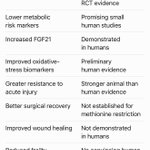
Human trials suggest benefits in metabolism, insulin and oxidative stress but evidence for improved surgical recovery that Jay Mitchell and colleagues showed in mice 🐁 remains inconclusive

Abstract and link to new review:
Methionine, a sulfur-containing essential amino acid, plays a pivotal role in epigenetic regulation through its involvement in one-carbon metabolism and as a precursor to S-adenosylmethionine (SAM), the universal methyl donor. This review explores how methionine availability dynamically influences DNA and histone methylation, non-coding RNA expression, and RNA modifications, ultimately shaping gene expression, cellular identity, and developmental outcomes. Emerging evidence suggests that balanced methionine intake is critical for maintaining epigenetic homeostasis. At the same time, both deficiency and excess can disrupt this equilibrium, contributing to diseases such as cancer, metabolic disorders, neurodevelopmental abnormalities, and cardiovascular dysfunction. Methionine deficiency is shown to impair DNA and histone methylation, alter non-coding RNA profiles, and compromise stem cell pluripotency and neurogenesis. Conversely, excess methionine can trigger aberrant hypermethylation, genomic instability, and metabolic imbalances, with links to oncogenic transformation and accelerated aging. Notably, methionine restriction (MR) enhances stress resilience, promotes healthy aging, and reduces tumor progression by reprogramming the epigenetic landscape. This review highlights methionine’s dualistic nature, both as a crucial epigenetic regulator and a potential contributor to disease when imbalanced. It also underscores the need for context-specific dietary strategies and further research into the intricate interplay between methionine metabolism, gene regulation, and long-term health outcomes. Understanding these molecular mechanisms may unlock novel nutritional and therapeutic approaches for disease prevention and epigenetic reprogramming.
tandfonline.com/doi/full/10.…

David Sinclair retweeted

Now live! The November issue of Lifespan Magazine 📕
100+ gorgeous pages of evidence-based insights, practical tips & breaking longevity news 🧬
lifespan.com/magazine

Aging clock tests. Are they worth it?
In the Nov issue of Lifespan Magazine. 100+ gorgeous pages of evidence-based insights, practical tips & breaking longevity news 😮
lifespan.com/blogs/magazine
