

Building @getoasisstudio
Bengaluru, India
Joined October 2020
- Tweets117
- Following418
- Followers75
- Likes1.3K










Deepanshu Pathak retweeted

Guys, this is very serious and you have to read this right now. The Riemann Hypothesis may have just been solved, and if the claim holds, it's an insane achievement.
In mathematics there is a famous problem called the Riemann Hypothesis, and it's about prime numbers. Primes are numbers like 2, 3, 5 and 7 that can only be divided by 1 and themselves. Every other number is built by multiplying them together, so they're the building blocks of all numbers. You can never tell exactly where the next prime will show up, but if you step back, there's a pattern.
Around 1,000, about 1 in 7 numbers is prime. Around a million, about 1 in 14. Around a billion, about 1 in 21. Primes get rarer at a steady, predictable pace.
Because of that pattern, mathematicians can estimate how many primes there are below any number. But the estimate is never exactly right. It's always a little off, and the big question is how far off it can get. Think of flipping a coin 1,000 times. You expect 500 heads, but you'll get something like 480 or 520. It's a little off, but never wildly, and you can predict how far off it will be.
In 1859 a mathematician named Bernhard Riemann found that the prime estimate's error isn't random. It's controlled by a hidden set of special numbers. Where those numbers sit decides how big the error gets. Riemann guessed that every single one of them sits on one straight line. If he's right, the error always stays small, just like the coin, and primes are as orderly as they could possibly be. If even one of those numbers is off the line, the error can grow much bigger, and primes are far messier than we think.
So far computers have found trillions of these special numbers, and every single one is on the line. But there are infinitely many, so checking will never be enough. You need a proof that covers all of them at once. For 167 years nobody has found one. It's one of the seven hardest unsolved problems in mathematics, with a million dollar prize attached.
Now a mathematician has posted a note saying that, working with Claude, he believes he has that proof. He says a computer has already checked every step, and that Claude raced ahead of him near the end. Experts still need to confirm it, but this isn't a random internet claim.
If it holds, it doesn't mean we can predict every prime. It means we finally know the pattern can never go wildly wrong. Thousands of math papers that begin "assuming the Riemann Hypothesis is true" become proven fact overnight. We'd also get firm limits on how far apart primes can be, and a guarantee that a fast method for testing whether a huge number is prime always works. And no, your bank account isn't in danger. Online security depends on how hard it is to break a huge number into its prime factors, and this proof doesn't make that any easier. If anything, it gives the math behind encryption a stronger foundation.
If it holds, this is bigger than one math problem. A question that beat the greatest minds in history for 167 years would have been cracked by a human and an AI in a matter of weeks. If AI can find answers and computers can check them, the limit on science is no longer how smart we are. It's how many good questions we can ask.

Had a great time at the quantum computing event at Quad AI today. Really enjoyed the session and the conversations!
@_Quantum_X_

1
84
We spend a lot of time measuring whether AI agents get the right answer.
But what about how they got there?
I wrote about agent evaluation, reliability, and why the final outcome doesn't tell the whole story.
medium.com/@deepanshupathak0…

1
3
90
This is amazing

We asked GPT-6 Astra to edit Qwen3.5-0.8B weights to improve math.
It directly changed only 0.016% of weights, fixing 0.8B's reasoning loops & improving math up to 6x and even instruction following 3x, without gradients or training.
We call this Weight-Space Programming: frontier LLMs can now natively read/write neural network weights! 🧵
Blog: rikiyat.github.io/blog/weigh…

Readers added context they thought people might want to know
LLM was given weights explicitly as text in prompt and used code/forward passes (per authors' logs) to ablate Qwen looping direction, a known thinking-mode issue per model card. Primarily fixed repetition in that mode, not general 'natively' improving weights/math.
rikiyat.github.io/blog/weight-sp…
github.com/RikiyaT/lm_und…
huggingface.co/Qwen/Qwen3.5-0…
huggingface.co/RikiyaT/Qwen3.…
2
111


okay so google launched genie 4, and its really interesting
not that long ago, generating a video from a prompt was impressive on its own. now AI can generate interactive worlds you can explore, modify in real time, with sound and character interactions too. pretty cool
3
134
Deepanshu Pathak retweeted

The largest math proof in human history is now computer-verified.
Today, Axiom announces a complete Lean auto-formalization of the Classification of Finite Simple Groups, the "periodic table of symmetry."
About 15,000 pages, built by over 100 mathematicians across generations.


i wish more apps understood that sometimes i just want to use the product. i don't need a daily streak, a reminder that i haven't opened it, a weekly summary and an email telling me what i missed.
1
74
why does every simple app eventually become a platform? you download something to solve one problem and six months later it's asking you to join a community, invite friends, subscribe to premium and turn on notifications.
2
90
started reaching out to people through cold emails instead of just waiting around. been a nice reminder that you don't always have to wait for opportunities to come to you.


2
109
it's kind of crazy that so much of the internet depends on open source projects maintained by people who might not even get paid for it. some random developer's weekend project can end up becoming a dependency for thousands of other projects.
2
88

cheap coding models are getting pretty good lately. minimax m3.1 flash and deepseek's new flash model both look interesting, especially for the price. it'll be interesting to see how they compare with claude and codex on everyday coding tasks.
57
if the coding quality is actually decent at this price, this could be really useful. gonna be interesting to try it out

MiniMax M3.1 Flash: Space Performance + Bunny Speed
🚀🐰 Yes, Space Bunny - which has topped global leaderboards with 200T+ tokens - was an earlier version of M3.1 Flash.
💰Redefining the performance economics of agentic AI. M3.1 Flash achieves frontier-level intelligence across key tasks such as Cowork (Automation-Bench: 62%; ALE: 30%), Coding (DeepSWE: 74%) and Visual Reasoning (BabyVision: 91%), at 1/3 the cost of M3 and 3x the speed.
API pricing (flat rate): $0.15 / $0.60 per 1M input/output tokens, with cache reads at $0.015 / 1M tokens.
Model weights will arrive on Oct 23.
API: platform.minimax.io
M Plan: minimax.io/m-plan
MiniMax Code for desktop: agent.minimax.io/download

1
36
From 2027, online stores in India must check themselves for dark patterns every year. So I built an agent that does the check. It walks through the checkout, records every fee and countdown timer, and flags what changed. Each finding has a screenshot. @Tiny_Fish @igniteroom

5
110
One thing i love about building in AI is how much of the work is public.
papers, model weights, inference engines, training code. you can go from reading an idea to running it yourself without waiting for a company to build a product around it.
incredible time to be an engineer.
2
58
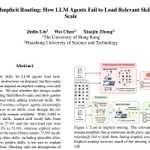
giving an agent more skills can actually make it worse at using them.
a new paper found that adding 1000 irrelevant skills dropped relevant-skill recall from 73.6% to 27.4%.
explicitly selecting skills kept it at 73.9%.
paper: arxiv.org/abs/2610.18522

2
74