






Since 2021, CIRES researchers have helped lead a new air quality monitoring program, which includes 12 sites across the U.S. They set up a suite of instruments that collect high-resolution air samples day and night. Read more: cires.colorado.edu/news/roof…
@JgrpBoulder @dougchem


66
Looking forward to sharing a few highlights on this work today at 10am at #AAAR2023
Work together with @jljcolorado @Pedro_CUBoulder @Benjamin_AtmChm and Donna Sueper (@ciresnews @cuboulder)

Come learn about our work on methods and software to quantify organic nitrates using AMS!
@DougChem will present this work at #aaar2023, @AmericanAerosol Annual Meeting tomorrow @ 10:00am in Portland in session: "1IM Instrumentation & Methods I: Chemical Instrumentation" Rm F150
Virtual Special Issue “Advances in Atmospheric Chemical and Physical Processes” Edited by J. Burkholder + J. Orlando out in @JPhysChem A.
Many insightful papers on chem kinetics, rxn mechs, hetero/interface proc, aqueous chem, aerosol proc, theoretical.
pubs.acs.org/doi/10.1021/acs…


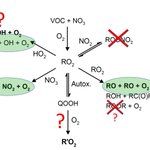
1/ Happy to share that our paper on yields & composition for monoterpenes + NO3 radical and RO2 fate is published.
TLDR for general public: trees emit monoterpenes (a reason forests smell good). Those react with oxidants and make particle pollution (haze)
pubs.acs.org/doi/10.1021/acs…

from a wide range of contributors, a few of which I could easily find here: @SallyNgGroup @CappaSnappa @TimothyHBertram @Andy_P_Ault @ManabuShiraiwa @SurrattGoldLab @MeganDWillis @dodehaan @NeilDonahue @H_Herrmann24 @amfankhauser ...
1
156
1/ Happy to share that our paper on yields & composition for monoterpenes + NO3 radical and RO2 fate is published.
TLDR for general public: trees emit monoterpenes (a reason forests smell good). Those react with oxidants and make particle pollution (haze)
pubs.acs.org/doi/10.1021/acs…

Looking forward to sharing a few highlights on this work today at 2pm at #aaar2022
Work by @julianefry @jljcolorado @jkrechmer @Pedro_CUBoulder @StevenSLBrown (& several others not on Twitter) @ciresnews @cuboulder
Come learn about our work on yields & composition for NO3 + monoterpenes with respect to RO2 fate!
@DougChem will present at #aaar2022, the @AmericanAerosol Annual Meeting tomorrow @ 2:00 pm in session "6AC Aerosol Chemistry V: Biogenic SOA" in Ballrm C
doi.org/10.1021/acs.jpca.2c0…
Looking forward to getting started on this field study!
This post is from an account that no longer exists. Learn more
5
1/ Happy to share that our paper on methods for measuring particle-phase nitrates in the atmosphere has been published.
TLDR: Application of these consistent methods shows pervasive trend of higher organic nitrates at lower concentrations.
amt.copernicus.org/articles/…

2/ In this study, we systematically re-evaluated methods for apportioning bulk aerosol organic (pRONO2) and non-refractory inorganic (NH4NO3) nitrates using real-time aerosol mass spectrometry (AMS from @AerodyneRes).

Info on CDPHE monitoring and general air quality -related recommendations just released by City of Louisville. louisvilleco.gov/Home/Compon…
Great resource on cleaning up the odors, air, and surfaces in your home after substantial smoke impact.

Here is information about the smells in your home after a fire and recommendations on how best to mitigate. From @ShellyMBoulder, @jdegouw, @ReidColleenE, @LeahAWasser, Bart Croes, & me - to help those who are now cleaning up after the #MarshallFire
tinyurl.com/fireairquality
1

Nice work on this analysis of indoor air sources and chemistry in a museum @DPrice_Sci! And thanks to everyone who contributed!

Our paper on the sources and fates of indoor volatile organic compounds was published in @ACSEarthSpace! Thank you coauthors for all of your hard work on this one. pubs.acs.org/doi/10.1021/acs… @DougChem @djpagonis @jljcolorado @ShellyMBoulder @GouwLab @SloanFoundation (1/9)

5
photos.app.goo.gl/v7fN7oZm9s…
Our doorcam happened to catch the fireball meteor just right, seen (and heard) across Colorado Sunday morning. Estimated as ~1 ton so possibly debris. Reportedly some folks woke up from the flash and looked outside to see what in the world was going on.
Congratulations @Benjamin_AtmChm et al. and well done on this analysis to further our understanding of sources and associated mortality of anthropogenic secondary organic aerosols - tapping into multiple field datasets across the N. Hemisphere, coupled with modeling.

Particulate matter (PM) contributes to haze and poor air quality, also leads to 3-4 million premature deaths / yr. To reduce deaths, we need to understand the sources of the PM. The work published today in @EGU_ACP investigated some of these sources: doi.org/10.5194/acp-21-11201… (1/n)

5
Congrats Dongwook!
Dongwook Kim @DKim_Chem, PhD student in the Jimenez group, won the AGU Paros Scholarship!! Congrats!

2
In a collaboration led by @erinkatz_ and @ProfPeteD we recently looked at conditions where the relative sensitivity of OA in the AMS for ambient aerosol might be different from the default assumption: (1/4)
Nice work by @erinkatz_ et al. quantifying and characterizing cooking aerosol using AMS in indoor environments.

Quantification of Cooking Organic Aerosol in the Indoor Environment Using Aerodyne Aerosol Mass Spectrometers by @erinkatz_ is out. A detailed, multi-instrument quantification effort to understand the composition of cooking emissions during #HOMEChem tandfonline.com/doi/abs/10.1…
2
Well done @HongyuGuo_ on this rigorous comparison and characterization analysis of aerosol volume measurements collected during the NASA ATom campaign!
Our paper on the submicron volume closure during the @nasaearth #ATom aircraft study is finally out. amt.copernicus.org/articles/… @HongyuGuo_ @Pedro_CUBoulder @Benjamin_AtmChm @DougChem @jljcolorado @DKim_Chem @NASAairborne @ciresnews #AtmosChem @blefer

1
A brief summary from @Benjamin_AtmChm on his paper just out on observations, modeling, and implications of aerosol acidity across the globe.
I am happy to announce that my paper, looking at how acidic particulate matter becomes as the air moves from polluted areas to the most pristine (middle of Pacific and Atlantic), has been published today: nature.com/articles/s43247-0… 1/n
