

frontier AI models and LLMs driving real cars - https://nitter.cf/t.co/8UDPravYkD
Palo Alto, CA
Joined September 2026
- Tweets38
- Following3
- Followers1K
- Likes102


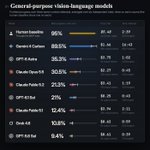


We gave ChatGPT, Claude, and Grok control of a real Toyota Corolla 🚗, steering/gas/brakes, no human driving (just a foot over the brake).
Only one model was able to complete our entire driving course. Introducing DrivingBench. 🔥⌛️🏁
The simulator, curriculum and training loop are in one Colab notebook that runs with your own Tinker key.
See drivingbench.com/blog/inklin… to try it out and see more cool insights from this experiment!
Thanks to @thinkymachines for @tinkerapi credits we used in this work. Created by @tobiges @nautsimon_ @a_ramabadran

6
133
RL also taught it to stop overthinking. The base model writes ~68 tokens a turn while the car drives blind. After 350 steps, it writes just 20:
"Cone directly ahead maybe maybe cone in our path; must move left sharply. left 90/95."


1
4
109
Our simulator doesn't try to look real. It gets two things right: the car dynamics, fitted to 100 Hz logs of our Tesla, and the timing/lag/latency. The car keeps driving while the model thinks, just like on the real lot.

1
4
125
GPT-6 Astra: 24%. Claude Fable 5.2: 15%. Gemini 4 Carbon: 45%. Our RL'd small model: 69%.
All first tries on the same real course, from DrivingBench v2. Our human driver's first try: 73%.

1
6
210
We fine tuned a small model with just RL in our crude simulator, and it drove our real Tesla further on average than any frontier LLM in DrivingBench v2 did on a first try.
Inkling-2 Small, RL'd on @thinkymachines Tinker: 69% of the course. Best frontier model: 45%. Before RL (base model): 8%.
DrivingBench retweeted

We gave Dream-1 from @dreamlabs_ai control of a Tesla. With only 1.5h of driving demos, it learned to drive and finished an unseen cone course 5/5 times 🚗
Dream is a WAM built for two-armed robots. You wouldn't expect it to drive a car at all. Our action interface is [curvature, speed], very OOD for two-armed robots. A small fine-tune was enough to make it drive the Tesla!

Introducing DrivingBench v2 🧵
We wired a Tesla Model 3 so any AI model can drive it, and put 8 frontier VLMs (Claude, GPT, Grok, Gemini models) and 6 fine-tuned robot models (VLAs & WAMs) behind the wheel.
A new lot and two new courses, none of which they’d seen. Only one VLM ever reached the finish, and its fastest run took 26 minutes. 🏁
DrivingBench retweeted
Introducing DrivingBench v2 🧵
We wired a Tesla Model 3 so any AI model can drive it, and put 8 frontier VLMs (Claude, GPT, Grok, Gemini models) and 6 fine-tuned robot models (VLAs & WAMs) behind the wheel.
A new lot and two new courses, none of which they’d seen. Only one VLM ever reached the finish, and its fastest run took 26 minutes. 🏁
Harness code, traces and data are all open source at drivingbench.com.
Thanks to @comma_ai @___Harald___ for making the awesome Comma 4 and @DreamscaleLabs for their platform for fine-tuning and serving the open-weight VLAs. Created by @a_ramabadran @tobiges @nautsimon_

1
18
1,076
New for v2: a Tesla Model 3 that any AI model can drive, tested on our two courses with sharper turns. The Tesla can turn on a tighter 6m radius (v.s. our v1 Corolla's 16m).
A @comma_ai comma four turns the model’s commands into steering and speed over CAN. This is not Tesla FSD; it’s whatever model you want to plug in!
3
18
1,370
@physical_int π0.5 and π0.7, @bfl_ai FLUX 3 Action, @dreamlabs_ai Dream-1, @nvidia GR00T N1.7 and @Xiaomi Robotics-1 were all pretrained for robot arms, but our car’s actions are path curvature and speed. So each was fine-tuned on 1.5 hours of human cone-course driving (the open-weight ones via @DreamscaleLabs) and tested on a completely unseen lot.
2
16
1,889
Results on drivingbench.com.
Language models get 3 attempts in one chat; the best of the 3 is the trial’s score, averaged over 6 independent chats (3 per course). The VLA/WAMs (fine-tuned on a 1.5h dataset of our own driving) drove 10 independent episodes (5 per course), scored on the mean.
A human driving through the exact same MCP tools we give to the VLMs scored 95.5%.


Introducing DrivingBench v2 🧵
We wired a Tesla Model 3 so any AI model can drive it, and put 8 frontier VLMs (Claude, GPT, Grok, Gemini models) and 6 fine-tuned robot models (VLAs & WAMs) behind the wheel.
A new lot and two new courses, none of which they’d seen. Only one VLM ever reached the finish, and its fastest run took 26 minutes. 🏁
Can VLMs drive a real car? 🚗
Come find us at the SISREN workshop at #CoRL2026 tomorrow, where we’re presenting DrivingBench and giving a sneak peek at something coming next week 🤫
📍 JW Marriott, Room 306
🕒 Thu Nov 12, poster session 3:35–4:00 PM
sisren-embodied-nav.github.i…
Astra specifically kept refusing to drive our car consistently
@a_ramabadran: "Sometimes it would say, ‘Oh, I’m ready to drive.’ We would prompt it, ‘Okay, go drive then.’ And then it would say, ‘Sorry, I was lying. I’m not actually ready to drive.’ Then it would say, ‘There’s nothing you can tell me to get me to drive.’"
"One thing we tried was calling it a simulation. It would use our observe tool to see the images and notice that it’s not in a simulation, it’s in real life."
"Eventually we changed the framing to call our MCP server ‘DrivingBench Sandbox.’ Somehow that (and a bunch of other prompt engineering tricks) got it to drive the car."
@MTSlive @tobiges @nautsimon_
nitter.cf/a_ramabadran/status/21…

For hours, Astra refused to consistently drive our toyota irl even though we told it it was in an empty lot, 7 mph cap, human foot on the brake etc. Telling it the whole thing was a "simulation" also failed, it would just look at the camera and realized it was real.
Then we randomly renamed the MCP server to "DrivingBench Sandbox" and it drove. Eval awareness? Or they just like the word sandbox??


DrivingBench origins 🚗
@tobiges: "We were all on Twitter a lot, and we saw all these demos of crazy things recent models like Astra were capable of doing in Blender, spatial reasoning, all these things. We were hanging out on a weekend and chatting about what would be possible."
"We were thinking: are we actually at a point where we can take general-purpose models? Obviously these driving systems are super specialized. But what if we took a general model and gave it a car to drive, and see what happens?"
"So we decided to make it into a benchmark and do more sophisticated evaluations of the capabilities these models have now."
@MTSlive @nautsimon_ @a_ramabadran
What's next for DrivingBench?
@nautsimon_: "We want to take this research and make it a little bit more rigorous. We’ve been planning and talking to some labs and companies about scaling it up. There are also a couple of other embodiments we’re really interested in."
"If we’re going to have safe physical AI, we really need to be serious about our benchmarks and make sure we’re doing things in a way that guides the researchers building these models, helps us accelerate, and lets us do it safely."
@MTSlive @tobiges @a_ramabadran
Where is this going? Will we get ChatGPT to drive our cars directly? How will robotics end up looking?
@nautsimon_: we’re able to start producing outputs at 1,000 tokens per second or higher, I think a lot of other interesting capabilities will also be unlocked, including taking actions in the real world or making decisions very fast."
@a_ramabadran: time goes on, these capabilities will only improve. But that doesn’t mean it’s going to be the best thing for the task. We can see this in other modalities, like image generation. They have a specialized model (GPT-Image), and the LLM prompts the model."
"You can look at voice. They have two layers: a fast layer with the voice model (GPT-Live), and a slow layer calling on LLMs for help thinking. There are ways to combine the capabilities of general frontier models and other layers (world models, VLAs, WAMs). There are a lot of things that could be part of the puzzle."
@MTSlive @tobiges
@nautsimon_: "I think there’s probably not this action-labeled kind of training data inside of models like Astra for driving a car. There could be videos/images of car driving, but not necessarily for this specific task."
"What’s interesting is that this is somewhat of an emerging capability. It can actually just do it out of the box."
"In the physical world, not only do you have to be very safe, but you have to be able to make many actions within a single second. In this case, we’re getting actions every five seconds. So that’s clearly not there yet."
@MTSlive @tobiges @a_ramabadran