





👇guys mght be gr8 at 🇺🇸 equities, but r not clued into EM. Smart 💰 received TRY and earns more carry than the controlled depreciation takes out. authorities learnt from the wobble in Feb 25 and kept the implicit contract with sufficient FX reserves. Economy is mostly dollarised


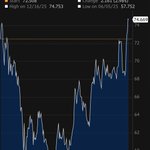
BREAKING: The lira just hit another record low. It's lost more than 99% of its value against the dollar since 2005.
Turkey's 10 year bond is at 32%.
It’s not looking good…

1
3
422
By construction you hit a new record low in FX often, it’s realising relative inflation betw the countries in real time! At least until disinflation in 🇹🇷 accelerates, or 🇺🇸 loses control 😂. Can TRY 🌀 out of control? Sure, it did in 2018 and 2022. Old Finmin brought back in 23.
1
51
The contra
nitter.cf/gbrew24/status/2091177…

“would represent… restoration … close to the 20 million barrels … moved… before war.. raise an important question about Iran’s capabilities…if large numbers of tankers… moving … Iran unwilling or unable to disrupt”
Combo of US protection and GCC side deals with Iran ? 🤔
273
“would represent… restoration … close to the 20 million barrels … moved… before war.. raise an important question about Iran’s capabilities…if large numbers of tankers… moving … Iran unwilling or unable to disrupt”
Combo of US protection and GCC side deals with Iran ? 🤔

There are essentially two ways to interpret the administration’s claims about the volume of oil now moving through the Strait of Hormuz.
The first is that Washington is significantly overstating the numbers in an effort to calm energy markets, push oil prices down, and demonstrate that the United States has established meaningful control over the Strait. Yet, independent maritime trackers have generally reported substantially lower volumes in the past days.
If the administration’s figures are inflated, the discrepancy will eventually become apparent in the physical oil market. Washington can influence expectations and prices in the short term, but it cannot manufacture millions of barrels of supply that never actually reach the global market.
The second possibility is far more consequential: the numbers are broadly accurate, and the United States has succeeded in creating a protected southern corridor that Iran has so far been unable to shut down, and it would represent a significant restoration of traffic, close to the 20 million barrels per day that moved through Hormuz before the war.
That would raise an important question about Iran’s capabilities. Tehran has continued attacking commercial shipping, but if large numbers of tankers are successfully moving through the U.S.-protected corridor, Iran has either been unwilling or unable to disrupt those particular movements on a significant scale.
But this should not necessarily be interpreted as a permanent American victory in Hormuz.
If the U.S. figures are accurate, they may actually increase the likelihood that Iran will search for different ways to disrupt the corridor and demonstrate that Washington cannot normalize maritime traffic while maintaining its broader pressure campaign against Tehran.
The real strategic question, therefore, is not whether the Fifth Fleet can protect a substantial number of tankers for several weeks, It is whether the United States can sustain this level of maritime protection indefinitel, and at what military, economic, and escalation cost.
#IranWar

🤔 Hard to see Trump resign, but everyone’s entitled to their opinion 🤷♂️
Eh? Oh, he meant Iran? 🤣 Well, if you don’t mind everyone dropping nukes on each other then possible 🫨

216
He wasn’t targeting the New York Post 🤣 ? Glad we cleared that up 😅

US Acting Attorney General Todd Blanche says he believes that the alleged White House Correspondents’ Dinner shooter was targeting Trump administration officials.
english.alarabiya.net/News/u…

153
EM Fin retweeted

#Iraq may be the single biggest economic casualty of the Hormuz crisis.
While Arab Gulf producers can reroute some exports (#SaudiArabia, #UAE), rely on storage and deep pockets (#Kuwait, #Qatar), Iraq’s oil system was built around one reality: Basra exports through the Strait of Hormuz.
And those exports are now gone. Iraqis have their political elite to blame. 🧵
(1) Before the war, Iraq produced ~4.4mn b/d and exported about 3.4mn b/d from its southern terminals.
When shipping through Hormuz stopped, Iraqi exports collapsed within 2–3 days, according to a video statement by the oil minister on Sunday.
He said, Iraq today is producing only ~1.5–1.6mn b/d, mostly to run refineries and power plants. My assessment is even lower ~1.2mn b/d.
(2) In other words: Iraq has shut in roughly 3mn b/d of production.
That is not just a supply shock for the market.
It is a fiscal shock for Iraq itself.
Oil revenues account for ~90% of government income.
(3) Baghdad is now scrambling for alternatives.
The only serious route left is the Kirkuk–Turkey pipeline to Ceyhan, which runs through the semi-autonomous Kurdistan Region.
Baghdad says it could quickly export ~300k b/d from federal fields, plus ~200k b/d from Kurdish fields.
But the pipeline is idle.
(4) Enter now the political crisis.
Baghdad says the KRG refused to restart exports, accusing Erbil of attaching to the negotiations conditions unrelated to oil.
The Kurdish government fired back hours later.
This is a two-decade old dispute. Their response is extraordinary.
(5) The KRG says exports cannot resume because:
• oil production in Kurdistan has halted after militia attacks on energy fields
• Baghdad imposed a “suffocating economic blockade” on Erbil
• the same militias attacking Kurdish energy infrastructure are funded and armed from Baghdad
(6) This is not a logistics dispute.
It is a full political breakdown between Baghdad and Erbil in the middle of the worst energy crisis Iraq has faced in decades.
And all of this is unfolding while Iran-aligned militias are launching drones and missiles across Iraqi territory, including inside Kurdistan.
(7) So the situation today is unprecedented:
• Iraq cannot export its oil from the south because of Iran
• the northern export route is politically blocked
• production is being shut down across major fields
• Iran-aligned militias are attacking energy infrastructure inside the country
(8 The irony is brutal and Baghdad might’ve overplayed its hand in previous months dragging its feet to re-open the Ceyhan pipeline, while delaying budgetary allocations to the KRG and salary payments to civil servants.
Iraq is paying the economic cost of a war it did not start and cannot control, while armed factions inside the country have dragged it into.
(9) If exports remain halted, Iraq will face a simple reality:
A state whose budget depends almost entirely on oil… without oil revenue.
This is a recipe for serious internal upheaval.
#oott


US needs to fix its rare earths and critical materials supply chain before any sanctioning of China can be contemplated.
98
EM Fin retweeted

Sharpe of FX carry in 2025
Turkey wins. Ignore RUB you can't trade it.
The central bank handing out free money to specs.

Yep, 🇺🇦 bonds coming off, with the EU EUR 140bn Loan financed by frozen 🇷🇺 assets in Euroclear also no longer on the agenda. Could be another bad crash before we start the next up-move as there has to be a resolution (in some shape) by early Q2 as 🇺🇦 run out of 💶 by then.

⬇️ 🇷🇺 asset financed loan off the table per Orban

A victory for the @PatriotsEU: the Brusselians backed down, Russian assets will not be on the table at tomorrow’s #EUCO. The Commission now pushes joint loans, but we will not let our families foot the bill for Ukraine’s war. Not on our watch.
83
Excellent analysis of the move to send frozen 🇷🇺 assets to 🇺🇦 in the form of a loan that is not expected to be re-paid and instead written off entirely ‘when the war ends with Russia paying reparations to Ukraine’ but where Euroclear could still be legally liable to return the 💶

#RadioMoskva
The EU’s Reparation Loan vote needs to fail
The EU’s vote on the Reparation Loan needs to fail. If it passes it will kill off any chance of a peace deal being signed. The US version of the plan is well advanced and special envoy to Ukraine retired Lieutenant General Keith Kellogg said last week that only points remain to be agreed. The EU versions of the plan are a non-starter and the proposed €210bn loan member states are due to vote on in the coming week has a continuation of the war built into the heart of it.
The EU is not trying to bring the war to an end. The various EU backed plans like the24-point peace plan (24PPP) proposed by European Commission President Ursula von der Leyen, theEuropean Parliament non-binding resolution (EPR) on November 27 and the latestE3-Ukraine 20-point peace deal on December 11 are all packed with red-line issues the Kremlin dismisses out of hand. Russian President Vladimir Putin has been accused of sticking to a maximalist position; the same can be said of the European Commission (EC).
Moreover, the Reparation Loan is illegal and will bring down a rain of lawsuits by Russia that it is likely to win. The US proposal to use $100bn of the frozen funds to set up a US-Ukraine investment fund is legal and more importantly, Putin has indicated he will agree to it handing Ukraine real reparation money.
US President Donald Trump is concretely talking about signing a peace deal by Christmas, including real Article 5-like security guarantees and $100bn of reparations that will be spent on rebuilding Ukraine as there will be peace.
European Commission President Ursula von der Leyen is talking vaguely about funding Ukraine’s continued military operations until such time as it is in “the strongest possible position” for undated negotiations. The money will not be spent on rebuilding Ukraine but funding more fighting, plus a €45bn payment to EU members for money they spent last year.
The US scheme is completely legal, and the Kremlin has strongly signalled that it agrees with most of the points on the list already. The EU scheme is illegal, and the Kremlin has rejected most of its points already. Indeed, the EU has been completely locked out of the current negotiations completely by both the US and the Kremlin.
As Zelenskiy himself said, he has a very difficult choice between keeping his dignity or losing a key partner.
War war rhetoric
The US and EU are now in open confrontation over who controls the frozen funds. But this shouldn’t be a squabble over who controls the cash, but how to spend it.
Does it really matter if the EU makes its €210bn “loan” (which will never be repaid as that is contingent on Russia agreeing to pay reparations, which will never happen unless it loses the war) or if the US runs a $100bn fund?
In both schemes not all the money goes to Ukraine anyway. The US will take half the returns from the US-Ukraine fund as payment. In the Reparation Loan the EU will take €45bn for itself to repay theG7 $50bn loan to Ukraine, approved on June 13 at a G7 summit in Italy last year.
And another glaring difference between them is that the US-Ukraine fund assumes that a peace deal is agreed, and all the money is dedicated to investment and reconstruction of Ukraine.
The EU Reparation Loan assumes that the war is not stopped, and a large amount of money doesn’t go into reconstruction, but into perpetuating the war. According to the draft, out of the €210bn in aid, €115bn is planned to support Ukraine's defence industry over five years and only €50bn is to cover budgetary needs. In effect none of the EU’s €210bn loan is dedicated to reconstruction unless the war miraculously stops on its own. Ukraine is projected to face a budget shortfall exceeding $79.8bn next year, if the war continues.
On the other hand, all of the $100bn US fund – which is not even a loan that needs to be repaid – goes on reconstruction on vital needs like fixing the energy infrastructure that will also bring a boost to economic activity.
Things like repairing real estate objects will have to be done by the private sector and the development banks, but that is already happening to a limited extent. International defence companies have become the primary driver of demand in Ukraine's office real estate market in 2025, replacing the IT sector, according to UTG real estate market analysis. And housing prices in the quieter cities have doubled on the back of high demand.
In the US scenario the massive $80bn budget deficit drops away following the end of hostilities and budget funding goes back to normal. The structure of the EU’s Reparation Loan spending structure has an assumption that the war continues built into it. At least the US only gets paid if it makes some profits for Ukraine from its investments.
Enemy at the gate
The rhetoric from the two camps is also very different. Trump is in a rush to end the killing, as he explicitly laid out in the new National Security Strategy (NSS) released last week. He has also downgraded Russia from “rival” to “Europe’s problem.”
Von der Leyen has repeatedly made the argument that the Reparation Loan will “significantly strengthen Ukraine’s hand.” The argument runs that by funding Ukraine, it will raise the cost to the Kremlin and show Europe can outlast Russia, “significantly strengthening” Zelenskiy’s bargaining position in “future” negotiations as Putin will see that Ukraine has the resources to continue defending itself for “at least another two years.”
Given Russia is making the fastest gains on the battlefield since the war started in 2022 and has taken an additional 500 square kilometres, this argument seems spurious at best and naïve at worst.
Nato Chief Mark Rutte has been even more jingoistic, urging EU member countries to do more to “prepare for the possibility of large-scale war” and warning that Russia may be ready to attack the alliance “within five years.”
"We are Russia's next target. And we are already in harm's way," Rutte said on December 11 during a speech in Berlin. "Russia has brought war back to Europe, and we must be prepared for the scale of war our grandparents and great grandparents endured."
This is little more than scaremongering to rally support for schemes like the Reparation Loan. Putindismissed claims that Moscow intends to invade another country as a “lie” and “complete nonsense” during a press conference in Bishkek on November 28. He also said he was prepared to sign a treaty to that effect with Europe at any time.
“The truth is, we never intended to do that. But if they want to hear it from us, well, then we’ll document it. No question,” the Russian president told reporters.
If Nato is serious about the looming Russian invasion, then why would it not take Putin up on his offer? At the very worst it will seriously embarrass Putin should he tear the treaty up and gift the moral high ground to the allies.
“[Europe] is on the side of war,” Putin said, adding that, "If Europe suddenly wants to start a war with us and starts it," Putin said, then it “would end so swiftly for Europe that Russia would have no one left to negotiate with.”
Funding the rebuild
The US plan does not address supporting Ukraine’s budgetary short fall, but as it assumes peace, presumably those budgetary needs will be reduced dramatically and can be funded by borrowing and tax burgeoning revenues in a post-war bounce.
The new IMF Extended Fund Facility (EFF) programme is for $8bn a year; pre-war after deductions for fines for failing to meet reform goals and other arguments, between 2017 and 2021 Ukraine received a grand total of a mere $5.2bn from the IMF. In 2019, Ukraine didn’t receive anything at all.
Access to the international capital markets will reopen and the local bond market has already been hooked up to the international financial system via Clearstream, giving the government a second significant source of access to foreign funds; international investors love the high-yielding short-term local debt, the appeal of which should be increased by a post-war recovery boom.
The World Bank has estimated the total cost of the damage done to Ukraine is $526bn (including indirect damage and economic losses), but as bne IntelliNews reported, the worst damage has been done in the east of the country in regions that will remain under Russian control. The Kremlin, not Bankova, will be responsible for paying for those repairs.
The damage done to the western parts of Ukraine that remain under Kyiv’s control is much less significant and will cost, making a back of the envelope estimate, around $200bn.
From this perspective, the US-Ukraine $100bn will go a very long way to meeting Ukraine’s reconstruction needs. Add to that the IMF money and the other International Financial Institutions (IFIs) assistance from the likes of the International Finance Corporation, European Bank for Reconstruction and Development (EBRD) and European Investment Bank (EIB), and the total IFI contribution is expected to be $75bn, according to Peterson Institute for International Economics (PIIE).
On top of that, the Trump administration has begun a conversation with Blackrock to restart the paused Ukrainereconstruction fund that could bring in between $400bn and $800bn, according to various reports. How realistic these numbers remain to be seen.
From an investor’s point of view there are two scenarios.
In the American scenario they arrive at Boryspil International Airport in a country where a clean negotiated end to the war has been signed, including “strong” security guarantees have been signed, backed with the promise of US military intervention should Russia reinvade. There is also an accelerated path to EU membership as soon as 2027, which since 1991 has been by far the most effective reform strategy any country could adopt. It creates an extremely attractive, but albeit not perfect, investment climate.
In the European scenario they arrive in a messy end that has probably been determined by Ukraine’s military capitulation or at least a perpetual war. No agreement with Russia has been signed leaving a sword of a Damocles’ threat of Russia’s reinvasion hanging over the country fr generations. Ukraine’s EU accession bid is still on the cards but the earliest it can happen in 2030, and even that is unsure. (Ask Turkey and all the Balkan candidates.)
This not an investment environment they will invest into, irrespective of how attractive the Ukraine investment story is. That leaves the reconstruction to be entirely reliant on the, still not insignificant, $75bn of IFI money.
If Europe goes on its own and takes full responsibility – both financially and militarily – for supporting Ukraine there is no scenario where it can force Russia to the negotiating table with better terms than are currently on the table, barring a very unlikely Russian economic collapse, as detailed in bne IntelliNews’ side-by-side comparison of the Ukrainian and Russian budgets.
As bne IntelliNews has reported,Europe can’t afford to take over the burden of supporting Ukraine, asmost EU countries are either in recession or approaching a crisis.
Moreover, Europe is also unable to provide Ukraine with the weapons it needs as after ignoring thedefence sector procurement contracts needed to upgrade Europe’s military it doesn’t have the production capacity. The mootedReArm defence sector modernisation plan has not started even its most powerful missiles that could change the game – the Franco-British Storm Shadow and GermanTaurus – are actually all out of production. As bne IntelliNewsreported,Europe will not be able to match Russia on the battlefield for at least five years, and it has alreadyfailed to offset the end of US military aid this year.
Long-term consequences
The Reparation Loan vote is unlikely to succeed as the opposition to the idea is building steadily. Belgium’s Prime Minister Bart De Wever has been the biggest problem as he refuses to release the money unless the whole of the EU bears the risks with his country. At the moment if Russia wins a lawsuit against Euroclear, where the money is held, Belgium would be on the hook to repay the entire amount.
The rest of the EU has been pressuring Wever to support the loan but has refused to offer the necessary guarantees. If anything, Wever has hardened his line in the last week due to this reticence calling the loan “theft.”
"This is money from a country with which we are not at war. It would be like walking into the embassy, taking out all the furniture, and selling it," he said.
Hungarian Prime Minister Viktor Orban and Slovak Prime Minister Robert Fico have both long been opposed to the idea of the loan, but they have since been joined by the recently appointed Prime Minister of Czechia Andrej Babis. And other far right leaders in the EU area lso against it. Over the weekend Italy’s Prime Minister Giorgia Meloni added Italy to the list along with Malta and Cyprus – both of which have business ties to Russia.
The issue of the Reparation Loan is only deepening a growing rift between the E3 (France, Britain and Germany) and theNordic supporters of Ukraine and the rest of the EU to the west and south which are more indifferent to Ukraine’s fate.
Both the International Monetary Fund (IMF) and the European Central Bank (ECB) have condemned the idea, saying countries need to respect international law.
And last week the Financial Times reportedthat British banks are opposing the proposal to transfer £8bn ($10.6bn) of frozen Russian assets to Ukraine. According to the FT, the banks fear the UK government will not protect them from potential damage if Russia takes them to court. In the short-term, a blizzard of Russian lawsuits are a given against governments and commercial banks. Which banks in the UK hold sovereign Russian assets is a closely held secret.
“The legal risk is that if Ukraine doesn’t pay back you need to repossess an asset that the government says is yours, but Russia says isn’t,” an adviser to major lenders told the FT.
The Kremlin will also retaliate by seizing Western assets stuck in Russia estimated to be worth approximately $288bn, according to Russian Finance Minister Anton Siluanov. Unlike the CBR money, these are privately-owned assets belonging to companies, banks, and individuals from the EU, G7, and allied countries that imposed sanctions on Russia following the full-scale invasion of Ukraine in 2022.
“We have about $288bn of Western assets immobilised or effectively frozen in our jurisdiction. Any hostile actions with our reserves abroad will receive a mirrored response,” Siluanov said earlier. Major Western companies like BP, Shell, UniCredit, Raiffeisen Bank, Carlsberg, and Danone are exposed with billions in assets still on Russian soil.
In the medium-term the cost of borrowing for Europe will rise notably. The leading economies of Germany, France and the UK have already lost their triple AAA ratings from the leading rating agencies, but the whole of Europe will be downgraded as a result of the Reparation Loan.
All three countries used to be AAA rated, but they have all lost this status since 2012. Germany is the best of the bunch, but S&P Global Ratings downgraded Germany from AAA to AA+ in October 2023. France has lost its triple-A rating from all three of the big agencies and now has an AA rating by S&P as its best result. And the same has happened with the UK, including a paltry Aa3 from Moody’s – the lowest grade in the top tier.
Given that in addition to the €800bn over four years needed to modernise Europe’s military, it needs to spend €800bn a year to modernise its economy to remain competitive with both the US and China, according to last year’s Draghi report, this not a good time to be making borrowing more expensive.
But the worst damage could come from a massive outflow of reserves of other countries, or deposits held in private banks. The euro will also suffer as trust in the currency will be undermined at a time when it is vying in de-dollarisation as the currency of choice for reserves and global trade.
No one knows how bad it could get, but as the vote looms, those questions are coming up now. Germany’s leading newspaper, Frankfurter Allgemeiner Zeitung (FAZ), slammed German Chancellor Friedrich Merz in aneditorial on December 10, saying: “Since at least the beginning of October, [Merz] has repeatedly championed the reparations bond without truly addressing the associated risks. He has neither substantively commented on the potential impact on the federal budget nor on the objections raised by the Belgian government and Euroclear."
Earlier European bankers called on EU governments to indemnify them against liquidity problems if there is an exodus from European banks. Belgian depository Euroclear could immediately lose €16bn in client assets in Russia if Moscow responds to the seizure of its frozen funds, Guillaume Elie, the depository's chief financial risk officer, said in an interview with AFP last week.
And the liquidity crunch could get very bad indeed. But even if there is no banking crisis, the reputational damage will hurt important financial centres like London permanently.
open.substack.com/pub/bneedi…

With the plan to use frozen Russian assets as collateral stuck due to Belgium not receiving strong enough guarantees from other member states to cover for the contingency a court awards Euroclear/ 🇧🇪 to repay the frozen assets to 🇷🇺, this will have to come from joint EU borrowing

EU to provide Ukraine with €90 billion to cover two-thirds of its financial needs for 2026 and 2027.
“We propose to cover two-thirds of Ukraine’s financial needs for the next two years — that’s €90 billion. The rest should be covered by international partners,” Ursula von der Leyen announced.
She added that the funds will primarily go toward direct budget support, building on existing successful instruments: macroeconomic financial assistance and the Ukraine Facility.

1
185
No, not suddenly - they have been expressing their concern for months, but were just not listened to.

So now Belgium suddenly considers using frozen Russian assets at the Belgian institution Euroclear to secure a €140 billion reparations loan for Ukraine to be "the worst option"
"We have a disappointing feeling that we have not been heard.
Our concerns are being downplayed. The texts that the Commission will present today do not address our concerns in a satisfactory manner.
It is unacceptable to use this money and leave us alone with the risks.
The proposed reparations loan is clearly not our preferred choice.
We do not seek to provoke our partners or Ukraine.
We simply want to avoid potentially catastrophic consequences for a member state that is being asked to show solidarity without receiving the same solidarity in return"
(Maxime Prevot,Minister of Foreign Affairs,Belgium)
1
1
109
Herr Merz, the Belgians have been saying this for months already. A lot of time could have been saved if “dissenters” were actually listened to instead of assuming you can slap them down in the end.

Germany’s Merz says frozen Russian assets for Ukraine must be a shared EU risk — and Belgium cannot be left carrying the burden alone — Reuters.
Merz writes in FAZ that EU states must incur an equal share of the risk, as a function of their respective economic performance. 1/

71