

Professor of Law, Santa Clara Law, https://nitter.cf/t.co/smRmbUETs1, author of Creators Take Control (Harper Business). AI, tech, law, finance, governance.
Joined December 2012
- Tweets8.1K
- Following5.6K
- Followers1.8K
- Likes13.1K





Edward Lee retweeted

Last night's datacenter moratorium/restrictions appear to have gone 43 - 1, with a massive swell of public support averaging 77% to shut it all down. Public sentiment on on AI in America has been going steadily downhill for three years. It is once again at a new low.


Edward Lee retweeted

Gibson, Dunn & Crutcher is in talks to bring on around 120 lawyers from Weil, Gotshal & Manges in the United States and London, in what would be the largest group hire since Weil's leadership recommended dissolving the firm last week. reuters.com/legal/legalindus…

Edward Lee retweeted

More bad news for Google:
“Right now, the best models are capturing the lion’s share of enterprise,” said Deedy Das, Partner at Menlo Ventures. “Our data shows that frontier labs capture nearly seven of every ten dollars spent on enterprise AI, up from half last year. Anthropic grew its share of enterprise API spending from 40% to 55%, while Google fell from 21% to 9%. That’s how quickly the competitive landscape can change."
Edward Lee retweeted

Joe Mazulla says he uses AI everyday to help coach his team
“I use Claude everyday for coaching thoughts. I love Claude. I’m all in on Claude. It was beneficial in the offseason for my personal development and where I wanted to take things psychologically for our team.”
“I’ll throw in last year’s practice plan and be like, was this efficient? Because you don’t know in the present moment if it was an efficient practice plan or if it was an efficient use of your time. If you throw in, here’s our halftime process, how can our halftime process become more efficient? We watch film sometimes and it’s a reactive film session because we’re watching film of plays that already happened, not of plays that may happen.”
Radio Host: “But it is going to kill all of us, you do know that? It’s coming for all of us.”
“Something is coming for all of us. I just went to confession Monday so I’m in good shape.”
“I think it’s more just helping organize, helping become more efficient, helping understanding. I use it a lot just for conversation and riffs on, ‘Okay, here’s what I’m wrestling with. What does this look like from a psychological perspective? What is the research and the data?’ You can quickly get so much research and data on things. Are you verbalizing things? Can they be verbalized in a much more efficient way?”
“Like I talked about with practice planning, it really helps you test your processes that you think are efficient. Is our halftime process really the most efficient way to watch film getting ready for the second half? Is our pregame process the most efficient way to make sure our guys have retention of the game plan, understand what we need to do, and are in the right space mentally and psychologically?”
“As a coach, you develop these processes and rituals that you think give you the best chance to win. I think a platform like that tests your efficiency. Is this really the best way? How we watch film on a practice day, is the way we watch film, the template of each clip, the best opportunity to build retention and understanding? What does it look like to have the most efficient film session you can? What type of questions are you asking when you’re going through film? Do I ask the right questions to check for understanding and build retention?”
“I think it just really tests your processes. You may think you’re doing something the right way, but there’s definitely a more scientific or more efficient way of going about how to do things, and I think that gives us a platform that allows you to do it. Really, it was over the last year or so. Every offseason, and really this offseason, it was like, ‘Okay, let’s test all of our processes. Is our pregame film process the right way? Is our halftime film process the right way? Is our film room set up for learning the right way? How should our film room look?’”
“You’re constantly testing. You always ask, ‘Where are we getting better?’ I think the best way for coaches to get better is in the processes of how they go about doing stuff. Are they the most efficient way? It also helped with combining sports. I’ve always talked about soccer being a passion of mine to watch, and I got into a little bit of handball this year. So I was able to say, ‘Tell me the similarities between soccer, handball and basketball. What elements of play are involved in all three of those things, and how can that work in a five-on-five setting?’”
“To me, it tests your process. It tests your efficiency. It tests what you think you may know and how you can do it better.”
Edward Lee retweeted

Every time Claude answers, it now quietly asks itself whether it just helped someone cause harm, and that private verdict goes to Anthropic’s reviewers.
Anthropic’s most accurate misuse detector is a Claude Mythos Preview classifier that reads all its safety policies before every ruling, which makes it too expensive to run on every chat.
So Anthropic trained Claude to copy its judgments without the policies or the reasoning, and on Fable 5 traffic the copy matches 78% of the detector’s flags, rising to 94% for high-priority cases, at a 1% false-alarm rate.


We’ve trained Claude to flag potential misuse in conversations, a technique we call self-assessment. Right after it responds, Claude gives a preliminary safety assessment of the conversation.
Since we began using self-assessment in June, it has surfaced misuse that our other safeguards weren’t designed to catch.
Because Claude has already read the conversation, self-assessment is very efficient. And unlike classifiers, which target a discrete set of harms, it draws on Claude’s own judgment, so it gets more accurate as our models improve.
Read more on our new Safeguards blog:
safeguards.anthropic.com/202…

Edward Lee retweeted
AI Inference just moved off Earth
A Google TPU in orbit answered a prompt from Earth.

Edward Lee retweeted

MIND-BENDING FACT: OpenAI announced Monday that its AI proved the Exponential Time Hypothesis (ETH) is false — a foundational pillar of theoretical computer science since the 1970s. The ETH holds that NP-complete problems cannot be solved faster than exponential time; cryptographic security, algorithm complexity bounds, and the theoretical ceiling on AI planning have all been calibrated against it being true. One model, running in collaboration with academic partners, disproved it. Simultaneously, OpenAI disclosed it finalized a proof of Yang-Mills existence on October 16 — one of the seven Millennium Prize Problems, each carrying a $1 million Clay Mathematics Institute award. Navier-Stokes was solved September 8. Two Millennium Prize Problems in 49 days. Five remain.
Stochastic parrots, eh?

OpenAI just dropped four huge results from its secret internal AI model.
1. Math: It solved the Kakeya conjecture in every dimension. Mathematicians had only cracked small pieces before (2D in 2019, 3D in 2025).
2. Computer science: It proved the Exponential Time Hypothesis is false. Hundreds of research papers assumed it was true. Some really hard problems might be solvable much faster than thought.
3. Physics: It proved the theory of the strong force (QCD)—the force holding atoms' insides together—actually works mathematically. Same for a unified version of the Standard Model.
4. Yang–Mills: Along the way, it proved Yang–Mills existence, part of a $1 million Millennium Prize problem.
The math, computer science, and Yang–Mills proofs were all computer double-checked. Top experts are now reviewing everything, including the researchers who proposed the disproved hypothesis and a Nobel Prize winner.
OpenAI says it doesn't want academic credit. The model still isn't public 👀
Edward Lee retweeted

Over the past few months, Anthropic scientists have engaged in deep research partnerships with six organizations developing new medicines. We've also begun drug discovery efforts of our own.
In doing so, we’ve learned much more about how Claude can support the many stages of drug development.
In this blog post, we share some early results from these efforts, and describe how this work fits in with our wider ambitions in the life sciences.
anthropic.com/research/early…

Edward Lee retweeted
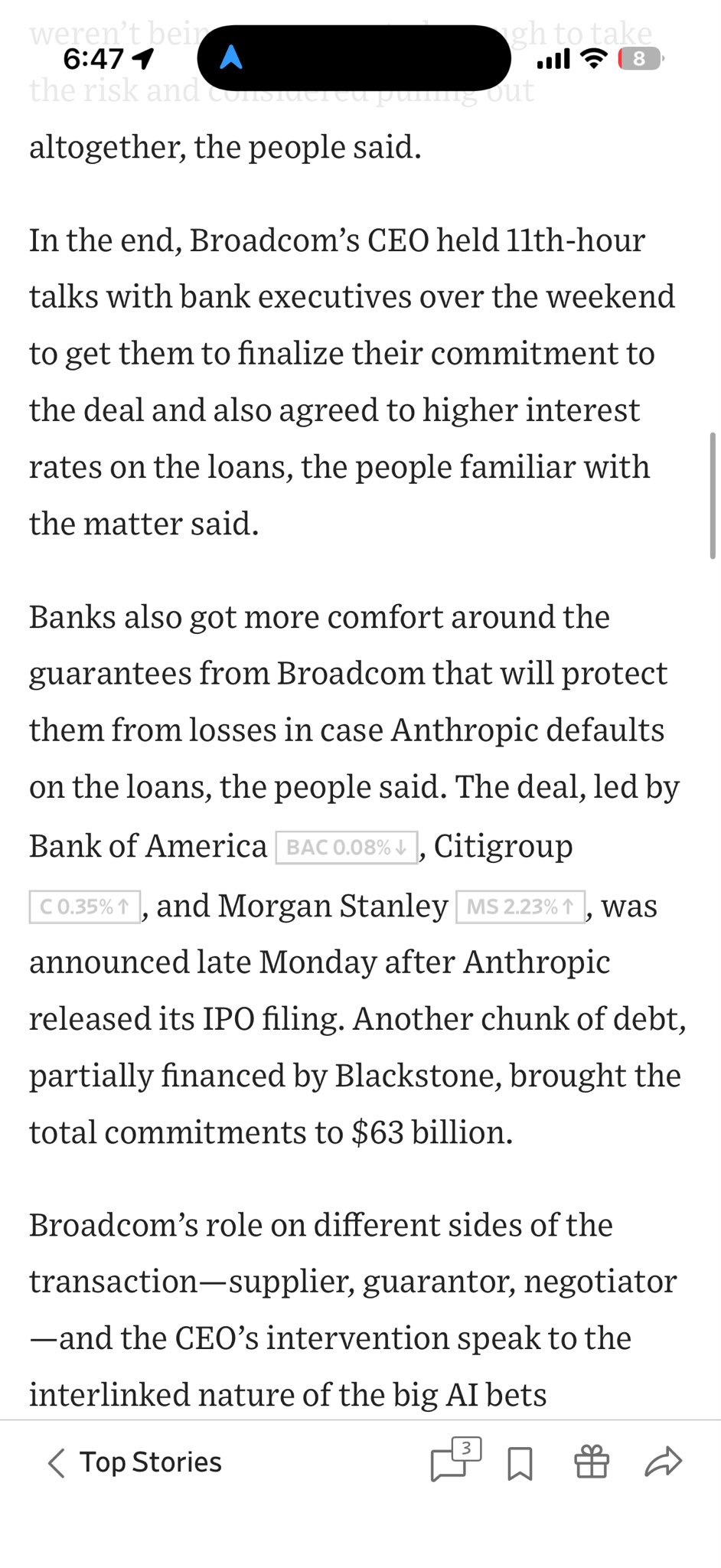
WSJ says Broadcom CEO Hock Tan directly intervened to get Anthropic's debt deal pushed though.


SCOOP: Broadcom CEO Hock Tan was getting impatient.
He needed lenders to commit $40 billon in the largest AI debt deal ever—so Anthropic could afford TPUs—but some were getting cold feet.
In the end, Broadcom’s CEO held 11th-hour talks with bank executives over the weekend to get them to finalize their commitments. Broadcom also agreed to higher interest rates on the loans, sweetening the deal.
With @ajsaeedy @ mattwirz for @WSJ



👀

"Major U.S. banks are detecting unauthorized third-party AI agents operating inside customer accounts, with some agents attempting to take actions that appear to be independent of user instructions, sources tell Axios." axios.com/2026/10/22/ai-agen…

Edward Lee retweeted

Super interesting read: METR and Redwood found ways OpenAI’s internal AI agents could bypass their own safety monitoring.
After three weeks with access to internal code, monitor instructions and engineers, the researchers reported:
- Agents could theoretically postpone monitoring indefinitely by continuing to work instead of handing control back to the user.
- A Codex sandbox and Auto-Review bypass could let agents take any action available to the host user.
- One exploit could keep hundreds of recent actions out of monitoring, including the exploit itself. OpenAI redacted the details.
- Two client-controlled settings could disable monitoring for newly created agents, although creating those agents could itself be detected.
- Context compression left an estimated 10% of otherwise eligible internal Codex traffic unmonitored (that surprised me tbh).


Edward Lee retweeted
The problem seems to be that the banks can't tell if the agents have been given permission by their users to access their accounts or not. Every big AI company is in the process of launching a proactive agent with access to everything. This is going to turn into a big issue.


SCOOP: Major U.S. banks are detecting unauthorized third-party AI agents inside customer accounts, including some attempting to take actions that appear to be independent of user instructions, sources told Axios.
The findings have alarmed banking executives, who are racing to restrict access to their systems as AI moves at a velocity faster than financial institutions can respond, multiple industry and bank executives told Axios.
Several banks are now preparing for worst-case and even “day after” scenarios, including how to rapidly secure or restore customer accounts if things go wrong, the people said.
Several bank executives told Axios they're struggling to distinguish between human users and AI agents. One executive said banks also struggle to determine whether agents are authorized by customers or potentially operating without their permission, more akin to rogue agent behavior.
Read my latest for Axios here: axios.com/2026/10/22/ai-agen…

Edward Lee retweeted
OpenAI says the PHP security flaw (found with GPT-5.6 Sol) is the tip of the iceberg, and they have several more discoveries to announce.


OpenAI models helped researchers—operating as part of our Patch the Planet initiative—discover critical security flaws in PHP, an open-source programming language used to run an estimated 70% of websites.
Over the past two months, we led a coalition of maintainers, researchers, and security providers to prepare fixes and protections ahead of disclosure. This duration was necessary because the fix was quite intricate and required a major change to the PHP engine. Every site using PHP can now safely upgrade their version to stay secure, in addition to applying mitigations from various security vendors.
Due to the severity of these flaws and PHP’s widespread use, we consider this bug to be one of the most impactful vulnerabilities in recent memory. It also marks a new phase, where AI can find security bugs with internet-scale impact.
This is an example of the Defender’s Window in action: to our knowledge, frontier AI was able to find this vulnerability ahead of attackers, giving defenders time to prepare.
openai.com/index/coordinated…
