

Tweets on grammar, usage, style, and punctuation. Website for editors, writers, and learners of English. @editorsmanual@mastodon.online
- Tweets318
- Following85
- Followers206
- Likes496




ALT Graphic titled "Are Holiday Greetings Capitalized?" The left panel has a festive background of stars and snowflakes and three cats dressed in a Santa hat, a reindeer hat, and an elf hat, delivering a present. The right panel has the following text. Capitalize names of holidays and words at the start of a sentence. Examples: Merry Christmas! We wish you a merry Christmas. Happy holidays! Good night, and happy holidays! Happy Hanukkah! Have a happy Hanukkah! Happy Fourth of July! Have a happy Thanksgiving. I wished her happy holidays. (Lowercase common nouns and adjectives.)

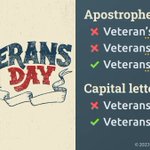
ALT Graphic on apostrophe in "Veterans Day." The left panel shows a retro-style poster that says "VETERANS DAY" in blue and red with a monochromatic ribbon swirling around the text and the date "NOV 11" on the ribbon. The right panel contains the following text. Apostrophe: Veteran's Day (incorrect, with apostrophe before “s”); Veterans' Day (incorrect, with apostrophe after “s”); Veterans Day (correct, with no apostrophe, official name). Capital letters: Veterans day (incorrect, with the word “day” lowercased); Veterans Day (correct, with both words capitalized, name of holiday, proper noun).

ALT Possessives of names ending in "s": Rules and examples. Chicago & APA style: Add an apostrophe and another "s" (Charles's boat, Harris's views). AP style: Simply add an apostrophe (James' car, Jesus' disciples). With family names, form a plural, then add an apostrophe (the Joneses' cat). With plural country names, don't add another "s" (the United States' imports, the Philippines' waterways).

ALT Graphic titled "Scare Quotes." The left panel shows an illustration of a dilapidated, clearly haunted house with a background of soaring bats silhouetted against the moon. Two ghosts, one by the gated driveway and another floating against the night sky, have opening and closing quotation marks for eyes. The right panel has the following text. Scare quotes convey irony, skepticism, or disdain. (Examples: Is that the "ghost"? Clearly, something "intelligent" wrote this.) Indicate nonstandard use of a word. (Examples: "Intelligent" chatbots now serve customers. This app lets you "try on" pants before you buy them.)

ALT How to write "Indigenous Peoples' Day." Correct: Indigenous Peoples' Day, with apostrophe after "s" (Chicago style). Correct: Indigenous Peoples Day, no apostrophe (AP style). Incorrect: Indigenous People's Day, with apostrophe before "s." Correct: Indigenous Peoples' Day, with all the words capitalized (name of holiday, capitalized). Incorrect: Indigenous peoples' day, with the words lowercased.

ALT Is "happy birthday" capitalized? Don't capitalize when you describe wishing someone. Example: I wished her a happy birthday [adjective + common noun]). Don't capitalize in dialogue. Examples: "Good morning and happy birthday, Remy," she said. They all cried, "Happy birthday!" Style personal greetings as you like. Example: Happy Birthday! (with balloon emojis)

ALT Apostrophe in "Mother's Day." Use an apostrophe before "s." (Incorrect: Mothers' Day; Incorrect: Mothers Day; Correct: Mother's Day.) Capitalize both words. (Incorrect: Father's day; Correct: Father's Day [name of holiday, proper noun].)

ALT Is "One in..." Singular or Plural? Grammatically singular. (Examples: One in five cats is immune to catnip. [One (in five) is immune.] One in three adults craves simplicity. One in ten people clicks on links.) Plural when based on meaning. (Examples: One in five cats are immune to catnip. [Not one, but twenty percent.] One in three adults crave simplicity. One in ten people click on links.)

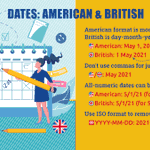
ALT Dates in American and British English: Rules and examples. American format is month-day-year; British is day-month-year (American: May 1, 2021; British: 1 May 2021 [no comma needed in British style]). Don’t use commas for just month and year (American/British: May 2021). All-numeric dates can be confusing (American: 5/1/21 for May 1, 2021; British: 5/1/21 for 5 January 2021). Use ISO format to remove ambiguity (YYYY-MM-DD: 2021-05-01).

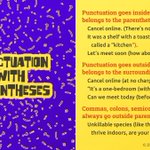
ALT Punctuation with parentheses: Rules and examples. Rule 1: Punctuation goes inside parentheses if it belongs to the parenthetical text. Examples: Cancel online. (There's no charge.) It was a shelf with a toaster (which the listing called a "kitchen"). Let's meet soon (how about tomorrow?). Rule 2: Punctuation goes outside parentheses if it belongs to the surrounding sentence. Examples: Cancel online (at no charge). "It's a one-bedroom (with a kitchen)." Can we meet today (before six)? Rule 3: Commas, colon, semicolons, and dashes always go outside parentheses. Example: Unkillable species (like the snake plant), which thrive indoors, are your best bet.

ALT Apostrophes in names of holidays. Apostrophe before "s": New Year's Eve, Mother's Day, Women's Day, Valentine's Day. Apostrophe after "s": All Saints' Day, All Fools' Day, Teachers' Day, Presidents' Day (Chicago style). No apostrophe: Veterans Day, Human Rights Day, Guy Fawkes Day, Christmas Eve, Presidents Day (AP style), Martin Luther King Jr. Day

ALT Commas, Parentheses, Dashes: How to Use. Commas integrate additional but closely related information into the sentence. Example: My sister, who is a doctor, agrees. (describe and explain) Parentheses set off additional information tangential to the main idea. Example: My sister (a doctor at Nusquam General) wrote this book. (add supplemental detail, afterthought) Dashes interrupt the sentence to make information stand out. (My sister—a doctor and a scientist—agrees. (draw attention, informal)

ALT How to use infinitives vs. gerunds: Rules and examples. Both can be the subject (“Infinitive: To err is human” [more formal]; “Gerund: Seeing is believing”). Some verbs can take either as object (“She likes to dance / dancing”). Others take only the infinitive (“I forgot to call him”). Still others take only the gerund (“You risk losing everything”). Most prepositions take only the gerund as object (“Thanks for calling me back”).

ALT Parentheses vs. square brackets. Parentheses (round brackets) enclose additional, optional information. Examples: Temperatures have risen globally (see Appendix A). Lulu bakes bread (buns and bagels). Square brackets enclose editorial clarifications to quoted text. Example: He said, “They [the trees] must be saved.” Square brackets set off text already within parentheses (brackets within parentheses). Example: July has been the hottest month on record (since 1880 [see Table 1]).

ALT "A" or "an" with abbreviations: Rules and examples. Use "a" before a consonant sound; "an" before a vowel sound. A NATO member; an NBA player. A STEM project; an SEO strategy. A FIFA team; an FBI agent. A LAN router; an LED screen. A UFO; an ATM; an EU mandate. A MoMA exhibit; an MBA program. A PDF; an XML file; an HTML page. A CEO; a VPN; a DIY store; a TBA. Tip: Read the abbreviation aloud: use "a" or "an" depending on how it is pronounced, not how it is spelled.

ALT Plurals of names ending in "y": Rules and examples. Simply add "s" to form the plural. (We have two Henrys in the family. The Murphys live next door to the Murrays.) Don't use an apostrophe. (Incorrect: The McCarthy's are here. Correct: The McCarthys are here.) Don't change "y" to "ies." (Incorrect: She met the Kennedies in the fifties. Correct: She met the Kennedys in the fifties.) To form the possessive, place an apostrophe after the "s" that makes the plural. (Incorrect: Is the Connolly's cat? Correct: Is that the Connollys' cat?)

ALT How to use square brackets. To enclose text added later to a quoted passage ("This new source [of energy] will change how humans live in the twenty-first century.") To add an editorial comment or clarification ("They [the two nations] wish for peace." "As Dash notes, "Peace /requires/ freedom" [italics mine].) For brackets within parentheses (Pollution affect pollinators (insects and birds that pollinate flowers [e.g., bees]). They have launched a new initiative (the Clean Energy Action Plan [CEAP]).)

ALT “Who” for animals: Rules and examples. Use “who” instead of “which” for animals with names. (Lava, who likes being around other animals, is a friendly little dog.) Use “who” for an animal that is personified or to indicate emotional closeness. (The cat, who seemed to like the attention, curled up cozily between us.) Use “which” or “that” to refer to a species or an unknown animal. (Sloths, which spend their lives hanging upside down, are the slowest mammals on Earth. The cat that was rescued has been adopted.) “Who” is also used to discuss animal behavior. (Dogs who refused the supplement were excluded from the study.)

ALT Comma before “who”: Rules and examples. Don’t use commas if “who” presents essential information (a restrictive clause). (“The woman who called earlier is at the door.” Which woman? The one who called earlier.) Use commas to introduce an optional description (a nonrestrictive clause). (“Maya, who grew up on a farm, loves cats.” We know who is being referred to: Maya. That she grew up on a farm is extra information enclosed in commas.) When you use a comma before a “who” clause, also use one after. (Incorrect: Rita, who likes adventure loves to travel. Correct: Rita, who likes adventure, loves to travel. [paired commas])

ALT Colon in lists: Rules and examples. Use a colon to introduce a list, but only after a grammatically complete sentence. (Incorrect: We offer: | Correct: We offer the following services: | Incorrect: They analyzed: | Correct: They analyzed three variables:) Use a colon after an independent clause (one that can stand alone as a sentence) within a sentence. (Incorrect: You will need: a hammer, a nail, and a ladder. Correct: You will need a hammer, a nail, and a ladder. Correct: You will need three things: a hammer, a nail, and a ladder.) Don't use a colon after a heading, title, or caption. Use formatting options instead. (Incorrect: Introduction: | Correct: Introduction [in bold])