

Onchain is the next online •|• Alpha & Threads •|• Researcher •|• My tweets are NFA 🦅
Moon
Joined October 2013
- Tweets36K
- Following3K
- Followers17.7K
- Likes60.7K



Elite🏝 retweeted
Pre-TGE projects are easy to get bullish on when the technology sounds impressive.
But I think the better way to research them is to separate what’s already shipped from what’s still developing.
@primus_labs is one of the privacy infrastructure projects on my research list, so here’s my scorecard across seven areas.
Not a price prediction. Just products, technology and execution.
…
α/ Working Applications — 9/10
Primus has moved beyond cryptographic research.
> Confidential Vault on BNB Chain
> Proof-of-Reserves applications
> zkTLS SDKs and verification contracts
The Vault reportedly attracted $1M+ in encrypted deposits on day one.
β/ Ecosystem Integrations — 9/10
Unitas, Brevis, Perena and AllScale cover different financial workflows.
> Unitas: Reserves and confidential finance
> Perena: Onchain reserve verification
> AllScale: Encrypted payroll testing
I like that these aren’t four versions of the same product.
γ/ Developer Activity — 8.5/10
Primus’s GitHub shows active development.
> zkTLS SDK and extension updates
> FHE and MPC tooling
> Reserve-verification repositories
Multiple components are progressing simultaneously.
δ/ Cryptographic Architecture | 9/10
zkTLS authenticates external information, while FHE enables encrypted computation.
AutoHoG reportedly processes encrypted 64-bit transfers in ~90ms.
The combination extends beyond private payments.
ε/ Business Model — 8.5/10
Primus documents an institutional Proof-of-Reserves service offering:
> Configurable verification
> Public dashboards
> Enterprise deployment
> Subscription pricing
There’s already a commercial product structure, even without disclosed revenue.
ζ/ Security & Verification — 8/10
Public code, cryptographic documentation and verifiable computation provide a foundation for evaluating the architecture.
Independent audits and production security evidence remain important.
η/ Adoption Potential — 8.5/10
Confidential finance, reserve verification, payroll and authenticated financial data give Primus several potential customer categories.
The next milestone is recurring usage across these applications.
…
Overall Research Score: 8.6/10
IMO, Primus has assembled something beyond a standalone privacy feature.
There are working applications, developer infrastructure, financial integrations and a defined enterprise offering.
The strongest part is how these components connect.
> zkTLS establishes authenticity.
> FHE protects computation.
> Financial applications turn both into products.
That’s why Primus remains one of my higher-conviction pre-TGE infrastructure projects.
The next phase is converting that technical foundation into sustained commercial adoption.

Pre-TGE projects are easy to get bullish on when the technology sounds impressive.
But I think the better way to research them is to separate what’s already shipped from what’s still developing.
@primus_labs is one of the privacy infrastructure projects on my research list, so here’s my scorecard across seven areas.
Not a price prediction. Just products, technology and execution.
…
α/ Working Applications — 9/10
Primus has moved beyond cryptographic research.
> Confidential Vault on BNB Chain
> Proof-of-Reserves applications
> zkTLS SDKs and verification contracts
The Vault reportedly attracted $1M+ in encrypted deposits on day one.
β/ Ecosystem Integrations — 9/10
Unitas, Brevis, Perena and AllScale cover different financial workflows.
> Unitas: Reserves and confidential finance
> Perena: Onchain reserve verification
> AllScale: Encrypted payroll testing
I like that these aren’t four versions of the same product.
γ/ Developer Activity — 8.5/10
Primus’s GitHub shows active development.
> zkTLS SDK and extension updates
> FHE and MPC tooling
> Reserve-verification repositories
Multiple components are progressing simultaneously.
δ/ Cryptographic Architecture | 9/10
zkTLS authenticates external information, while FHE enables encrypted computation.
AutoHoG reportedly processes encrypted 64-bit transfers in ~90ms.
The combination extends beyond private payments.
ε/ Business Model — 8.5/10
Primus documents an institutional Proof-of-Reserves service offering:
> Configurable verification
> Public dashboards
> Enterprise deployment
> Subscription pricing
There’s already a commercial product structure, even without disclosed revenue.
ζ/ Security & Verification — 8/10
Public code, cryptographic documentation and verifiable computation provide a foundation for evaluating the architecture.
Independent audits and production security evidence remain important.
η/ Adoption Potential — 8.5/10
Confidential finance, reserve verification, payroll and authenticated financial data give Primus several potential customer categories.
The next milestone is recurring usage across these applications.
…
Overall Research Score: 8.6/10
IMO, Primus has assembled something beyond a standalone privacy feature.
There are working applications, developer infrastructure, financial integrations and a defined enterprise offering.
The strongest part is how these components connect.
> zkTLS establishes authenticity.
> FHE protects computation.
> Financial applications turn both into products.
That’s why Primus remains one of my higher-conviction pre-TGE infrastructure projects.
The next phase is converting that technical foundation into sustained commercial adoption.
Elite🏝 retweeted
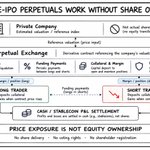
Private companies don’t need to issue shares for traders to speculate on their valuations.
That’s what makes pre-IPO perpetuals different from tokenized equities.
Take a private company like Anthropic.
A perpetual market can offer price exposure to its estimated valuation without the exchange holding Anthropic shares or having access to its shareholder register.
Here’s how the structure works.
…
α/ Reference Valuation
The contract needs a benchmark.
Depending on the venue, that might come from private-market transactions, external valuation estimates or a market-derived index.
Because there’s no continuously traded public stock, the quality of this reference is critical.
β/ Mark Price
The venue calculates a mark price used to determine unrealized profits, losses and liquidation risk.
This may differ from the latest traded contract price to reduce manipulation from isolated trades.
γ/ Funding Payments
Perpetual contracts have no fixed expiration.
Periodic funding payments between longs and shorts help manage differences between the contract price and its reference.
The exact funding mechanism depends on the exchange.
δ/ Collateral and Margin
Traders deposit collateral, often stablecoins, to open positions.
The exchange records their exposure and margin requirements, but no private shares change hands.
A $10,000 long position with $2,000 collateral represents 5x exposure to the contract’s price movement, not $10,000 of equity ownership.
ε/ Liquidation
If the mark price moves against the trader and their margin falls below the required maintenance level, the exchange can liquidate the position.
This happens entirely within the derivatives system.
ζ/ Financial Settlement
When a trader closes a position, the venue calculates the difference between entry and exit prices.
Profits and losses are credited or debited through the venue’s settlement system.
The trader receives no company shares.
> No ownership transfers.
> No voting rights.
> No shareholder registration.
And unless the contract explicitly provides otherwise, an eventual IPO doesn’t automatically convert the perpetual into public equity.
…
The entire structure separates price exposure from legal ownership.
A private company’s valuation becomes something traders can take long or short exposure to, while the actual shares remain outside the derivatives market.
The critical question is how reliably the venue can price that exposure when the underlying equity has no continuous public market.

Private companies don’t need to issue shares for traders to speculate on their valuations.
That’s what makes pre-IPO perpetuals different from tokenized equities.
Take a private company like Anthropic.
A perpetual market can offer price exposure to its estimated valuation without the exchange holding Anthropic shares or having access to its shareholder register.
Here’s how the structure works.
…
α/ Reference Valuation
The contract needs a benchmark.
Depending on the venue, that might come from private-market transactions, external valuation estimates or a market-derived index.
Because there’s no continuously traded public stock, the quality of this reference is critical.
β/ Mark Price
The venue calculates a mark price used to determine unrealized profits, losses and liquidation risk.
This may differ from the latest traded contract price to reduce manipulation from isolated trades.
γ/ Funding Payments
Perpetual contracts have no fixed expiration.
Periodic funding payments between longs and shorts help manage differences between the contract price and its reference.
The exact funding mechanism depends on the exchange.
δ/ Collateral and Margin
Traders deposit collateral, often stablecoins, to open positions.
The exchange records their exposure and margin requirements, but no private shares change hands.
A $10,000 long position with $2,000 collateral represents 5x exposure to the contract’s price movement, not $10,000 of equity ownership.
ε/ Liquidation
If the mark price moves against the trader and their margin falls below the required maintenance level, the exchange can liquidate the position.
This happens entirely within the derivatives system.
ζ/ Financial Settlement
When a trader closes a position, the venue calculates the difference between entry and exit prices.
Profits and losses are credited or debited through the venue’s settlement system.
The trader receives no company shares.
> No ownership transfers.
> No voting rights.
> No shareholder registration.
And unless the contract explicitly provides otherwise, an eventual IPO doesn’t automatically convert the perpetual into public equity.
…
The entire structure separates price exposure from legal ownership.
A private company’s valuation becomes something traders can take long or short exposure to, while the actual shares remain outside the derivatives market.
The critical question is how reliably the venue can price that exposure when the underlying equity has no continuous public market.
Bitcoin is trading below $78K, but the deeper concern is how poorly altcoins are holding up relative to BTC.
The October 29–30 selloff exposed considerable weakness across major assets.
The numbers:
> BTC: ~$77K–$78K
> ETH: -5.2%
> XRP: -7%
> BNB: -7.1%
> Total liquidations: $1.55B
> Long liquidations: $1.34B
That’s a substantial leverage flush, with longs accounting for roughly 86% of liquidations.
But forced selling ending doesn’t automatically mean buyers have returned.
…
BTC Structure:
The first recovery test is $78K–$80K.
A sustained reclaim would bring $81.5K–$82K into focus, while losing $76K–$77K would weaken the recovery setup considerably.
Altcoin Relative Strength
ETH/BTC and SOL/BTC remain the cleaner measures of whether capital is rotating into altcoins.
If BTC rebounds while those pairs continue declining, altcoins are simply recovering in dollar terms without gaining relative strength.
That isn’t enough to establish a broader altcoin recovery.
…
Derivatives Positioning:
Negative ETH and SOL funding alongside declining open interest suggests leveraged positions have been reduced.
This can create conditions for a relief rally, particularly if short positioning becomes crowded.
But a leverage reset isn’t the same as sustained spot demand.
The confirmation I’d look for:
> BTC reclaiming $80K
> ETH/BTC and SOL/BTC establishing higher lows
> Altcoin spot volume expanding
> BTC dominance declining as alts gain in USD terms
> Open interest recovering without excessive positive funding
Two outcomes remain possible.
1. Recovery: BTC reclaims $80K, alt/BTC pairs improve and spot demand expands.
2. Further weakness: BTC rejects $78K–$80K, dominance remains elevated and alt/BTC pairs establish new lows.
Until relative strength improves, altcoin rallies remain tactical rather than confirmed capital rotation.
I’d rather miss the initial bounce than mistake a derivatives liquidation event for genuine buying demand.
BTC needs to recover its structure. Altcoins still need to demonstrate independent strength.

Crypto had a dark day following the biggest hack in Binance’s history.
$6.3 billion wiped out in a single day.
Meanwhile, @A7interX is making waves with fast transactions, bank grade security and seamless transfers without the need for a bridge.
And the numbers speak volumes:
• 15,000 clients
• Just 0.3% in fees
• 2,000 transactions daily
• Coverage across 100 countries
• USDT in, bank transfer out through SWIFT
While CT is still reacting to another major security incident, A7 International is focused on making cross border payments faster, simpler and more accessible.
Sometimes, the best response to industry setbacks is to keep building.
Link in the comments.


Elite🏝 retweeted
How much of stolen crypto actually gets recovered?
I compared five major exploits from 2025–2026 involving more than $8B in reported losses.
The results show how differently crypto companies respond to hacks, and why $3B frozen doesn’t mean $3B recovered.
The incidents:
> @Binance: ~$6.3B affected
> @Bybit_Official: ~$1.4B stolen
> @DriftFDN: ~$295M in verified user losses
> @CetusProtocol: ~$223M stolen
> @GMX_IO: ~$40–42M compromised
…
α/ Binance: Freezing Assets
On October 29, attackers moved billions from Binance-controlled wallets. Binance’s October 30 disclosure estimated the impact at $6.3B, with approximately $3B frozen through coordination with blockchain partners.
That’s 47.6% of the preliminary incident value, but not a 47.6% recovery rate. Frozen assets remain inaccessible until investigations and restitution arrangements determine what can be returned.
Binance also committed to covering customer losses using company resources and SAFU. Final recovery and reimbursement figures remain undetermined.
β/ Bybit: Replacing Customer Assets
In February 2025, Bybit lost approximately $1.4B in ETH-related assets.
Its subsequent disclosures reported:
> $73.36M frozen
> $29.7M recovered
> $141M+ in illicit flows traced
Yet customer reserves were restored to 1:1 within 72 hours.
Bybit shows how an exchange can make customers whole using replacement capital without recovering most of the stolen assets. Customer reimbursement and asset recovery are two different outcomes.
γ/ Cetus: Validator-Assisted Recovery
The May 2025 Cetus exploit drained approximately $223M. Around $162M was frozen through Sui validator intervention and subsequently returned, equivalent to roughly 72.6% of the estimated theft.
Cetus also used:
> $7M in company reserves
> $30M USDC loan from Sui Foundation
> Initial pool replenishment: 85–99%
These resources helped replenish affected pools to approximately 85–99% during the initial restoration process. Remaining losses required additional financing and planned token compensation.
δ/ GMX: Negotiated Return
GMX V1 suffered a $40–42M exploit in July 2025. The team negotiated with the exploiter, who returned the funds to a DAO-controlled recovery arrangement in exchange for a $5M bounty.
GMX later described the affected assets as recovered, although the bounty and subsequent LP distributions still influenced the final economics.
Recovering the assets doesn’t mean the exploit had zero financial cost.
ε/ Drift: Recovery Through Future Revenue
Drift’s April 2026 exploit resulted in approximately $295M in verified user losses.
Its recovery plan introduced DFX, issuing one token per dollar of verified loss.
At the October 1 opening:
> DFX supply: ~299.5M
> Recovery pool: ~$3.1M
That placed the initial redemption value near $0.0104 per token, returning slightly more than 1% of a verified claim.
The pool is intended to receive future revenue and partner contributions, while another ~$9.2M in frozen assets required legal authorization before transfer.
Unlike the other cases, a substantial portion of Drift’s proposed restitution depends on future funding rather than assets already returned.
…
Five incidents, five recovery approaches. But the percentages aren’t directly comparable.
There are four separate measurements:
1. Traced: Assets linked to an exploit.
2. Frozen: Assets prevented from moving.
3. Recovered: Assets returned to authorized control.
4. Reimbursed: Value delivered to affected users.
These categories can overlap, creating double-counting risks.
Recovery also depends on token prices. Returning 10,000 ETH at $2,000 after a $3,000 theft means 100% recovery in ETH, but 66.7% in dollar terms.
Binance relied on freezes and reimbursement. Bybit replaced assets. Cetus used validator intervention and financing. GMX negotiated returns. Drift established claims against future recoveries.
Freezing stolen assets isn’t the same as returning funds to affected users.

How much of stolen crypto actually gets recovered?
I compared five major exploits from 2025–2026 involving more than $8B in reported losses.
The results show how differently crypto companies respond to hacks, and why $3B frozen doesn’t mean $3B recovered.
The incidents:
> @Binance: ~$6.3B affected
> @Bybit_Official: ~$1.4B stolen
> @DriftFDN: ~$295M in verified user losses
> @CetusProtocol: ~$223M stolen
> @GMX_IO: ~$40–42M compromised
…
α/ Binance: Freezing Assets
On October 29, attackers moved billions from Binance-controlled wallets. Binance’s October 30 disclosure estimated the impact at $6.3B, with approximately $3B frozen through coordination with blockchain partners.
That’s 47.6% of the preliminary incident value, but not a 47.6% recovery rate. Frozen assets remain inaccessible until investigations and restitution arrangements determine what can be returned.
Binance also committed to covering customer losses using company resources and SAFU. Final recovery and reimbursement figures remain undetermined.
β/ Bybit: Replacing Customer Assets
In February 2025, Bybit lost approximately $1.4B in ETH-related assets.
Its subsequent disclosures reported:
> $73.36M frozen
> $29.7M recovered
> $141M+ in illicit flows traced
Yet customer reserves were restored to 1:1 within 72 hours.
Bybit shows how an exchange can make customers whole using replacement capital without recovering most of the stolen assets. Customer reimbursement and asset recovery are two different outcomes.
γ/ Cetus: Validator-Assisted Recovery
The May 2025 Cetus exploit drained approximately $223M. Around $162M was frozen through Sui validator intervention and subsequently returned, equivalent to roughly 72.6% of the estimated theft.
Cetus also used:
> $7M in company reserves
> $30M USDC loan from Sui Foundation
> Initial pool replenishment: 85–99%
These resources helped replenish affected pools to approximately 85–99% during the initial restoration process. Remaining losses required additional financing and planned token compensation.
δ/ GMX: Negotiated Return
GMX V1 suffered a $40–42M exploit in July 2025. The team negotiated with the exploiter, who returned the funds to a DAO-controlled recovery arrangement in exchange for a $5M bounty.
GMX later described the affected assets as recovered, although the bounty and subsequent LP distributions still influenced the final economics.
Recovering the assets doesn’t mean the exploit had zero financial cost.
ε/ Drift: Recovery Through Future Revenue
Drift’s April 2026 exploit resulted in approximately $295M in verified user losses.
Its recovery plan introduced DFX, issuing one token per dollar of verified loss.
At the October 1 opening:
> DFX supply: ~299.5M
> Recovery pool: ~$3.1M
That placed the initial redemption value near $0.0104 per token, returning slightly more than 1% of a verified claim.
The pool is intended to receive future revenue and partner contributions, while another ~$9.2M in frozen assets required legal authorization before transfer.
Unlike the other cases, a substantial portion of Drift’s proposed restitution depends on future funding rather than assets already returned.
…
Five incidents, five recovery approaches. But the percentages aren’t directly comparable.
There are four separate measurements:
1. Traced: Assets linked to an exploit.
2. Frozen: Assets prevented from moving.
3. Recovered: Assets returned to authorized control.
4. Reimbursed: Value delivered to affected users.
These categories can overlap, creating double-counting risks.
Recovery also depends on token prices. Returning 10,000 ETH at $2,000 after a $3,000 theft means 100% recovery in ETH, but 66.7% in dollar terms.
Binance relied on freezes and reimbursement. Bybit replaced assets. Cetus used validator intervention and financing. GMX negotiated returns. Drift established claims against future recoveries.
Freezing stolen assets isn’t the same as returning funds to affected users.
Elite🏝 retweeted

how on earth do you FUD the largest crypto exchange in the world when you're literally part of the crypto industry? do you even know what you're doing?
when chaos hits, we need to stand together, not turn against each other. crypto is already fighting enough battles.
✌🏻
Elite🏝 retweeted
One of the most frustrating things about leveraged trading?
Getting wiped out by a sudden wick, only to watch the market move exactly where you predicted minutes later.
Or having to close a perfectly good position simply because you need to sleep or step away from the charts.
That's why I've been looking into @jaspervault and its Perpetual Protect (PP) feature lately.
The idea is pretty interesting.
Instead of relying solely on a traditional stop-loss that immediately closes your position, PP offers temporary protection designed to help manage liquidation risk during extreme volatility.
A few things I particularly like about the concept:
α/ Stay in the trade: Helps protect against short-term volatility without automatically forcing you out of your position.
β/ Less screen time: Useful when you're sleeping, away from your desk, or simply don't want to babysit every candle.
γ/ On-chain transparency: Clear visibility into protection costs, duration, and execution conditions.
Of course, PP isn't a free pass to trade recklessly. Protection comes with fees, time limits, and specific conditions. Risk management still matters.
But having another option beyond simply closing a position? That's something I think leveraged traders should pay attention to.
Sometimes the hardest part of trading isn't getting the direction right. It's surviving the volatility long enough to see it play out.
Want to give PP a try?
The Jasper Vault team is offering PP vouchers to help cover Gas costs for users interested in testing the feature.
If you'd like one, tell me your wallet~
Explore Jasper Vault
app.jaspervault.io/#/referra…
🤝 Paid partnership

One of the most frustrating things about leveraged trading?
Getting wiped out by a sudden wick, only to watch the market move exactly where you predicted minutes later.
Or having to close a perfectly good position simply because you need to sleep or step away from the charts.
That's why I've been looking into @jaspervault and its Perpetual Protect (PP) feature lately.
The idea is pretty interesting.
Instead of relying solely on a traditional stop-loss that immediately closes your position, PP offers temporary protection designed to help manage liquidation risk during extreme volatility.
A few things I particularly like about the concept:
α/ Stay in the trade: Helps protect against short-term volatility without automatically forcing you out of your position.
β/ Less screen time: Useful when you're sleeping, away from your desk, or simply don't want to babysit every candle.
γ/ On-chain transparency: Clear visibility into protection costs, duration, and execution conditions.
Of course, PP isn't a free pass to trade recklessly. Protection comes with fees, time limits, and specific conditions. Risk management still matters.
But having another option beyond simply closing a position? That's something I think leveraged traders should pay attention to.
Sometimes the hardest part of trading isn't getting the direction right. It's surviving the volatility long enough to see it play out.
Want to give PP a try?
The Jasper Vault team is offering PP vouchers to help cover Gas costs for users interested in testing the feature.
If you'd like one, tell me your wallet~
Explore Jasper Vault
app.jaspervault.io/#/referra…
🤝 Paid partnership
Elite🏝 retweeted
Tokenized equities reached roughly $3.74B by October 28.
The market has spent 2026 competing to issue more stocks onchain. But the deployment numbers tell a different story.
Binance Research reported:
• Tokenized equity supply: +390.4% YTD through September 15
• Capital actively deployed: 1.95% → 7.54%
• bStocks utilization: 11.2% versus 7.4% industry-wide
By October 19, bStocks utilization had reached approximately 17%.
Supply is growing, but the infrastructure needed to borrow and short these assets remains underdeveloped.
That could be where the next competition begins.
…
α/ More Inventory Than Financing
By October 28, the largest tokenized equity platforms included:
• @bstocksfinance: $1.4B
• @Ondo: $931M
• @xStocksFi: $623M
Tokenized equity DeFi deposits grew from $21.6M to $289.1M by September.
Of that capital, 65.4% was in liquidity pools and 28.1% in lending.
But lending activity doesn’t necessarily mean investors can borrow the stocks themselves.
Much of it involves using tokenized shares as collateral to borrow stablecoins.
That’s different from lending shares to market makers and short sellers.
…
β/ Perpetuals Have Volume. Spot Has Inventory.
Around 56% of bStocks trading occurred outside regular U.S. market hours.
Derivatives can accommodate that demand because traders can take leveraged long or short positions without sourcing shares.
But arbitrage becomes harder when prices diverge.
If NVIDIA perpetuals trade above tokenized shares, traders can buy spot and short the perpetual.
Reverse the premium, and traders need shares to sell.
Without borrowable inventory, arbitrage becomes one-sided, allowing pricing gaps to persist.
More trading volume alone won’t solve that.
…
γ/ The Missing Securities Lending Market
@Binance allows eligible bStocks to serve as collateral, but its documented facility doesn’t support borrowing the stock tokens themselves.
The economics are different.
→ Collateral lending: Borrow stablecoins against tokenized shares.
→ Securities lending: Borrow the shares for short selling, hedging and arbitrage.
The second model could generate borrowing fees for stockholders while improving liquidity across spot and derivatives markets.
But custody, legal restrictions and liquidation mechanisms remain obstacles.
…
δ/ Who Has The Advantage?
Binance has distribution and existing trading demand. bStocks reached $1B in assets within 125 days.
Ondo has a substantial tokenized equity inventory, but that inventory still needs to become accessible to borrowers.
Ethereum, Solana and BNB Chain already support lending infrastructure. Integrating actual securities borrowing requires more than accepting stocks as collateral.
The opportunity may belong to whoever connects issuers, lenders, market makers and trading venues.
…
ε/ The Revenue Opportunity
At $3.74B in tokenized equity value, securities lending could become a separate fee market.
Illustrative annual gross borrowing fees:
• 5% borrowed at 3%: $5.6M
• 15% borrowed at 5%: $28.1M
• 30% borrowed at 8%: $89.8M
These are scenarios, not forecasts. Actual revenue depends on eligible inventory, borrowing demand and fee sharing.
A platform listing hundreds of stocks could still have limited financing activity.
Another with fewer assets but deeper borrowing markets could support tighter prices and more efficient hedging.
…
Conclusion
Tokenized equities have made considerable progress on issuance and distribution.
Financing is still catching up.
bStocks has trading activity. Ondo has inventory. Lending protocols have existing infrastructure.
But none of those alone establishes a functioning securities-borrowing market.
The next tokenized equity winner may be determined by how much inventory traders can actually borrow, rather than how many stocks a platform lists.

Tokenized equities reached roughly $3.74B by October 28.
The market has spent 2026 competing to issue more stocks onchain. But the deployment numbers tell a different story.
Binance Research reported:
• Tokenized equity supply: +390.4% YTD through September 15
• Capital actively deployed: 1.95% → 7.54%
• bStocks utilization: 11.2% versus 7.4% industry-wide
By October 19, bStocks utilization had reached approximately 17%.
Supply is growing, but the infrastructure needed to borrow and short these assets remains underdeveloped.
That could be where the next competition begins.
…
α/ More Inventory Than Financing
By October 28, the largest tokenized equity platforms included:
• @bstocksfinance: $1.4B
• @Ondo: $931M
• @xStocksFi: $623M
Tokenized equity DeFi deposits grew from $21.6M to $289.1M by September.
Of that capital, 65.4% was in liquidity pools and 28.1% in lending.
But lending activity doesn’t necessarily mean investors can borrow the stocks themselves.
Much of it involves using tokenized shares as collateral to borrow stablecoins.
That’s different from lending shares to market makers and short sellers.
…
β/ Perpetuals Have Volume. Spot Has Inventory.
Around 56% of bStocks trading occurred outside regular U.S. market hours.
Derivatives can accommodate that demand because traders can take leveraged long or short positions without sourcing shares.
But arbitrage becomes harder when prices diverge.
If NVIDIA perpetuals trade above tokenized shares, traders can buy spot and short the perpetual.
Reverse the premium, and traders need shares to sell.
Without borrowable inventory, arbitrage becomes one-sided, allowing pricing gaps to persist.
More trading volume alone won’t solve that.
…
γ/ The Missing Securities Lending Market
@Binance allows eligible bStocks to serve as collateral, but its documented facility doesn’t support borrowing the stock tokens themselves.
The economics are different.
→ Collateral lending: Borrow stablecoins against tokenized shares.
→ Securities lending: Borrow the shares for short selling, hedging and arbitrage.
The second model could generate borrowing fees for stockholders while improving liquidity across spot and derivatives markets.
But custody, legal restrictions and liquidation mechanisms remain obstacles.
…
δ/ Who Has The Advantage?
Binance has distribution and existing trading demand. bStocks reached $1B in assets within 125 days.
Ondo has a substantial tokenized equity inventory, but that inventory still needs to become accessible to borrowers.
Ethereum, Solana and BNB Chain already support lending infrastructure. Integrating actual securities borrowing requires more than accepting stocks as collateral.
The opportunity may belong to whoever connects issuers, lenders, market makers and trading venues.
…
ε/ The Revenue Opportunity
At $3.74B in tokenized equity value, securities lending could become a separate fee market.
Illustrative annual gross borrowing fees:
• 5% borrowed at 3%: $5.6M
• 15% borrowed at 5%: $28.1M
• 30% borrowed at 8%: $89.8M
These are scenarios, not forecasts. Actual revenue depends on eligible inventory, borrowing demand and fee sharing.
A platform listing hundreds of stocks could still have limited financing activity.
Another with fewer assets but deeper borrowing markets could support tighter prices and more efficient hedging.
…
Conclusion
Tokenized equities have made considerable progress on issuance and distribution.
Financing is still catching up.
bStocks has trading activity. Ondo has inventory. Lending protocols have existing infrastructure.
But none of those alone establishes a functioning securities-borrowing market.
The next tokenized equity winner may be determined by how much inventory traders can actually borrow, rather than how many stocks a platform lists.
Elite🏝 retweeted

Open Interests in the RWA sector only is accelerating hard.
Metrics tell this fact (counted on DeFi):
+ Total RWA perps OI: $5.939b
+ Total perps OI: $19.775b
This means OI on RWA accounts for roughly 30% of the total OI. It's a massive surge in less than 1 year since HIP-3 was introduced to support perps on RWA.
In this post, let's compare the 3 different trading models in this field: @tradexyz, @variational_io and @gmtrade_xyz.
Disclaimer: NFA, DYOR.
1. Tech/order book
+ @tradexyz uses Hyperliquid's order book as the largest HIP-3 builder-deployed venue.
HIP-3 lets anyone who stakes 500,000 HYPE deploy their own perpetual markets on Hyperliquid.
+ @variational_io has no order book, its Omni app uses an RFQ model.
A trader asks for a quote, a vertically integrated market maker called the Omni Liquidity Provider (OLP) aggregating liquidity from centralized exchanges, DEXs and over-the-counter sources.
+ @gmtrade_xyz also has no order book, it's a community deployment of the GMX V2 code on Solana.
Traders trade against liquidity pools at oracle prices instead of against other traders' orders. Liquidity is split into pools. Commodity markets use Chainlink Data Streams.
2. RWA supports
+ TradeXYZ: 74 stock perps, ETFs, equities indices, commodities, FX, pre-IPO
+ Variational: tokenized stocks, commodities, FX, pre-IPO
+ GMTrade: tokenized stocks, commodities
TradeXYZ has the largest coverage of rwa products supported.
3. Operational metrics:
+ TradeXYZ:
OI: $3.977B
30D Volume: $78.637B
Volume as a multiple of OI: 19.7x
No points program
+ Variational:
OI: $888.41M
30D Volume: $51.868B
Volume as a multiple of OI: 58x
Omni points program to incentivize $VAR
+ GMTrade:
OI: $164.33M
30D Volume: $23.069B
Volume as a multiple of OI: 140x
GT points program
The volume-to-open-interest multiple is a rough indicator of how sticky positions are.
TradeXYZ's multiple is lowest, so positions are held longer relative to trading.
Variational and GMTrade turn over much faster, which can reflect market-making and short-term trading, and in some periods points farming.
Which ones would you choose for each occasion?

Elite🏝 retweeted

Building secure blockchains today is important, but preparing them for tomorrow’s unknown risks matters just as much.
That’s one reason I’m interested in what @Starknet is exploring with cryptographic agility.
Security shouldn’t depend on assuming that the methods we trust today will remain reliable forever. Networks also need a practical way to adopt new cryptographic techniques as threats evolve.
For me, the real strength lies in designing for change rather than waiting for a problem to appear before looking for a solution.
Curious about Starknet’s approach to quantum readiness? 👇
quantum.starkware.co


Elite🏝 retweeted
I’ve always found the separation between Solana and EVM development a bit unnecessary.
You have Solana offering fast, cheap execution, while a huge portion of crypto’s applications are still built with Solidity.
Developers end up choosing between the two, even when their applications could benefit from both.
That’s why I like what @RomeProtocol is building.
Rome runs an EVM directly inside Solana as a single program, rather than treating the two environments as separate chains that need bridging.
The setup allows:
1. Solidity contracts to call Solana programs in one atomic transaction.
2. EVM and Solana users to keep their respective wallets.
3. Both sides to interact with the same contract state and liquidity.
And this is already live on Solana mainnet, with a Halborn audit and public code. You can also trace EVM transactions back to their Solana instructions on the Via explorer.
For me, the appeal is pretty simple. Developers shouldn’t have to abandon familiar tooling just to build applications that tap into Solana.
Rome gives them a way to work across both environments without splitting the underlying state.

I’ve always found the separation between Solana and EVM development a bit unnecessary.
You have Solana offering fast, cheap execution, while a huge portion of crypto’s applications are still built with Solidity.
Developers end up choosing between the two, even when their applications could benefit from both.
That’s why I like what @RomeProtocol is building.
Rome runs an EVM directly inside Solana as a single program, rather than treating the two environments as separate chains that need bridging.
The setup allows:
1. Solidity contracts to call Solana programs in one atomic transaction.
2. EVM and Solana users to keep their respective wallets.
3. Both sides to interact with the same contract state and liquidity.
And this is already live on Solana mainnet, with a Halborn audit and public code. You can also trace EVM transactions back to their Solana instructions on the Via explorer.
For me, the appeal is pretty simple. Developers shouldn’t have to abandon familiar tooling just to build applications that tap into Solana.
Rome gives them a way to work across both environments without splitting the underlying state.
Elite🏝 retweeted
If you’re exploring @primus_labs, here’s something worth knowing about its reputation system. 👀
Your reputation grows through XPs, which you earn by completing and verifying records on the platform.
Here’s how to get started:
- Visit s.kaito.ai/PyXPv2r
- Connect your wallet.
- Download the Chrome extension on desktop.
- Complete the available attestation tasks.
Each verified task adds to your Primus reputation score in the app.
I initially received 10 XPs per task, but after verifying them again, I received 4 each. Rewards may vary as the tasks or system change.
So, what can you verify?
Agentic Era
→ PnL records from Polymarket, FOMO and Hyperliquid
→ AI usage from OpenAI, MiniMax, DeepSeek and Cursor
→ Trading activity from Binance, Bybit, OKX and Bitget
There are also two other categories:
→ Identity Profile
→ Platform Activities
The tasks use Primus zkTLS technology to verify information from supported platforms while helping protect the underlying data.
The more you explore, the more you’ll understand how Primus is building around verifiable data and privacy.
Have you checked your XPs yet? 👀
