

Partner @AmplifyPartners, writing https://nitter.cf/t.co/LSbi0EEiHU
San Francisco, CA
Joined October 2011
- Tweets3.4K
- Following973
- Followers19.3K
- Likes10.4K





Pinned Tweet
Announcing Amplify Bio 🧬
I've joined Amplify Partners to help build a $200M fund dedicated to technical founders in bio.
This has been part of a long evolution—from writing code as a computational biologist, to writing >200k words about this sector in The Century of Biology, to getting the chance to write checks backing great bio founders with Packy at Not Boring.
This has also been a long evolution for Amplify. Since 2012, Amplify has exclusively focused on helping researchers and engineers become great founders. Amplify partnered with category-defining infrastructure and AI companies like Datadog, Fastly, Runway, and Temporal from the very beginning.
The focus on technical founders led Amplify towards bio—partnering with founders like Chris Gibson, Brandon White, Alex Beatson, John Chodera, and Theofanis Karaletsos.
But we're just getting started. Despite the chaos in the public markets, we believe it's a great time to start bio companies.
Here's why: amplifypartners.com/blog-pos…

We've been busy at Amplify Bio!
It's a privilege to be in business with the technical founders transforming the life sciences.
And, personally, it's a privilege to work alongside this team every day. If you've spent time with Sunil, David, Luke, or Madelyn, you'll know exactly what I mean.
If you haven't, we've got a whole slate of programming intentionally designed for this ecosystem in the New Year, so we'll see you there!


Elliot Hershberg retweeted

Up until recently it was just me hacking on prototypes, but my company is starting to feel real. We are 4 people, have a real physical office, and we just closed a seed round with @AmplifyPartners – looking forward to share a bit more about what we are working on soon!
Elliot Hershberg retweeted
Cheers to the UK’s AI builders. 🇬🇧
Tonight in London, @JensenHuang announced new investments in @boltz_bio, @ForesightWorks, @hivergeai, @PrimaMente, and Riverlane.
From new medicines to quantum computing, there’s plenty to build.
🤖 Made with AI

Xinchen is a highly underrated thinker at the intersection of AI and Bio.
Worth reading the motivations + strategy for Waypoint's platform they've built in pursuit of out-of-distribution medicines!

AI in biology may have a data problem before it has a model problem.
It’s easy to use AI to make drug discovery faster & more efficient. The much harder challenge is discovering impactful medicines humans would never have found.
AI models are only as useful as the data they learn from, and it’s especially hard in biotech. The biggest and most valuable goals in AI in biotech are to cure diseases we haven’t been able to cure and design therapeutics capable of doing things that haven’t been possible before. By definition, these goals aren’t represented in our training data.
For our second essay at Waypoint Bio, we wrote about the data we think we’ll need to build out-of-distribution medicines: waypointbio.com/writings

“That's part of what makes frontier drugs worth pursuing. You may need to invent both the molecule and the way to discover it. If you succeed, you can leave behind more than one medicine: you can make a whole class of problems look more tractable.”
Great post by @srikosuri. One of the most exciting applications of all the new tools in biology is to go after the biggest unsolved problems.
This is why we need more biotechs led by deeply technical founders!


We're hosting an evening event for engineers, researchers, and builders at the intersection of AI in Biology.
If you're in the area on 9/24, come join us!
luma.com/byiw9j9u

Major props to @lennypruss who was Temporal's first ever investor.
Technical founders can build massive businesses!

Elliot Hershberg retweeted

@ElliotHershberg joins us at The Lantern Summit.
Helps lead @AmplifyPartners' $200M bio fund. Writes The Century of Biology, on what computation can and can't do for medicine.
Shanghai · 26–27 Oct 2026
thelanternsummit.com 🏮

Elliot Hershberg retweeted

Thanks for following my cancer journey, it has been quite the ride! I’m 16 months cancer free now. I view two people as my cofounders on the journey of going ‘founder mode’ on my cancer. These are Jose M. Mejia Oneto, who was in my YC batch of W15 with Shasqi doing cancer therapies, and became my best friend! And @JAC0BSTERN who I met through Jose and who left his job in biotech to become ‘CEO of my health’. After we made progress on my disease we started creating companies to make the latest scientific advances more accessible to others. We’ve started 15 companies in the last year and a half under the Even One Ventures umbrella, see evenone.ventures/ for more information.

Elliot Hershberg retweeted

Free life hack to fall in love with San Francisco as an aesthetics enjoyer - look at it through the eyes of artist Yoichi Nishikawa (@YohIchi_N) - a literal background painter for Studio Ghibli!


Notes on what comes *after* intismeran (Moderna's personalized cancer vaccine):
I've been very excited about the early data for this program and the potential of what it could become. But it's also got some clear room for improvement that creates exciting opportunities for founders and investors.
Two investments we've made at @AmplifyPartners along these lines:
1. As many have pointed out, this program aims to prevent disease *recurrence* — it's not a "cure" or even a monotherapy. @btnaughton and @DevinScannell are building Decade Inc., which is an applied AI research lab making the next generation of personalized cancer drugs. their approach has the same broad applicability of mRNA vaccines but is designed to be dramatically more potent. More to come in time...
2. There's still a lot of room for improvement in the combination setting to prevent recurrence. The name of the game is to identify the right antigens, the right delivery vector for T cell activation, and the right clinical setting. We're very excited about how Infinitopes is tackling this equation. Their first clinical trial is underway.
For scientists, engineers, investors, and pharmas exploring this space, reach out!


Elliot Hershberg retweeted
My cancer case is n=1. I'm not holding it up as a model, because most of what I did is not specifically replicable or scaleable. But it is a proof of concept that fully personalized medicine, built around one patient's own biology, is viable in ways it simply wasn't a few years ago. I have lived a version of the future of cancer care that I think is worth aspiring to more broadly.
Many of the tools that made this future possible for me are getting better, faster, cheaper, and more accessible every year. I think what we need next is the infrastructure to deploy these tools, and the community willing to build this infrastructure, one patient at a time.
I want to help that future arrive faster. I wrote an article in The Cancer Letter cancerletter.com/guest-edito… for the physicians and researchers closest to the patients who could benefit most from this approach, who also believe in this future. If you are working towards building the systems and practices that will make personalized medicine operationally real, we want to collaborate with you too.

After yesterday's Moderna pop, I decided to look back through the Century of Biology "portfolio"
Some dates of when I covered topics/drugs/companies:
- Personalized cancer vaccines (covered BioNTech March 16, 2025, then Moderna's Ph2 intismeran data on Jan 18, 2026 and again April 12, 2026)
- BridgeBio (deep dive on Feb 16, 2025. Share price up ~2.39x since then.)
- DNA Synthesis (deep dive on April 17, 2022 highlighting Twist, which is up ~3.35x since then)
- AbCellera (covered their strategy in an essay April 14, 2024. They are up ~2.67x since then. Same essay would give ~1.63x for Alnylam.)
- Verve Tx (wrote about June 2, 2024, acquired by Lilly for ~2-2.57x since then.)
On the private company side: Enveda, Manifold, Dyno, Living Carbon, and others have been doing amazing things!
Worst performing stocks I've heavily featured are probably Ginkgo and Intellia—but the story is far from over on both!
"CoB is for entertainment purposes only, not investment advice," yada yada, and it's much easier to blog about this stuff then to return $$ running a hedge fund. I'm just a simple early-stage VC!
But it's fun to think about the "score card" for the various topics I've covered and predictions I've made on my little corner of the Internet over the years.
Which Way, Western Biotech?
One reductionist model of drug discovery is that it's a heroic search across an NxN grid. Along one dimension, there are the modalities in our therapeutic arsenal. On the other, the known target hypotheses with varying levels of biological evidence. (Another dimension is indication, but we're simplifying here!)
In this framing, the anxiety for American biotechs is that Chinese biotechs are increasingly sampling this grid at an alarming rate—from molecular discovery to first-in-human studies.
It's definitionally zero sum: the grid is finite! So protectionists argue that we should regulate like we are guarding a scarce resource.
If this is the whole story, there is a real reason to be worried about the future of American biotech! The asymmetry in speed of search is multifactorial. (cc @MWCvitkovic)
China has:
1. Favorable policy (and state-level planning)
2. Favorable labor economics
3. A much more intense work culture
4. An integrated ecosystem across R&D, manufacturing, and hospitals
5. A way bigger population (big deal for trials)
But I don't think it *is* the whole story. American biotech has a beautiful blend of true off-the-grid thinking and risk capital to support these ideas.
What is off the grid? Wholly new modalities. New biology. Or even ideas that reject the grid altogether: like AI-powered personalized medicines that defy any conception of a singular target.
The positive sum view of biotech's future is still extraordinary hopeful for America.


I'm not sure you can conclude that biotech in Boston/Cambridge is on the right track right now. Some responses I've gotten this summer about the local ecosystem:
On China: "We'll just out-innovate them" (Not sure how that happens when both home-grown and US-trained Chinese scientists are doing world-class science)
On AI: "It's just a bubble and tech investors will move out of biotech once it pops" (The same plan brick-and-mortar stores had during the dot-com boom)
Feels like the best-case default is SF becomes the US leader for biotech just like semiconductors did in the last century. Worst-case is the US misses out entirely and the world's biotech R&D runs through China. Either way, Boston isn't in the picture unless we start experimenting with new models now
P.S. We should still invest in making FIH studies faster in the US, and rebuilding / on-shoring critical biotech infrastructure!
P.P.S One major flaw of the reductionist grid description is that it can be easy to imagine all cells on the grid are equal. They aren't! There are entire regions of the grid that require new technology for successful exploration. These regions don't have the same zero-sum dynamic where search speed is the primary competitive advantage.
Elliot Hershberg retweeted

Learning biotech part 2:
Once you understand process of finding drugs, you should study the incentives that drive decisions.
Why does someone choose to launch the 200th EGFR program? Inevitably there's a set of incentives, and often data-driven risk analysis, motivating these seemingly silly decisions.
While new biotechs often challenge existing assumptions, understanding Chesterton's fence is the smartest way to decide where and why you deviate.
I would start by reading AstraZeneca's retrospective on why their programs won or lost:
“Lessons learned from the fate of AstraZeneca’s drug pipeline: a five-dimensional framework.” pubmed.ncbi.nlm.nih.gov/2483…
The '5Rs' they identified are a good representation of the risks pharma prioritizes: right target, right tissue, right safety, right patient, and right commercial potential.
YC tells their companies to talk to users. But who is the 'user' for biotech?
- Ultimately, we make medicines for patients to enjoy healthy lives.
- The FDA judges whether it works.
- But doctors decide what to prescribe.
- And insurance and medicare actually pay for the treatment.
This makes the situation more confusing for new biotechs. But your product needs to work for all four of those user.
(even if you plan to sell to pharma before approval, they have the same users, so you just have one more user to please)
I recommend the book 📚 "Her-2" about Genentech's mega-successful drug Herceptin, which includes decisions about which diseases and trials they tried it for first. If those decisions had been wrong, the drug might have died.
I'd also recommend (any and all) episodes of 🎧 "Hard Drugs" from @salonium and @JacobTref, especially for examples where the science incentives are stronger than financial ones.
harddrugs.worksinprogress.co…
After that, try deconstructing decisions you see in the news, like Genentech choosing to exit cancer immunology two years ago or everyone buying 'radiopharmaceutical' biotechs. What got derisked, or saw added risk?
One source of 'irrational behavior' might be classic short-term performance goals among executives at public companies. At any given time, pharma's revenue come from a small number of patent-protected drugs. When patents expire on a top product revenue plummets, so you often see acquisitions of mature companies that might get a new big approval before the cliff.
Basics of patent cliffs here: biopharmadive.com/news/pharm…
and this episode of @alexkesin and Matthew Pech's 🎧 Approved goes deep on that drug, including at ~90m how Merck sought to protect its profits: podcasts.apple.com/us/podcas…
Ultimately, incentives all come back to 1) a desire to improve humanity's conditions by scientists who go into biomedicine, and 2) free market competition.
When you see something that seems cool (like PCSK9 gene therapy) but isn't super hot, check the incentive stack to understand why (in this case, strong competition with lower risk).
And when you see an opportunity nobody is filling, at least find out why.
More good content on this topic includes:
@alexkesin’s ✍️ “Pharmacopoeia” broadly covers how biopharma behaves, for example in “Pharma Is Hollywood, Roughly”:
alexkesin.com/p/pharma-is-ho…
@ElliotHershberg’s ✍️ “The Century of Biology” has a series on platform companies, like BridgeBio, that dissects incentives:
centuryofbio.com/p/bridgebio
Finally, 📚 “The Great American Drug Deal” by @PeterKolchinsky is relevant as big picture context on how healthcare works and how the medicines it pays for flows back into the next generation of drugs. You can also get the short version on this website: nopatientleftbehind.org/fund…


Starting companies is hard, and it's a boon when you can learn from how others have done it.
There's way more content on tech than biotech, but I thought I'd put together an overview of the good resources that do exist:
For the big picture, start with @Atelfo blog post ✍️:
atelfo.github.io/2023/12/23/…
And if you want a fun read that tracks 'finding medicines' from prehistory to today, read The Drug Hunters 📚:
amazon.com/Drug-Hunters-Impr…
Now you know the system that exists. If you're a biologist, next step is to understand that finding a gene/protein target is just the beginning. 'What to do' is essential, but often things fail because you're able to do it in the right place for the right amount and duration (or even know what those are).
Here I'd honestly ask your fave LLM to walk you through 'Medicinal Chemistry 101' 🤖, covering potency, selectivity, the main modalities ADME, PK/PD, formulation, tox studies, CMC.
Make sure you understand the big differences between small molecules, antibodies, protein drugs, siRNAs, and cell/gene therapy.
After that, I'd work through a couple of concrete examples to see things in (messy) practice:
📚 “The Billion-Dollar Molecule” (and the sequel “The Antidote”) on how Vertex was formed and struggled their way to a first success.
📚 For Blood and Money by @nathanvardi. Same: fun & teaches you a lot about the confluence of science, money, and people that go into biotech.
After that, I'd go peruse @LifeSciVC's blog to understand how traditional biotech investors look at these endeavors - the main thing to pay attention to is what risks he keeps calling out.
Note that Atlas and other 'Boston biotech VCs' are a dominant group, but not the only way companies get funded. The original biotechs (all the ones called 'Gen' something), and the 2010s 'techbio' companies have a different thesis inspired by full-time founders as the scarce resource, though most of the risks are the same.
This post is a good place to start:
lifescivc.com/2025/10/twenty…
Finally, Derek Lowe’s “In the Pipeline” blog offers >20y of 1) commentary on biotech next, which you can now assess with the benefit of hindsight, and 2) more details on medicinal chemistry if you found that part exciting. Here's one starting place:
science.org/content/blog-pos…
Speaking of, someone should take his best posts and turn them into a book... 😉
I'll expand each of the topics here into more resources throughout the week, stay tuned.

Data that still lives rent free in my head after CSHL AI in Bio:
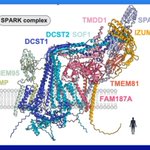
In silico prediction of the ten-subunit complex that appears to control sperm-egg fusion. Done with AlphaFold Multimer. Absolutely stunning.
This complex is so gnarly that this group hasn't been able to empirically validate the structure yet, but every single line of experimentation supports this structural model being correct.
It's like the AI model is a molecular microscope that can see what we can't even detect.
For me, it reframed the upper bounds of where molecular machine learning is going in next ~2-3 years. We're just getting started!

The full preprint is really worth checking out. Stunning basic research accelerated by AI.
doi.org/10.64898/2026.05.13.…
Elliot Hershberg retweeted

Thank you to the @decodingbio team for having me at the AI x Bio summit at the NYSE last week.
Great panel chaired by @ElliotHershberg on how new technologies can create both new types of medicines and new kinds of companies.


