
Postdoctoral Fellow at @PsychPrinceton, studying early language and communicative development in human infants.
Princeton, NJ
Joined July 2019
- Tweets123
- Following98
- Followers128
- Likes118




Pinned Tweet
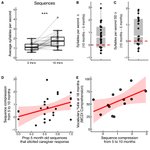
1/12 Animals often communicate in phrases with sequential structure. Vocal learners, however, are often studied one note or syllable at a time. What are the origins of vocal sequences in animals that learn vocal communication? Find out in our new paper spanning birds+babies🧵
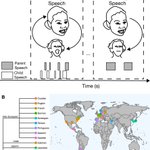
How do languages become learnable for young children? Read our paper out now in Current Biology “Immature vocalizations elicit simplified adult speech across multiple languages” to find out! 🧵 of our findings below: cell.com/current-biology/ful… 1/9
w/ @MikeHGoldstein & @levy_jacob we show that kid’s immature vocalizations & speech actively elicit language from caregivers that is linguistically simplified & learnable. We find this in 13 languages, showing a robust social pathway for making language learning easier to do 2/9

1
1
92
My colleague and collaborator @hv_zhang brought **two** new papers into the world this month. Both explore what keeps prelinguistic infants "in the game" of vocal turn-taking! Check out her thread for an overview of the two papers:

Turn-taking is crucial for the development of communication, but why do infants engage in the game of vocal turn-taking? For answers, check out TWO of my papers out this month in Infancy twtr.to/x9V6W and Infant Behavior & Development twtr.to/FAkrY a 🧵

6
256

How do infants learn to produce the consonant sounds of their ambient language? To find out, check out our CogSci proceedings paper “Statistical learning or phonological universals? Ambient language statistics guide consonant acquisition in four languages” A 🧵: /1
w/ @pcontrerask @MH_Christiansen @SharynneMcLeod @MikeHGoldstein @DrKateCrowe & Katharine S. Wang we show that even a mundane measure of statistical structure that could guide consonant acquisition explains variance in the age @ which children learn a given consonant! /2

Do infants modulate their own language input? Is the use of simpler IDS in response to infant vocalizations specific to child-centric cultures? Out now in TopiCS: “Immature vocalizations simplify the speech of Tseltal Mayan and U.S. Caregivers” A 🧵: /1 bit.ly/3EEzLIQ

w/ @middycasillas & @MikeHGoldstein, we show that Tseltal children’s early vocalizations actively change the social environment in ways that may make lang learning easier to do. Tseltal mothers’ speech in response to children’s vocalizations is simplified in ling structure. /2
2
3
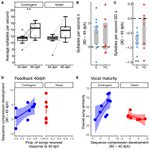
What are the origins of vocal communication in human infants? Read our paper out now in Developmental Science "Learning how to learn from social feedback: The origins of early vocal development" to find out! 🧵of our findings below:onlinelibrary.wiley.com/doi/…

w/ @MikeHGoldstein, Jen Schwade & Laura Vollmer, we show that communicative development originates in adults’ responses to babbling. As infants (2- and 5-month-olds) realize that their early sounds have social potency, they develop expectations about the efficacy of their voice.

Excited for #IASCL2021! Thursday 7/15, SYM 6, I present cross-linguistic evidence that children's vocal production across at least 9 different languages elicits simplified speech from their caregivers. See you at live Q&A from 11:30 AM - 12:00 PM EST! iascl2021.com
10
@SRCDtweets tomorrow, Thursday Apr. 8 @ 2:45 my and @ashleycleung's symposium "The Diversity of Caregiver-child Coordination and its Contributions to Language Development" is happening -- we hope you can join us for an interesting discussion surrounding our 4 great talks!

Attending #SRCD21? Interested in parent-child communication and language development in typical and atypical populations? Come to our symposium "The Diversity of Caregiver-child Coordination and its Contributions to Language Development" at 2:45pm EDT on Thursday, April 8!
Interesting new paper from @AnneWarlaumont showing that caregiver recasts and expansions of infants' canonical babbling predicts infants' productive vocabulary at 13 months!
journals.plos.org/plosone/ar…
1
it just works 🤷♂️

CHILDES is the premier resource for studying transcripts of children's language.
We created childes-db.stanford.edu, a reproducible, versioned interface.
Now childes-db has a 2020 update, with 1) updated R API, 2) new Python API, 3) phonbank, and 4) bugfixes.

1
2
Audio papers? Yes!

This is the first article I've recorded so people can listen while doing other things. @CeliaHeyes , if you, @NickJChater, or Dominic Dwyer would like a free copy of the recording, just let me know where to send it to!
Recording available for £3 here:
articulateacademia.bandcamp.…

What is the social function of infants’ babbling? If you’re at the Many Paths to Language Workshop today, please come check out my poster "The function of infants' prelinguistic vocal sequences" which received a best student poster award! #MPaL2020
Staying excited for extremely cool scientific meetings~
This Post is from an account that no longer exists. Learn more
My first conference paper [bit.ly/2ouw9G0] won Best Paper Award @ICDL_EpiRob 2019! @MikeHGoldstein and I found at larger sample sizes, infants elicit simplified caregiver speech just by babbling. Thanks to @JessicaLMontag and @FelixThoemmes for insightful discussions!
My first publication found here:[bit.ly/2ZIblaL]! We found that babbling functions as a social catalyst @MikeHGoldstein: Adults unconsciously modify their speech to include less unique words, only in response to baby’s babbling - not when adults simply talk to babies.