
God first || All things Web, Certified Human Resources Personal
Joined November 2023
- Tweets13.2K
- Following396
- Followers490
- Likes10.1K





Pinned Tweet
DAC is built around the idea of creating a trusted digital ecosystem where assets, data, and business operations can work securely and transparently.
It represents more than technology
it represents a community working together to build better digital tools.
The blue DAC symbol represents trust, connectivity, innovation, and forward movement.
Dac emphasizes that technology is ultimately created for people and powered by people.
DAC is for the community.
DAC is for builders.
DAC is for the future.
Gdac always


Enenche retweeted
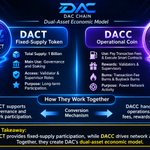
DACT vs DACC: Understanding DAC's Dual-Asset Model
1. DACT – Fixed-Supply Token
DACT has a fixed maximum supply of 1 billion tokens.
It focuses on long-term participation in the DAC ecosystem through governance, staking and validator or supervisor access.
Its fixed supply provides a predetermined token limit.
2. DACC – Operational Coin
DACC powers everyday activities on the DAC network.
It is used to pay transaction fees, execute smart contracts and reward validators and supervisors for maintaining the blockchain.
3. DACC Rewards and Burns
New DACC enters circulation through block rewards given to network participants.
Meanwhile, transaction-fee burns and periodic buyback-and-burn mechanisms remove DACC from circulation.
This creates a balance between new coin issuance and supply reduction.
4. How They Work Together
DACT supports governance and network participation, while DACC handles network operations and rewards.
DAC also provides a conversion mechanism connecting both assets.
DACT provides fixed-supply participation, while DACC drives network activity through fees, rewards and burns.
Together, they form DAC's dual-asset economic model.
Enenche retweeted

DAC is in Switzerland for the Digital Asset Summit 2026.
On the agenda: connecting with institutional allocators and following the frameworks shaping regulated tokenization.
Read more ↓
dachain.tech/news/connecting…

Enenche retweeted
Magic states have been a major challenge in advancing practical quantum computing.
Google has now demonstrated a way to produce them on Willow with significantly fewer errors.
The timeline to useful quantum computing is getting shorter.


Enenche retweeted
NEW TO INTERSTELLAR, OPERATIVE?
Here is the whole loop in four steps.
Start here → interstellar.dachain.io

Enenche retweeted
Some security measures require constant updates to stay effective. Fix it today, repeat it tomorrow.
But real-world assets need lasting protection, not temporary solutions. Security must remain strong for the entire lifetime of the asset.
Enenche retweeted
Not all quantum computers pose a risk to your wallet.
Advantage2 is designed to handle complex optimization tasks, not break cryptographic signatures.
Understanding the difference is what matters.

Enenche retweeted
One Transaction, One Fresh Address.
DAC’s Yellow Paper recommends using a fresh address for every transaction.
Why does this matter?
Reusing the same address can make it easier to connect different transactions and track activity over time.
By generating a new address for each transaction, DAC helps reduce address linkability and strengthen user privacy.
It’s another step toward making blockchain transactions more private and secure.
With DAC, privacy starts with the way transactions are designed.
@dac_chain $DACT
Enenche retweeted
Not every quantum computer is a threat to your wallet.
Advantage2 is built to solve optimization problems, not to crack signatures.
Worth knowing which is which.
Joined

Before the first trade comes the first conversation.
Our Discord is now open: discord.gg/tickrofficial
Tick Zero is the highest role you can claim right now. Spots are limited.
Claim it, get your Tick Zero card, and share it on X.

8
Enenche retweeted
OPERATIVES, A NEW CRATE HAS ENTERED INTERSTELLAR.
DAC is teaming up with some of the biggest players in the space for an exclusive run of Partner Quantum Crates.
First up is @surgence_io, with $500 USDC up for grabs.
Open it → interstellar.dachain.io
Enenche retweeted
Quantum Technology Is Advancing. Is Blockchain Ready?
As quantum computing grows, traditional blockchain security faces new challenges.
DAC is preparing for the future with its quantum-resistant Layer-1, PoQW, and quantum entropy.
Think ahead. Stay secure. Build with DAC.
Enenche retweeted
Security shouldn't be something that needs constant upgrades to stay effective.
Real-world assets require protection that lasts, not systems that need repeated patches to remain secure.
Their security must stand the test of time.
Enenche retweeted
What Happens When Quantum Computers Challenge Blockchain Security?
Today, blockchains rely on cryptographic systems like RSA and ECDSA to protect digital identities, wallets, and transactions.
Powerful, fault-tolerant quantum computers could use Shor’s algorithm to break these systems, putting traditional digital signatures at risk.
DAC approaches the problem differently.
Rather than relying only on replacing existing signature algorithms, DAC focuses on protecting transaction data before it travels across the network.
1. Physical Quantum Entropy
DAC uses physical randomness generated through the Barkhausen effect to produce entropy for its one-time-pad approach.
This helps conceal transaction information, including public keys, while transactions are in transit.
The idea is to reduce the information an attacker can observe and exploit, rather than relying solely on the mathematical difficulty of breaking a signature.
2. Proof of Quantum Work (PoQW)
DAC also introduces Proof of Quantum Work, a different approach to blockchain mining and block production designed as part of its broader quantum-security architecture.
🚀 Why This Matters
Quantum security is not just about protecting today's transactions. It is about preparing for a future where current cryptographic assumptions may no longer be safe.
DAC combines physical entropy, transaction confidentiality, and a different mining approach to build toward a more quantum-resilient blockchain.
The quantum threat is approaching. Building for it must start today.
🔗 dachain.tech
Enenche retweeted
How DAC Is Preparing for the Quantum Era
Quantum computers could eventually weaken some of the cryptographic systems that protect today's blockchains.
DAC is developing a different approach to help address this future challenge.
The goal is to strengthen transaction protection, improve the use of randomness, and explore new ways to secure blockchain operations.
1. Lattice-Based Cryptography
Lattice-based cryptography relies on mathematical problems believed to be difficult for both traditional and quantum computers to solve. It is one of the leading approaches to post-quantum security.
However, DAC's published technical paper focuses on quantum entropy and transaction protection rather than presenting lattice-based signatures as its main security mechanism.
2. Quantum Entropy: Randomness from Nature
DAC's technical paper describes generating randomness using the Barkhausen effect, a physical phenomenon associated with changes in magnetic materials.
This approach aims to provide unpredictable values that can support cryptographic security.
By using physical randomness, DAC seeks to strengthen the protection of transaction information against potential future threats.
3. Entropy-Padded Transactions (EPT)
DAC proposes combining transaction data with physical randomness before broadcasting it across the network.
Think of it as adding a protective layer around information while it travels between computers.
The aim is to make transaction information harder for outside observers to analyse and reduce the exposure of sensitive cryptographic data.
Its effectiveness depends on secure implementation and proper management of the random values.
4. Proof of Quantum Work (PoQW)
DAC also proposes Proof of Quantum Work, a consensus approach designed around quantum annealing and optimisation problems.
Unlike traditional blockchain systems that rely on conventional hashing-based mining, this approach explores a different method of producing blocks.
While quantum entropy focuses on randomness and transaction protection, PoQW addresses how the network reaches consensus.
The Bigger Picture
DAC's quantum-security approach focuses on three main areas:
- Quantum Entropy: Using physical processes to generate unpredictable randomness.
- Entropy-Padded Transactions: Adding protection to transaction data during transmission.
- Proof of Quantum Work: Exploring an alternative approach to blockchain consensus.
Together, these mechanisms represent DAC's approach to preparing for the quantum era.
However, their real-world security depends on implementation, independent testing, and continued technical validation.