

EMAC serves as a catalog and integration platform for modeling and analysis resources focused on studying exoplanets. Not an official NASA account.
- Tweets246
- Following1K
- Followers673
- Likes302
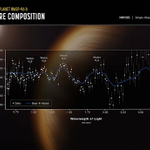






ALT Graphic of the atmospheric composition of exoplanet WASP-39 b, showing 2 graphs and a background illustration of the planet and its star. The top graph shows data from Webb’s NIRISS instrument, the bottom graph data from NIRSpec. Both graphs show the amount of light blocked on the y axis versus wavelength of light on the x axis. The y axes range from 2.00 percent (less light blocked) to 2.35 percent (more light blocked). The x axes range from less than 0.1 microns to 5.5 microns. Data points are plotted as white circles with gray error bars. A curvy blue line represents a best-fit model. The NIRISS data covers a range of about 0.5 to 3.0 microns and highlights the signatures of potassium, water and carbon monoxide in semi-transparent bars of varying colors. Potassium is gray, water is blue, and carbon monoxide is red. The NIRSpec data covers a range of about 2.5 to 5.25 microns. It highlights water and carbon monoxide in addition to sulfur dioxide in green and carbon dioxide in yellow.

ALT Graphic of the atmospheric composition of exoplanet WASP-39 b, showing 2 graphs and a background illustration of the planet and its star. The top graph shows data from Webb’s NIRCam instrument, the bottom graph data from NIRSpec. Both graphs show the amount of light blocked on the y axis versus wavelength of light on the x axis. The y axes range from 2.00 percent (less light blocked) to 2.35 percent (more light blocked). The x axes range from less than 0.1 microns to 5.5 microns. Data points are plotted as white circles with gray error bars. A curvy blue line represents a best-fit model. The NIRCam data covers a wavelength range of about 2.5 to 4.0 microns and highlights the signatures of water in a blue semi-transparent bar. The NIRSpec data covers a range of about 0.5 to 5.25 microns and highlights multiple signatures of water, in addition to sodium in a dark blue bar, carbon monoxide in red, carbon dioxide in light green, sulfur dioxide in dark green, and carbon dioxide in yellow.


ALT Webb’s first near-infrared spectrum of Mars, captured by the Near-Infrared Spectrograph (NIRSpec) Sept. 5, 2022, as part of the Guaranteed Time Observation Program 1415, over 3 slit gratings (G140H, G235H, G395H). The spectrum is dominated by reflected sunlight at wavelengths shorter than 3 microns and thermal emission at longer wavelengths. Preliminary analysis reveals the spectral dips appear at specific wavelengths where light is absorbed by molecules in Mars’ atmosphere, specifically carbon dioxide, carbon monoxide, and water. Other details reveal information about dust, clouds, and surface features. By constructing a best-fit model of the spectrum, by the using, for example, the Planetary Spectrum Generator, abundances of given molecules in the atmosphere can be derived. Credit: NASA, ESA, CSA, STScI, Mars JWST/GTO team


ALT Graphic titled “Hot Gas Giant Exoplanet WASP-39 b Atmosphere Composition, NIRSpec Bright Object Time-Series Spectroscopy.” The graphic shows the transmission spectrum of the hot gas giant exoplanet WASP-39 b captured using Webb’s NIRSpec Bright Object Time-Series Spectroscopy mode, with an illustration of the planet and its star in the background. The data points are plotted as white circles with grey error bars on a graph of amount of light blocked in percent on the vertical y axis versus wavelength of light in microns on the horizontal x-axis. The y-axis ranges from 2.00 percent (less light blocked) to 2.35 percent (more light blocked). The x-axis ranges from 3.00 microns to 5.6 microns. A curvy blue line represents a best-fit model. One broad, prominent peak visible in the data and model is labeled “Carbon Dioxide, C O 2” The carbon dioxide peak is centered around 4.3 microns and has a y value of between 2.25 and 2.30 percent of light blocked.

ALT This illustration shows what exoplanet WASP-39 b could look like, based on current understanding of the planet. In the middle of a black backgrouond is a purple planet with pink wisps across the surface. Only a small crescent of the planet is visible on the left side as a small Sun-like star shines on it from the top left of the image.