

Voted Best Infotainment Account on X 2025 | Follow for daily doses of wonder and wisdom!
New York
Joined May 2014
- Tweets32.9K
- Following1.5K
- Followers384K
- Likes6.8K
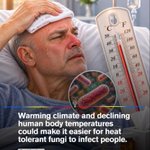




Most fungi cannot survive inside the human body because our normal body temperature of around 37°C acts as a natural defense. But some fungi are adapting to heat.
One concerning example is Candida auris, a drug resistant fungus that can grow at human body temperature and survive temperatures as high as 47°C.
Researchers are also investigating another surprising development. Average human body temperature in the United States has declined by approximately 0.03°C per birth decade.
Scientists have not established a direct connection between these trends. However, they warn that as fungi become more heat tolerant, the temperature barrier protecting humans could become less effective.
This raises concerns about future fungal infections, particularly among vulnerable hospital patients.
#FungalInfections #ClimateChange #ScienceNews


Researchers are exploring ways to turn the massive amounts of waste heat generated by AI data centres into energy for desalination.
The proposed system would redirect heat from cooling equipment into evaporation and distillation processes, potentially producing around 200,000 gallons of fresh water every day.
However, there is a major challenge. Most data centre waste heat is too cool to drive desalination efficiently, meaning heat pumps or specialised thermal systems may be necessary.
The process would also require electricity for pumping and water treatment.
If engineers can overcome these challenges, future AI facilities could help supply nearby communities with fresh water while putting otherwise wasted heat to productive use.
#ArtificialIntelligence #DataCenters #WaterTechnology

At 24, Xu Chenghong had almost no family left to celebrate his wedding. His father died when he was 3, his mother remarried when he was 5, and his grandmother, who raised him and his older brother, passed away 2 years later.
After dropping out of school, Xu worked various jobs and saved money to marry the woman he loved. But as the wedding approached, he realised they could barely fill 3 tables.
So he posted an invitation online, hoping just 10 or 20 strangers would show up.
Instead, thousands travelled from across China to celebrate with him. Guests brought livestock, household appliances, food and even thousands of roses.
The celebration became so enormous that around 150 chefs reportedly joined the cooking effort, while local residents and officials helped organise the crowds.
What began as a lonely wedding invitation turned into an extraordinary gathering of strangers.
#HumanKindness #HeartwarmingStories #China


Sir Patrick Stewart, the legendary British actor who brought Captain Jean Luc Picard to life in Star Trek: The Next Generation and Professor Charles Xavier in the X Men films, has died at the age of 86.
He passed away on October 28, 2026, at his home in Los Angeles, surrounded by the love and care of his family.
His extraordinary career spanned more than 6 decades, from Shakespearean theatre to some of the most iconic science fiction and superhero franchises in entertainment history.
Knighted by Queen Elizabeth II in 2010 for his contributions to drama, Stewart also shared a close friendship with fellow actor Sir Ian McKellen.
His performances shaped generations of audiences, leaving behind a legacy that will continue to live on through the characters he portrayed.
#PatrickStewart #StarTrek #XMen

The rosy boa is a nonvenomous snake native to the southwestern United States and northwestern Mexico. It is known for its slow, deliberate movement, with reported speeds of around 1 mile per hour.
But moving slowly does not make this snake an ineffective hunter.
Instead of chasing prey over long distances, the rosy boa relies on camouflage, patience, and carefully timed strikes. It waits for small animals to come within reach before launching an attack.
Its muscular body allows it to constrict its prey, making speed less important to its hunting strategy.
This fascinating desert predator demonstrates that survival is not always about being the fastest. Sometimes, staying hidden, conserving energy, and choosing the perfect moment can be just as effective.
#RosyBoa #WildlifeFacts #Nature


Across Japanese cities, green roofs and rooftop gardens are transforming ordinary buildings into pockets of nature above busy streets.
But these gardens do much more than improve the view.
Plants provide shade and release moisture through evaporation, helping cool the surrounding environment. The vegetation and soil layers can also reduce heat entering buildings, potentially lowering indoor temperatures.
They also help manage heavy rainfall by absorbing and temporarily storing water, reducing the amount of runoff entering urban drainage systems.
And there is another benefit. These green spaces can provide food and shelter for birds, bees, butterflies, and other wildlife, creating small habitats in densely populated cities.
This approach is particularly valuable for tackling the urban heat island effect, where buildings, roads, and concrete surfaces make cities significantly warmer than surrounding areas.
Rooftop gardens are not a complete solution, but alongside parks and street trees, they can help make cities cooler, greener, and more welcoming.
#Japan #GreenCities #ClimateSolutions

Every year, Switzerland releases an official photograph of its 7 member Federal Council, with the incoming president helping shape the message behind the image.
For 2026, President Guy Parmelin wanted the photograph to represent transparency, cooperation, and trust in the younger generation.
Instead of relying solely on established professionals, he invited 4 young photography students from a vocational school in Vevey, Switzerland, to create the official portrait.
But here is the interesting part. The students were not kept out of the final picture. They appeared in the background, showing themselves at work while the government leaders posed in front of the camera.
Their presence was intended to make the creative process visible and highlight the role young people can play in important public responsibilities.
The photograph transformed a formal government portrait into a visual statement about openness and giving the next generation meaningful opportunities to contribute.
What do you think about giving young students the responsibility of creating an official government portrait?
#Switzerland #Photography #YouthEmpowerment

In August 2010, China experienced an extraordinary traffic jam on highways leading toward Beijing. The queue stretched for approximately 60 miles, leaving thousands of drivers waiting for hours and, in some cases, days.
Some drivers reportedly traveled just 1 kilometer in an entire day. People slept in their vehicles, played cards, and searched for ways to pass the time. Vendors even moved between stranded cars, selling food and water to those caught in the gridlock.
Heavy truck traffic, roadworks, and vehicle breakdowns contributed to the massive congestion, making it extremely difficult to clear.
What should have been a normal journey became an exhausting test of patience. The next time a 30 minute traffic jam frustrates you, remember that drivers in China once faced a wait that lasted nearly 2 weeks.
#ChinaFacts #TrafficJam #AmazingFacts

Scientists in Japan have engineered a system that hijacks the extra carbon monoxide (CO) emitted by certain cancer cells. A blood‑borne protein transports a tiny metal‑based catalyst into cultured liver, cervical, breast and lung cancer cells. Inside the cells, the catalyst reacts with the CO to assemble a drug‑like molecule that markedly slows tumor cell growth, while sparing normal cells.
The proof‑of‑concept experiments were performed in laboratory dishes, demonstrating selective toxicity driven by the tumor’s own gas emissions. Researchers caution that the technique is still at an early stage and must be validated in animal models before any human trials.
If successful, this strategy could open a new class of therapies that turn a cancer’s metabolic by‑product against itself.

On October 16, 2026, Google updated its privacy policy to address how information from these services may be used when you choose to connect your data to supported Google features.
Here is why it matters.
If you connect your apps, Google’s AI features may use information from your emails or files to provide more personalized answers. For example, Search could use a hotel reservation in your inbox to recommend nearby activities. Information shared through these connections may also influence the ads you see.
Google says advertisers do not receive your raw emails or photos.
Want more control over your privacy?
Review your connected app permissions in Search and Gemini, disconnect services you do not want linked, and check your ad preferences in My Ad Center. Also review your Search Services History, because disconnecting an app does not automatically erase previously saved activity.
#GooglePrivacy #DataPrivacy #TechNews

In a remarkable medical breakthrough, South Korean doctors successfully implanted a 3D bioprinted windpipe into a woman who had lost part of her trachea following thyroid cancer surgery.
The custom implant was created using donor stem cells, cartilage cells and biodegradable materials. Remarkably, the patient did not require immunosuppressive medication, and doctors reported successful tissue integration after six months.
Performed in August 2023 and announced in March 2024, the procedure represents a major step forward in regenerative medicine. Although long term safety remains under study, scientists hope similar technology could one day help repair damaged organs and reduce dependence on donor transplants.

But there is a catch. You would not simply be relaxing or binge watching your favorite shows. You would be participating in a demanding scientific study designed to help prepare astronauts for space travel.
During bed rest experiments, volunteers remain in a tilted position with their heads slightly lower than their feet. This helps researchers simulate some of the effects of microgravity on the human body.
Scientists monitor changes in muscle strength, bone density, circulation, balance, and other bodily functions. The findings can help researchers develop ways to protect astronauts during long missions in space.
Similar studies have offered participants compensation, including an €18,000 allowance for a European space medicine study involving 60 days of bed rest. However, that specific study was organized by the German Aerospace Center in collaboration with NASA, not a simple open offer from NASA to anyone.
Would you spend 60 days in bed if it meant helping scientists prepare humans for future space missions?
#NASA #SpaceScience #HumanBody

Scientists have discovered that jumping spiders may experience sleep patterns surprisingly similar to humans, including a stage resembling REM sleep, when most human dreaming occurs.
Researchers studying Portia fimbriata spiders observed twitching legs, moving eyes, and distinct periods of deep rest.
Even more fascinating, when scientists disrupted their sleep, the spiders spent nearly 80% more time displaying REM like behavior the following night, suggesting they can accumulate sleep debt and need to recover lost sleep.
Although scientists haven’t confirmed whether spiders actually dream, the findings suggest that complex sleep patterns may exist far beyond mammals.
Could these tiny creatures be dreaming about hunting, escaping predators, or exploring their surroundings?

During a recent episode of Logan Paul’s podcast, adult‑film performer Riley Reid described a painful moment with a former boyfriend. After returning home from a shoot, he refused to kiss her, telling her she made him feel “disgusted.” Reid said the rejection made her feel like a “disgusting person” and questioned how anyone could stay with someone who makes them ashamed of their career. Her account has sparked conversation about the challenges porn workers face in intimate relationships and the broader stigma surrounding the industry. The story was reported by Rolling Stone and the Daily Star.

Horseshoe crabs have a remarkable natural defense system. Their blood contains special cells that react to endotoxins produced by certain bacteria, triggering a clotting response.
Scientists discovered that this reaction could help detect dangerous contamination in medicines, vaccines, and medical equipment.
The blood is used to produce a testing substance called Limulus Amebocyte Lysate (LAL), which has played an important role in pharmaceutical safety for decades.
Its unusual blue color comes from copper based hemocyanin, which carries oxygen through the animal’s body.
However, collecting this valuable blood comes at a cost. Horseshoe crabs are captured, partially bled, and usually returned to the ocean, but some do not survive the process.
The $15,000 figure is widely quoted, although the actual commercial price remains difficult to verify.
An ancient ocean creature has helped protect modern medicine in ways most people never imagined.
#HorseshoeCrab #ScienceFacts #MedicalScience #NatureFacts #DidYouKnow

President Luiz Inácio Lula da Silva, 80, has won a fourth nonconsecutive presidential term, defeating Senator Flávio Bolsonaro with 51.8% of the vote against 48.2%, according to official results.
Flávio is the son of former Brazilian president Jair Bolsonaro, who is serving a 27 year prison sentence following his conviction over a coup plot.
The election carried international significance. US President Donald Trump had imposed tariffs on Brazilian goods amid tensions over Jair Bolsonaro’s prosecution, while Lula campaigned on defending Brazil’s sovereignty.
Flávio Bolsonaro finished ahead in the first round but lost the decisive runoff. He has refused to concede and said he would seek to have the result annulled, challenging a decision that extended voting hours.
Lula’s victory marks a remarkable political comeback, but his next term will begin amid deep divisions in Brazil and tensions over its relationship with Washington.
The result also delivers a setback to the Bolsonaro family’s attempt to return to power.
#BrazilElection #LulaDaSilva #WorldPolitics

On February 13, 1972, French geologist Michel Siffre descended 440 feet into Midnight Cave in Texas to study how the human body responds to complete isolation from sunlight, clocks, and calendars.
His research team tracked his sleep and waking periods but never told him the time or date.
Without daylight to guide him, Siffre’s biological clock began drifting away from the normal 24 hour cycle. His periods of wakefulness and sleep changed, and his perception of time became increasingly unreliable.
The isolation also took a psychological toll. He experienced loneliness, emotional distress, and difficult moments that made him question the experiment.
When the study ended, Siffre’s experience helped scientists better understand circadian rhythms, the internal biological processes that regulate sleep and wakefulness.
His research became an important contribution to chronobiology, the study of biological timing.
The experiment revealed something remarkable: without external cues, our bodies still keep time, but that internal rhythm does not always match the world outside.
#MichelSiffre #HumanPsychology #SleepScience


Spain is facing growing pressure to ban intensive octopus farming because of concerns about animal intelligence, suffering, and the challenges of keeping these remarkable creatures in captivity.
In July 2026, plans for a major commercial octopus farm in Spain’s Canary Islands were abandoned. The proposed facility aimed to raise up to 1 million octopuses annually, but the company cited business and regulatory reasons for withdrawing its project.
Why are scientists and animal welfare advocates concerned?
Octopuses can solve puzzles, learn from experience, escape complex enclosures, and show striking problem solving abilities. They are also naturally solitary, making crowded farming environments a serious welfare concern.
Washington and California have already enacted restrictions on octopus farming, while proposals for broader protections continue to develop.
The debate raises a difficult question: if an animal can learn, feel pain, and experience stress, what responsibility do humans have toward it?
#Octopus #AnimalIntelligence #AnimalWelfare

