
Theoretical physicist (postdoc) at ULB Brussels. Quantum simulation, tensor networks & fractional Chern insulators Latest work: https://nitter.cf/t.co/WQZuSHglZ4
- Tweets146
- Following211
- Followers357
- Likes434




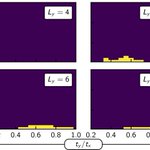


ALT (a) Central charge c extracted from the bipartite entanglement entropy using a scaling collapse for four legs and at most four bosons per site (Nmax=4). We find extended phases with one (c=1) and two (c=2) chiral bosonic edge modes. (b) These phases coincide with those found for a hard-core three-body repulsion (Nmax = 2). In both panels the gray region indicates very weak interaction strengths U/tx < 0.5 where for Nmax = 4 the central charge could not be deter- mined with the necessary accuracy.


ALT In panel a), the typical training procedure is displayed: we sample snapshots of the system, evaluate the energy, update the neural network parameters and repeat... Panel b) shows the training progress of the recurrent neural network (RNN) for an exemplary set of parameters. Panel c) shows the phase diagram for a bosonic Hofstadter model with long-range van der Waals interactions.


ALT BCC won a first price for mixed choir and prices for the "best performance of the compulsory work", the "best performance of a moronic folk song", the "beat developed and innovative program" and the highest rated choir (91% !🥳)


ALT (a) Possible experimental realization of the proposed measurement protocol using a synthetic bilayer Hofstadter-Hubbard system with internal states (1). (2) On one side of the system, the edges are coupled to obtain an effective single layer system. (3) Measurements of off-diagonal elements of the one-particle reduced density matrix are possible using a local pulse protocol involving both layers. (b) Correlations extracted from 10.000 numerical snapshots without any post-processing and with experimentally relevant errorbars from shot-noise. The algebraic decay of the two-site correlations of the composite bosons (red squares) can be clearly distinguished from the exponential decay of the original bosonic correlations (blue circles). (c) Tensor-network diagram of the extended perfect sampling scheme which allows for numerical snapshots of composite boson correlations equivalent to the ones obtained in the proposed experiment.
ALT In panel a), the typical training procedure is displayed: we sample snapshots of the system, evaluate the energy, update the neural network parameters and repeat... Panel b) shows the training progress of the recurrent neural network (RNN) for an exemplary set of parameters. Panel c) shows the phase diagram for a bosonic Hofstadter model with long-range van der Waals interactions.

ALT a,b) Energy per particle and c,d) Hubbard interaction energy of the ground state for two different system sizes and different numerical methods. a,c) For a small system of 6×6 sites we find excellent agreement between the NQS (red dots) and exact diagonalization results (solid lines). b,d) For a larger system of 12×12 sites and small or large magnetic flux we find excellent agreement between NQS and a matrix product state (MPS) simulation at bond dimension 2048. In the intermediate regime between α = 0.2 and α = 0.3 we find deviations in the energy and the Hubbard interaction energy. For bond dimension 32, the number of variational parameters for the MPS and NQS is comparable. Here, the NQS finds lower energy for all values of the magnetic flux For all simulations, we considered a Hubbard repulsion of U/t = 4 and a Hilbert space truncation to at most two bosons per site.


ALT (a) Possible experimental realization of the proposed measurement protocol using a synthetic bilayer Hofstadter-Hubbard system with internal states (1). (2) On one side of the system, the edges are coupled to obtain an effective single layer system. (3) Measurements of off-diagonal elements of the one-particle reduced density matrix are possible using a local pulse protocol involving both layers. (b) Correlations extracted from 10.000 numerical snapshots without any post-processing and with experimentally relevant errorbars from shot-noise. The algebraic decay of the two-site correlations of the composite bosons (red squares) can be clearly distinguished from the exponential decay of the original bosonic correlations (blue circles). (c) Tensor-network diagram of the extended perfect sampling scheme which allows for numerical snapshots of composite boson correlations equivalent to the ones obtained in the proposed experiment.
