

PhD student at @durham_history, studying society, governance, and politics on the 16th-century Anglo-Scottish borders. Funded by @wolfsonfdn.
Durham, England
Joined May 2019
- Tweets3.1K
- Following2.7K
- Followers1.5K
- Likes5.7K


Lovely gravestone in Holy Trinity church, Norton Malreward, Somerset.
This tender one
Be neath this
Stonn did hovrt
To none
The name is lost but they were the father of Henry and Mary Shepherd (?) and died 3rd June 1669.


Can anyone help with the pictured line?
"And Iohnes cristie armestronge of the stark /
hewght, ewill engles and a [???]. Albeitht the..."
I could swear that the second word is 'harlote', which... could be right, I guess? The first... 'arausue'?


2
1
348
St Mawes Castle, Cornwall. Built in the 1540s to guard the Carrick Roads from the threat of invasion from France and the Holy Roman Empire.


1
218

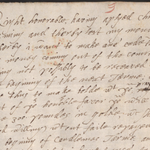
In December 1597, Thomas Scrope made an audacious request of Sir Robert Cecil. Having spent the winter at court and "aplyed Christmas gaming and therby lost my money", he asked for the immediate loan of "300. poundes in golde" to pay off his debts!


1
6
294

Can anyone suggest reading on the topic of early modern subjecthood--people's conceptualisation of the duties and responsibilities of the subject, and the mirroring responsibilities of their prince?
Going over my notes I don't have much *directly* on this specific topic.
Does anyone know of a resource for finding biographical information on 16th-century English Jesuits?
Alternatively, was it common for non-Jesuit priests to be mistaken for Jesuits?
I'm trying to work out the identity of someone referred to as "the Jesuit Dudley"...
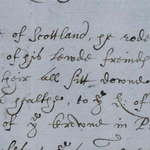
In 1601, the border officer Thomas Musgrave made two unlicensed journeys to meet King James, and on his return he and his "lewde freinds" went to a pub in Penrith where they "did their all sitt downe vppon their knees, and every man drunke a healthe to y[e] k[ing] of Scotts".

In 1602, Sir Robert Cecil had to write to George Nicolson, English agent in Scotland, to ask him what was going on between Lord Scrope and the Grahams in the west march, "be cause my lord writeth soe confusedly to and fro in this matter".


#OnThisDay in 1570, the forces of the rebel Leonard Dacre were defeated by a regime army lead by Lord Hunsdon in a bitter battle across a river on Geltsdale Moor. Hunsdon described Dacre's followers as giving "the prowdyst charge apon my shott that euer I saw".

Any suggestions for what 'in y[e] te[m]ple' in this family tree, scribbled by Burghley in 1596, might mean?
I assumed a reference to one of the Innes of Court but it seems strange not to specify which one, so perhaps it's something else?
(Or am I mis-transcribing it?).


1
3
1,121
Three women were mustered as horsemen in Northumberland in 1584: Widow Shepard of Dunstan, Widow Johnson of Embleton, and Widow Armorer of Lesbury.


In March 1597, the guy delivering a letter to Carlisle Castle "did loose the same in the Streete and myssing the same before he came to the castle came backe and sought the Streete agayne and founde the said letter and came to the saide castle to delyu[er] the same." Exciting!

Random privy council find, 17th August 1597: Richard Berd, former mayor of Wareham, claimed that the then-mayor had abused his authority and had him enlisted as a soldier on a "private grudge"--despite the fact he was 60 years old!
(PC 2/22 p. 352).

4
279
A broken record?
Two letters from Warden Thomas Scrope to Burghley, June 1596 and February 1597, the first complaining of the Grahams (an unruly border 'surname') and the second their allies the Carletons (a more or less respectable family of march officers) IN IDENTICAL TERMS.


2
9
690
Any experts on the Elizabethan privy council seen anything like this before?
A letter addressed as from the council as a body, but with different parts written as first person--"I the Secretarye" (Cecil), "I the lo[rd] chamb[er]layne" (Hunsdon), then back to Cecil.


A reminder of the personal dimension of early modern governance:
Sir Robert Cecil tells warden Thomas Scrope, "familiaritye began betweene vs in our younger yeares when neyther of vs thought of affayres... noe man wilbe more readye in anye thinge wherein I maye doe you honor".


6
384
In August 1596, Warden Thomas Scrope warned Burghley that the queen's lenient policy towards the unruly Grahams of Esk would "in shorte tyme to bringe the state of y[e] borders into the nature of an Anarchie or populer gouernem[ent], by their dispisinge of the princes lawes".

8
381
Random find: English map of the defences of Hulst, the Netherlands, 1596. It seems to be a snapshot view of the progress of Albert VII, who took the town in that year--two of the forts have been "wonne" by the enemy, but others are marked as "ours".
(SP 84/52 ff. 248 - 249).

In 1591/2, the English Captain Musgrave sheltered & assisted the Scot rebel Earl of Bothwell. James complained & Liz had him imprisoned.
Musgrave complained he had "latelye loste a great p[ar]t of his liuinge by the deathe of his wyffe" so couldn't afford prison--very romantic!

