Mothers Against Police Brutality (@FightingMothers) header
Mothers Against Police Brutality (@FightingMothers) profile picture

Advocate for impacted families through accountability and policy change https://nitter.cf/t.co/IGUdO7Lypo

Dallas, TX
Joined November 2013
Photo by Mothers Against Police Brutality (@FightingMothers)Photo by Mothers Against Police Brutality (@FightingMothers)Photo by Mothers Against Police Brutality (@FightingMothers)Photo by Mothers Against Police Brutality (@FightingMothers)Photo by Mothers Against Police Brutality (@FightingMothers)Photo by Mothers Against Police Brutality (@FightingMothers)Photo by Mothers Against Police Brutality (@FightingMothers)Photo by Mothers Against Police Brutality (@FightingMothers)Photo by Mothers Against Police Brutality (@FightingMothers)Photo by Mothers Against Police Brutality (@FightingMothers)
Aiyana Stanley-Jones was 7 years old. She was asleep on the couch when a Detroit police team raided her family’s home after midnight in May 2010. Officers threw a flash-bang grenade through the window, and the officer first through the door fired.
1
40
She was shot in the head and died. The police were looking for a murder suspect who lived on the other side of the duplex. A TV crew was even filming outside. The officer was tried twice, both juries deadlocked, and the last charge was dropped in 2015.
1
28
In 2019, Detroit settled with her family for $8.25 million. The Council on Criminal Justice recommends that police verify, more than once, who is in a home before a raid, including children. Who should have to verify who’s inside before police raid a home?
5
A no-knock warrant lets police enter a home without announcing themselves first. By one estimate, local police conducted 60,000 to 70,000 no-knock or quick-knock raids a year by 2010.
1
21
A New York Times investigation found at least 31 civilians and 8 officers died during no-knock raids from 2010 to 2016. Neither the federal government nor the states keep an official count. Only a handful of states ban them outright.
1
6
In the rest, it comes down to a judge’s approval. When should police be allowed to enter a home without knocking? What about when children are inside?
5
Every state lets some children be tried as adults, and how it happens depends on where you live. In some states a judge decides. In others, the law sends a child to adult court automatically, based on age and offense. In some, the prosecutor chooses, with no judge involved.
1
16
And some states have set no minimum age at all. A child tried as an adult can face adult sentences. Search your state plus “transfer to adult court” or “juvenile waiver” and see what it says: what's the youngest age, and who makes the call.
1
3
Then ask yourself if that's right.
1
The Supreme Court has said children are constitutionally different from adults in their culpability, because they’re less mature and more impulsive.
1
16
According to The Sentencing Project, 27 states and D.C. have banned it, and the U.S. is the only nation that sentences people to life without parole for crimes committed before 18.
1
3
As of 2020, more than 8,600 people were serving life with parole or sentences of 50 years or more for crimes committed under 18. What is the harshest sentence a child should be able to get?
1
We have rules for who can be around children. Background checks, mandatory reporting, limits on what adults can do. When it comes to police, there’s almost nothing.
1
16
The AP found in 2021 that no law specifically prohibited police force against children, and few use-of-force policies mention age. Since then, Connecticut passed a law limiting when police can handcuff children under 14. That’s one limit, in one state.
1
1
8
Meanwhile, about 45% of public schools had a school resource officer in 2017-18, an armed officer with arrest power. We protect kids from nearly every danger we can name. Why not the one we hand a badge and a gun?
5
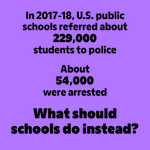
In the 2017-18 school year, the last full year before the pandemic, the U.S. Department of Education counted 229,470 referrals of students to law enforcement and 54,321 school-related arrests in public schools.
1
16
That matters beyond the day it happens. Research links adolescent arrest to more offending later, including into adulthood, even after accounting for who is more likely to get arrested.
1
2
A first court appearance during high school has also been linked to a higher chance of dropping out. So each of those arrests can follow a child for years. What should schools do instead when a child is in trouble?
1