

Anca at the movies | World Cinema in words and images | Former FlicksAndMore
Boston | Madrid
Joined May 2021
- Tweets18.7K
- Following1.5K
- Followers2.5K
- Likes162K







Anca at the Cinema retweeted

Le Samouraï (1967) dir. Jean-Pierre Melville
#NeoNoir #Noirvember
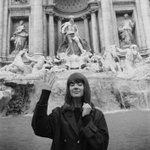
Françoise Hardy at the Trevi Fountain, Rome.
One coin tossed into the fountain, one wish to return to Rome. 🇮🇹


Berlin in Wings of Desire (1987) Wim Wenders
Wings of Desire (Der Himmel über Berlin) is also a portrait of West Berlin before the fall of the Wall. Wim Wenders explores a divided city through its streets, squares, libraries, monuments, industrial spaces, and vacant lots
Major landmarks and monuments
Siegessäule (Victory Column) — the golden Victory statue overlooking the city.
Kaiser-Wilhelm-Gedächtniskirche — the war-damaged Memorial Church and its modern bell tower.
Potsdamer Platz — the desolate, divided square where Homer searches for the Berlin of his memories.
Berlin Wall (Berliner Mauer) — the physical division of the city, including the border near Lohmühlenbrücke.
Anhalter Bahnhof — the ruined façade of the once-grand railway terminus.
Berliner Funkturm (Berlin Radio Tower) — visible in aerial views of the city.
Architecture and significant buildings
Staatsbibliothek zu Berlin, Potsdamer Straße — Hans Scharoun's modernist State Library, with its extraordinary reading room.
Hotel Esplanade — the historic hotel ruins used for the Nick Cave concert and scenes with Marion.
Hochbunker Pallasstraße — the massive Second World War air-raid bunker.
Pallasseum — the monumental modern housing complex associated with the bunker.
Franz-Klühs-Straße housing estate — the modern residential architecture surrounding Circus Alekan.
Europa-Center — a prominent commercial building in West Berlin.
Internationales Congress Centrum (ICC Berlin) — the futuristic conference complex.
Theater des Westens — the historic theatre visible in the city imagery.
Bridges, streets, and railway architecture
Langenscheidtbrücke, Schöneberg — the railway bridge where Damiel comforts the dying motorcyclist.
Lohmühlenbrücke — the bridge near the former East–West border.
Yorckbrücken (Yorck Bridges) — the railway viaducts.
Bahnhof Zoologischer Garten — the major West Berlin railway station.
U-Bahnhof Güntzelstraße — an underground station featured in the film.
U-Bahnhof Hallesches Tor — another station associated with the driving sequences.
Kurfürstendamm — West Berlin's celebrated boulevard.
Oranienstraße, Kreuzberg — one of the streets Damiel walks after becoming human.
Waldemarstraße — the street where Damiel awakens as a human being.
Goebenstraße, Schöneberg — where Damiel exchanges his armour for ordinary clothing.
4. Urban landscapes and public spaces
Großer Tiergarten — the great urban park surrounding the Victory Column.
Großer Stern — the monumental roundabout at the Victory Column.
Theodor-Wolff-Park site — formerly the vacant ground occupied by Circus Alekan.
Gleisdreieck — railway infrastructure and neglected urban terrain.
Mehringplatz — a residential square featured in the city's aerial imagery.
Lohmühlenplatz — near the Wall and the meeting place of the angels.
The vacant lots of Potsdamer Platz (above) is among the film's most important landscapes.

Anca at the Cinema retweeted

Happy 89th, Claude Lelouch
Claude Lelouch’s stylish classic A MAN AND A WOMAN 1966


Paris on Screen: The City in Passing
Cléo de 5 à 7 (1962) Agnès Varda
Places and architecture list ⬇️


Cléo de 5 à 7 (1962) Agnès Varda
Paris — Places and Architecture
Rue des Bourdonnais — The café Ça va, ça vient and the surrounding commercial streets.
Châtelet and Les Halles — The busy commercial heart of central Paris.
Pont Neuf — The historic bridge crossing the Seine.
The Seine — Riverbanks, bridges and views encountered during Cléo's taxi journey.
Boulevard Raspail — A major Left Bank boulevard.
Boulevard du Montparnasse — Cafés, traffic and the urban life of Montparnasse.
Le Dôme — The celebrated Montparnasse café.
Boulevard Edgar-Quinet — Street markets and everyday neighborhood activity.
Rue Huyghens — A quieter Montparnasse street associated with Cléo's journey.
Parc Montsouris — Landscaped gardens, winding paths, mature trees and a waterfall.
Place d'Italie and the 13th arrondissement — Streets and urban scenery along the later part of the journey.
Hôpital de la Pitié-Salpêtrière — Historic hospital complex with monumental courtyards and institutional architecture.
Carrefour de l'Odéon — Historic Left Bank intersection, surrounded by traditional Parisian buildings.
Place Denfert-Rochereau — Major square connecting Montparnasse with southern Paris.
Gare Montparnasse — Railway architecture and the surrounding transport district.
Rue des Artistes — Residential street and staircase near Parc Montsouris
The film's Paris is especially interesting for its ordinary urban architecture: shopfronts, cafés, apartment buildings, markets, metro entrances and streets, rather than famous monuments.


Rome on Screen: August on a Vespa
Caro diario (1993) Nanni Moretti
List of places and architecture ⬇️


Caro diario (1993) Nanni Moretti
Places and Architecture
Rome: The Vespa Chapter
Garbatella — residential courtyards, gardens, and apartment buildings
Spinaceto — modern residential architecture and urban planning
Casal Palocco — suburban villas, gardens, and residential streets
Villaggio Olimpico — modernist housing built for the 1960 Olympics
Flaminio — residential streets and twentieth-century architecture
Ponte Flaminio — monumental bridge over the Tiber
Monteverde — leafy residential neighborhoods and apartment buildings
Tufello — postwar residential housing
Vigne Nuove — late twentieth-century housing complexes
Via Dandolo — historic residential architecture and rooftop terraces
Via delle Sette Chiese — streets through southern Rome
Gianicolo (Janiculum Hill) — narrow streets and hillside architecture
Parioli — elegant residential streets
Piazza del Popolo — historic public square
Porta San Sebastiano and the Aurelian Walls — ancient Roman fortifications
Cinema Fiamma — historic cinema on Via Bissolati
Idroscalo di Ostia — waterfront landscape and the memorial to Pier Paolo Pasolini
The particularly interesting architectural sequence is Moretti's survey of Garbatella (1927), Villaggio Olimpico (1960), Tufello (1960), Vigne Nuove (1987), and Monteverde (1939)—a miniature history of twentieth-century Rome told through its housing.

Anca at the Cinema retweeted
#Bales2026FilmChallenge
Oct 29: Film made between 1990-2010 everyone should see
The White Meadows (2009)
Though it's an allegorical critique of Iranian society, its ideas feel universal. Its striking imagery & unconventional narrative make it a remarkable piece of cinema.

