

@FoodscapingCo
Account based inUnited States
About this account
- Account based in
- United States
- Connected via
- Web
Account-level information from X, not a live location or the device used for a specific post.
We are completely dedicated to transforming all land into food and beneficials growing areas, using Permaculture methods.
Eugene, Oregon
Joined October 2014
- Tweets5.4K
- Following2.6K
- Followers1.2K
- Likes787







People without any known direct contact developed comparable relationships with plants, involving selection, cultivation, seed saving, and the gradual alteration of inherited characteristics. Plants and #seeds inform #ProjectLichen
theconversation.com/ancient-… – at Veneta, OR

A computational architecture in which information is processed and interpreted as close as practical to its origin, while shared knowledge moves through a Distributed Data Matrix according to need, consequence and available capability. #ProjectLichen via #ECropolis. – at Veneta, OR

Things are moving blindingly fast. I understand the resistance to #AI and as a 78 year-old great grandfather I could be expected to join the opposition. However I would rather live and learn.

Did Google just automate the PhD?
Google researchers built an AI that reads a problem, forms hypotheses, runs experiments, writes the paper, and simulates its own peer review. No human steps in once the problem is set.
It's called ScientistTwo.
They gave it 107 problems from papers accepted at ICLR, ICML, and NeurIPS, and it beat the published human result on 86 of them.
The average gain over the human method was 25.2%.
The average paper took about 2.5 days and cost about $3,765 in model and compute costs.
Nine human reviewers compared 33 of these AI papers with accepted human papers. Their overall verdict was a tie.
The same paper has the less exciting numbers too.
The reviewers gave the human papers a small edge on methodological rigor.
The authors say it isn't producing spotlight-level work yet.
The median gain was 7.7%, so a few big wins pull the average up.
Without its checking agents, 19 of its 1,840 citations were fake, and one solution broke the task rules to get a better score.
With the checks on, both dropped to zero.
A researcher still has to pick the right question.
The AI cuts the wait for the answer to a few days.
Would you trust a paper if you knew an AI ran every experiment in it?
Paper's in the first reply 👇

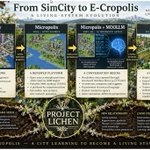
#SimCity was a unique game created back in the 1980's by Will Wright. The code was open-sourced with a GNU license and named Micropolis. Our intention is to create a #permaculture centric version under the name E-Cropolis as part of #ProjectLichen.
foodscaping.substack.com/p/e…

One more comment related this post and project we created a Github repo. It is an informative container for now but will grow in content as we progress. github.com/CFWHISPERER/e-cro…

I just wanted to apologize, the shortened URL created by X is not working, this is worrying as I wonder if this happened before. We are looking into it.
Turing proposed that interacting chemical substances, which he called morphogens, could produce spatial patterns through two processes: local chemical reactions and diffusion between neighboring regions. Aside from the evolution of computing, Turing's work drives #ProjectLichen – at Veneta, OR

And then it seems correct to ask when will the logical melding of #Bitcoin and #AI fully evolve? The #Bitcoin Nodes and the underlying network are the key and unique infrastructure. Never mind data centres imagine if the task were "we need to create 17,000-20,000 end-points"!

⚙️ 𝗔𝗴𝗲𝗻𝘁𝗶𝗰 𝗔𝗜 𝗘𝘅𝗽𝗹𝗮𝗶𝗻𝗲𝗱: 𝗧𝗵𝗲 𝗙𝘂𝘁𝘂𝗿𝗲 𝗼𝗳 𝗔𝘂𝘁𝗼𝗺𝗮𝘁𝗶𝗼𝗻
AI is moving beyond generating content.
The next phase is about AI that can 𝗽𝗹𝗮𝗻, 𝗿𝗲𝗮𝘀𝗼𝗻, 𝘁𝗮𝗸𝗲 𝗮𝗰𝘁𝗶𝗼𝗻 𝗮𝗻𝗱 𝗰𝗼𝗺𝗽𝗹𝗲𝘁𝗲 𝘁𝗮𝘀𝗸𝘀.
Here’s how Agentic AI fits into the bigger AI evolution:
1️⃣ 𝗪𝗵𝗮𝘁 𝗶𝘀 𝗔𝗴𝗲𝗻𝘁𝗶𝗰 𝗔𝗜?
• Advanced AI systems that can think, plan and act with greater autonomy
• The next evolution beyond traditional GenAI interactions
• AI agents that can execute tasks end-to-end instead of simply responding to prompts
2️⃣ 𝗛𝗼𝘄 𝗱𝗼𝗲𝘀 𝗶𝘁 𝘄𝗼𝗿𝗸?
Agentic AI brings together several technologies:
• LLMs + Deep Learning + RAG + Tool Calling
• Goal decomposition into smaller sub-tasks
• Memory layers to retain context across workflows
• APIs, apps, scripts and external tools to execute actions
Instead of asking AI to complete every individual step, you give it a goal — and the agent can determine the steps required to achieve it.
3️⃣ 𝗚𝗲𝗻𝗔𝗜 𝘃𝘀 𝗔𝗴𝗲𝗻𝘁𝗶𝗰 𝗔𝗜
𝗚𝗲𝗻𝗔𝗜 → Creates new content
𝗔𝗴𝗲𝗻𝘁𝗶𝗰 𝗔𝗜 → Takes actions, solves tasks and manages workflows
That shift from 𝗴𝗲𝗻𝗲𝗿𝗮𝘁𝗶𝗻𝗴 𝘁𝗼 𝗱𝗼𝗶𝗻𝗴 is what makes Agentic AI so important.
4️⃣ 𝗪𝗵𝗮𝘁 𝗺𝗮𝗸𝗲𝘀 𝗔𝗴𝗲𝗻𝘁𝗶𝗰 𝗔𝗜 𝗱𝗶𝗳𝗳𝗲𝗿𝗲𝗻𝘁?
• Multi-agent collaboration
• Real-time planning and reasoning
• Cost-aware and resource-optimized execution
• Self-correction and error recovery
• Feedback loops and evaluation
• Safety, governance and observability
5️⃣ 𝗪𝗵𝗲𝗿𝗲 𝗰𝗮𝗻 𝗔𝗴𝗲𝗻𝘁𝗶𝗰 𝗔𝗜 𝗯𝗲 𝘂𝘀𝗲𝗱?
→ Customer support automation
→ Lead generation and sales workflows
→ DevOps and analytics
→ Automated reporting
→ Finance, HR and operations
→ Data pipelines and business workflows
The possibilities go far beyond chatbots.
6️⃣ 𝗪𝗵𝘆 𝗱𝗼𝗲𝘀 𝗶𝘁 𝗺𝗮𝘁𝘁𝗲𝗿?
Because the future of AI may not be about having an AI assistant that simply answers your questions.
It could be about having AI that:
𝗣𝗹𝗮𝗻𝘀 → 𝗔𝗰𝘁𝘀 → 𝗖𝗵𝗲𝗰𝗸𝘀 → 𝗟𝗲𝗮𝗿𝗻𝘀 → 𝗜𝗺𝗽𝗿𝗼𝘃𝗲𝘀
That is the bigger shift:
From AI that generates answers → to AI that gets work done.
And Agentic AI could become one of the biggest building blocks of that transition.
❤️ Like
🔁 Retweet
🔖 Bookmark
Follow @sonalshukla3377 for more such posts
#AgenticAI #AIAutomation #GenAI #ArtificialIntelligence #MachineLearning

#ProjectLichen is a framework for reconnecting living systems, energy systems, human coordination, land use, technology and governance into one coherent design.
It begins with a deceptively simple question:
What capabilities remain?
projectlichen.github.io/

Thought provoking points here, however I would contend that #Bitcoin > blockchain > proof-of-work > difficulty-adjustment > halving > nodes have been equally cinsequential.

andrej karpathy spent 7 years inside OpenAI watching GPT go from 117M to 1T parameters. in 2024 he said: "the transformer architecture is the most important thing that happened in the last 50 years of computing."
not crypto. not blockchain. not the cloud. the transformer.
sam altman put $100B behind that bet. google restructured their entire company around it. meta open-sourced it to stay relevant.
everyone is using LLMs. almost nobody understands them. that gap is where the money is.
LLM is not a tool. it's infrastructure.
and in 2025 - not knowing how it works is the same as not knowing how electricity works in 1920.
here's what's actually happening inside:
your text doesn't enter the model as words. it gets broken into tokens - numerical IDs like 101, 4287, 318 - then mapped into 768-dimensional embedding vectors.
the model never reads language. it reads geometry. every word becomes a point in high-dimensional space, and meaning is distance between those points.
then comes the attention mechanism. Q, K, V matrices. the formula: Attention(Q,K,V) = softmax(QK^T/√d_k)·V.
every token votes on every other token. "bank" near "river" votes differently than "bank" near "money." the model learns context, not definitions.
Vaswani's 2017 paper called it "Attention Is All You Need" - and they were right.
scaling laws changed everything. Kaplan and OpenAI proved in 2020: double the parameters, performance improves on a predictable curve.
L(N) = AN^-α + B, where α ≈ 0.076. this wasn't intuition. it was physics.
Anthropic, Google, and Meta all built their roadmaps around this single equation.
then something unexpected happened. at a certain scale, models started doing things nobody programmed.
in-context learning. chain-of-thought reasoning. tool use. these weren't features. they were emergent.
GPT-6 Astra: ~1T parameters. 1M context window. MMLU score 92.1. outperforms humans across 57 domains.
the people making real money right now are not the ones prompting better.
they're the ones who understand the architecture - and build on top of it before the gap closes.
Bookmark & watch today.
know the infra or get priced out.
Another updated explainer on our E-Cropolis project, part of the overall #ProjectLichen goals. Most #food is eaten in towns and cities yet most is grown miles away from there. We are trying to #gameify this so we can grow food near to where we eat it.
archive.org/details/e-cropol…

E-Cropolis, our proposed game-level evolution to SimCity and Micropolis, proposes a careful extension: retain the city and its economic machinery, but allow it progressively to recover living capabilities. #ProjectLichen continues to emerge.

Can #computing merge harmoniously with #permaculture? In my case it has and this was my first foray into computing, a Sinclair ZX80. A BBC came next, then an IBM PC clone and then #ProjectLichen. – at Cornalba, Lombardia

There is,really no way to overstate the elemental importance of #seeds to our worldwide food systems. Patenting seeds and IP controls are an anathema to such systems and this was a key motivation in our creating #ProjectLichen. Because - Seeds Before Ego!

Blimey, lots more to learn here. I wonder what can happen when Jev meets #Seeds? Sounds like a #ProjectLichen tech conundrum. – at Veneta, OR

I STOPPED LETTING CLAUDE MAKE DECISIONS THE DAY I BUILT THIS JEV AGENT FOLDER
I used to let Claude decide, write and act on every single step
-> now Claude only writes. Jev makes the calls, code does the acting, and every step leaves a receipt
here's what's inside the folder:
• the input
> AGENTS.md - when to call Jev, when to skip it
> state/build_state.py - goal, workers, done, missing, constraint. evidence, never a summary
• Jev decides (questions/)
> route.py - which model tier gets the task
> next_worker.py - which worker acts next
> relevance.py - keep or drop each tool output
> done.py - is the goal actually met
> risky.py - does this send, pay or delete?
• code acts (rules/)
> hard_rules.py - stop after ten actions, never publish unapproved
> thresholds.yaml - act only on confident answers. fraud needs 0.95
• Claude writes (workers/)
> research.py - sources and notes
> writer.py - drafts and briefings
> the only place in the whole folder where text gets generated
• the proof
> receipts/decisions.jsonl - options offered, chosen id, re-check, fallback
> evals/ - dozens of my own labelled traces, thresholds tuned on them
• the guards (hooks/)
> pre_tool_use.sh - every command checked before it runs
> stop.sh - checks "all done" before the agent is allowed to stop
10,000 decisions for $0.42. median 300 ms
an LLM writes, Jev decides, code acts
Retaining the capability to reproduce #seeds after climatic disruption.
Hopefully our 2,556-variety collection, landrace development, seed multiplication and Fabaceae Food Forest experiments become something quite different from simply “saving seeds.”
secretlifeofseeds.com/p/seed…

Repletive vs depletive. – at Veneta, OR

Crop roots = standard oil well
Crop roots + mycorrhizal network = a fungal fracking system.
Just like their petroleum counterpart, the root+fungi system is extractive because we harvest the collected nutrients.
The difference is that we keep adding nutrients back to the soil.

ALT From Wikipedia. Root system extended by a mycorrhizal hyphae network.

This is the first part of a 3- part series on climate changes over millenia. It is well worth watching. 2 major points; first, water-vapour is incredibly important; second, ocean temperature change/rise is very impactful.
youtu.be/K6tWEjkEiZU?is=YSKm… – at Veneta, OR

The inconvenient truth for data-centre expansion.
Nearly 90% of annual upstream oil-and-gas investment since 2019 has been needed simply to compensate for declining production, rather than provide additional supply.
iea.org/reports/the-implicat… – at Cornalba, Lombardia

One of our main priorities with #ProjectLichen is building water retention strategies into our growing systems. The damage caused by ongoing fossil-fuels use needs to be mitigated, stridently.
yaleclimateconnections.org/2… – at Veneta, OR
