

Building Gurusup Brain in @GurusupHQ
San Francisco, CA
Joined May 2017
- Tweets157
- Following526
- Followers189
- Likes255






Pinned Tweet
Every prompt, skill, and subagent encodes a hypothesis about what the model can't do. When the model changes, those hypotheses need to be proven again.

Same email, same skill, four ways to run it:
→ Direct tools: 20 requests, 139 s, $0.018
→ Code Mode, small model: 21 requests, 109 s, $0.018
→ One program, large model: 5 requests, 108 s, $0.249
→ Saved program, small model: 4 requests, ~33 s, $0.008
Only the last one is cheap and fast at the same time, because the model writes nothing during the run.

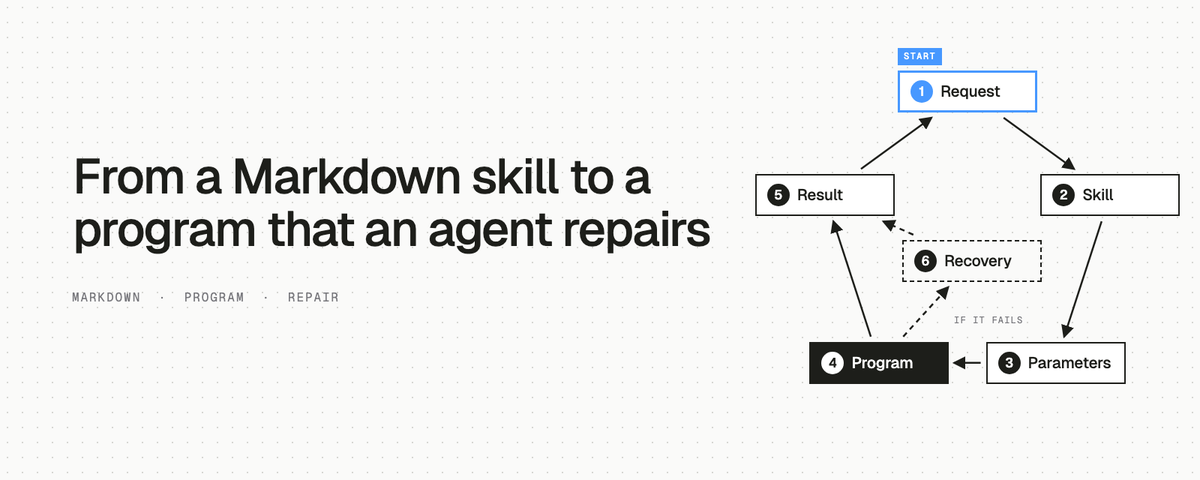
A skill in Markdown pays for the same reasoning on every run. I turned it into a saved program that an agent repairs from its own traces.
Built at @gurusuphq with Pydantic AI, Monty and Logfire (@pydantic) and @composio.
3
54


Francisco Pastor retweeted

I’ve been working on voice agents for a while, and one question keeps coming up: how do we keep a conversation flowing while the agent looks things up and takes action?
I’ve written down some of the challenges and what I’ve learned so far 👇


Every tool you add to an MCP server eats context before the agent has done anything.
Cloudflare's API has 2,500+ endpoints. One tool each would be 1.17M tokens, more than any model can hold. So they gave the agent two tools, search() and execute(), and let it write code against the spec. About 1,000 tokens.
More and more people are realizing what is possible with Code Mode approaches.
blog.cloudflare.com/code-mod…

1
36
Is RAG dead? Not really. But on its own it didn't cover what we needed.
This Wednesday at 1:00 PM CET I'm streaming live with @lambdaloopers and @VictorMolla14 on what a company actually gains with a company brain.
YouTube and LinkedIn Live:
linkedin.com/events/75262080…

1
53
The episode is out. Two hours on how we built a company brain, with Lambdaloopers
Not RAG. Not a folder of markdown in Obsidian.
What we learned:
→ RAG on its own didn't cover what we needed
→ Markdown second brains work for one person. Sharing them across a team through Git doesn't scale
→ Plugging in every MCP helps, until the agent fires 20-30 calls and stops before it reaches the source with the latest update
→ So: ingest everything raw, curate it with an LLM, and keep it as markdown a human can check, vectors and a graph
→ The ontology starts as a loose seed and grows from the data. A company can be a client, a partner or a supplier, and the system works that out
→ Permissions go before the search, not after. If you filter at the end, the model has already seen what it shouldn't
→ Conflicts between sources get flagged. Most reconcile on their own, the rest go to whoever knows
→ No retrieval agent summarizing for you. Your Claude or Codex does the searching
youtu.be/knueINqtmCU

3
162
I'll be in Berlin talking about agents with Pydantic AI at the PyAI meetup, hosted at @jetbrains' office.
Also on the lineup:
Jodie Burchell (@t_redactyl), on LLM evals as a measurement problem and Laís Carvalho (@lais_bsc) from @pydantic
100 spots: luma.com/pyai-s9dw

A skill in Markdown pays for the same reasoning on every run. I turned it into a saved program that an agent repairs from its own traces.
Built at @gurusuphq with Pydantic AI, Monty and Logfire (@pydantic) and @composio.
Claude Code's experimental Code Mode lets the agent write JavaScript to combine tool calls and filter results before they reach the model.
One implementation detail caught my attention: in auto mode, the classifier reviews the program before it runs. It doesn't see values computed during execution, like a file path returned by a search.
Each tool call still goes through deny/ask rules and PreToolUse hooks.
That distinction matters. Reviewing the program upfront and checking what it actually tries to do are two different jobs.
code.claude.com/docs/en/code…

2
109
some code only needs to exist for one task.
that's what interests me about Code Mode in Pydantic AI. The agent writes a small program to call tools, combine their outputs and filter what it needs. This keeps intermediate results out of the context and reduces model calls.
run it, use the result, throw it away.
if a piece turns out to be useful again, keep it. Otherwise, it's already done its job.
@pydantic

Code Mode in Pydantic AI is one line:
capabilities=[CodeMode(monty_sandbox=logfire.agent_sandboxes)]
The model writes one script that calls your tools, and Agent Sandboxes runs it. In our example, without that line, tokens and cost roughly double.
pydantic.io/jhQRw
1
36
A skill in Markdown pays for the same reasoning on every run. I turned it into a saved program that an agent repairs from its own traces.
Built at @gurusuphq with Pydantic AI, Monty and Logfire (@pydantic) and @composio.
Francisco Pastor retweeted

GuruSup's agents call their tools from Python they write, and Pydantic Monty runs it. The model reads the findings, not every intermediate response.
@GurusupHQ has built on Pydantic AI since Jan 2025 and handles 15M support messages a year.
pydantic.io/7xhMN

I live in a bubble and half the time I don't notice. I open X and it looks like everyone is running 20 agents in the cloud.
Then I go to an event in Amsterdam and the senior engineers I talk to haven't really touched AI yet, it just isn't part of their day to day. My friends at other companies are happy if they get access to a Claude Code subscription at all.
There are a lot fewer people deep into this than it looks from the timeline.
1
3
81
Recomendable seguir a @mattpocockuk
hace poco compartió su Home Repo
aihero.dev/the-home-repo-pat…


Working with agents across multiple repos is a pain
Where do you put the skills? The steering files? The tooling?
Let me propose a solution I've been using for months (that I thought was too boring and obvious to post)
It's a pattern called the Home Repo. Enjoy:
2
96
Someone compiled a 32-bit RISC-V CPU into the weights of Qwen3.5-4B, and I can't stop thinking about it.
Eleven extra layers, none of their weights are learned, a compiler computes every one. It runs code during inference, with no external tool or sandbox.
It's an experiment, the benchmarks are small and it doesn't beat the base model at reasoning. What caught my attention is what it opens up: one model mixing probabilistic interpretation with exact execution.
Some ideas I've been thinking on:
An agent that interprets a negotiation freely while a deterministic part holds the budget and the commitments
An agent that builds small tools for itself during a task, and keeps the useful ones as a library of skills
A memory that doesn't just store facts, it tracks which decisions depend on them, so changing one flags what needs review
And a way to test it without the weird architecture: same model, same tasks, three setups, external tools without reusable procedures, external tools with them, and internal execution. Measure accuracy, time, cost and failures from reusing procedures that no longer fit.
The model: huggingface.co/divagr1925/Qw…
How it works: github.com/divagr18/qwenpute…

1
2
57
Yes, that’s right. We’ve started adding some:
@happy_scribe – save all your calls in a brain
@zernio – have agents post on social networks using the content from the brain
@posthog – all your product information connected to the rest of your company’s data
We want more infrastructure for agents.

Founders, 👇
Tienes un servicio preparado para agentes? Deja aquí tu MCP.
En Gurusup el MCP se ha convertido en nuestro principal canal de leads y en uno de los principales de partners, porque nuestros agentes sin MCPs no tienen tools, así que cuanto más conectado esté el producto, más cosas pueden hacer.
Pon el tuyo en comentarios y vemos cómo ligarlo con @gurusuphq

Francisco Pastor retweeted

Founders, 👇
Tienes un servicio preparado para agentes? Deja aquí tu MCP.
En Gurusup el MCP se ha convertido en nuestro principal canal de leads y en uno de los principales de partners, porque nuestros agentes sin MCPs no tienen tools, así que cuanto más conectado esté el producto, más cosas pueden hacer.
Pon el tuyo en comentarios y vemos cómo ligarlo con @gurusuphq
Francisco Pastor retweeted
Our agents now write code to do their work. The hard part wasn't letting them. It was deciding what they still can't decide.
It started with a talk we took apart at our Hacker House. A day later, the first version was running in production for the @gurusuphq team.
Our agents were built around customer conversations: load the conversation, the instructions and the configured actions, then reply or run an approved operation. That still works when the procedure is predictable.
But on broader assignments the goal is clear and the path isn't. So instead of building a dedicated operation for every variation, we let the agent write more of the procedure itself.
It decides which steps to take, which tools to combine, what to delegate and when to ask a human.
It can't give itself a new permission, approve its own external action, or decide what state we keep.
That split shaped the runtime:
→ Code Mode lets the agent write the procedure in Python
→ Monty runs it within limits
→ Tools keep permissions at the boundary
→ Workspaces give it files and a shell
→ Temporal lets the work wait, recover and continue
We're not replacing every workflow with generated code. If you know the procedure and you'll repeat it, explicit app logic is still the better call.
If you're giving agents more freedom, write down first what they can't decide. The more they can build, the longer that list gets.
@juanse_VA wrote up the technical side, with code, execution traces and a live demo comparing tool calling vs Code Mode: nitter.cf/juanse_VA/status/21204…

