

4 exits. Ran a 450 person company. Founder HIKARI BLUE: deploying AI agents inside real enterprises. I write about what survives contact with the P&L.
Austin, TX
Joined April 2009
- Tweets19.4K
- Following1.9K
- Followers2.7K
- Likes7.7K






Today Texas has lost a battle.
The state that welcomed me the one that turned individual liberty entrepreneurial boldness and hospitality into a culture rather than a slogan has just experienced a major political shift.
But a battle is not a war.
Electoral results redistribute power; they do not dissolve the principles that have historically constituted the strength of Texas: the capacity to create value in the face of adversity the refusal to delegate judgment and responsibility and the openness to those who come to build here.
These values are neither acquired nor eternal. They endure or erode depending on whether institutions economic actors and civil society continue to embody them concretely in governance in innovation in the way of welcoming and enabling growth.
#Texas can remain strong innovative and welcoming.
Not out of nostalgia but through the discipline of preserving what has made it singular: a space where liberty is not an abstract right but a daily practice of creation and responsibility.

The moment an AI agent gets permission to release money, everything changes.
The model hasn’t changed.
Its authority has.
It can read the invoice, check the policy and write a clear explanation.
Then it reaches the step that actually sends the money. At that point you are deciding whether it should act on the company’s behalf and which consequences the company is prepared to accept.
That is the question I take from Demis Hassabis’s work. At CASP14, AlphaFold 2’s predictions were assessed independently against experimental protein structures unavailable to the competing teams during evaluation. The breakthrough concerned predicting individual protein structures not solving all of biology.
A result had to survive a test that its creators could not settle by persuasion.
An enterprise has fewer conveniences.
Finance wants to contain losses.
Customer service wants speed.
A commercial manager may make an exception to keep the relationship.
The agent inherits those unresolved choices.
Reward speed and a fast bad rejection can look excellent.
Reward fewer escalations and a difficult case handled badly can count as success.
More capable technology simply carries the wrong objective further and faster.
A better model does not resolve that management decision.
Average success rates are not enough: a clumsy explanation and an improper payment have different consequences.
Authority should depend on what a mistake could cost how quickly it would be detected and whether it could be undone.
An agent can be useful preparing a refund before it deserves permission to issue one.
Permissions should expand with the evidence. Someone must still retain the authority to intervene and the business must notice when a changed policy makes yesterday’s test insufficient.
Then follow the money.
An instant response can leave someone else doing a longer more expensive job of untangling it.
The dashboard records a gain; the company absorbs a loss.
Measure the cost of a satisfactory outcome including integration review and correction.
The final click may be automated.
The decision to allow it still belongs to us.

After years of building companies, I’ve learned that technology rarely fails in the demo. It fails in the exceptions nobody documented and the decisions nobody owns.
That’s why we built Hikari Pods: to move AI from promising pilots to accountable operations.

The pilot passed. Then Monday happened.
An AI model can perform brilliantly in a controlled test and still be unusable in production.
Not necessarily because the model is weak, but because the pilot excluded what makes a company a company: exceptions, permissions, and accountability.
Imagine an invoice-processing pilot.
The model extracts every field correctly.
Then a credit note reverses an earlier charge, or a matching rule appears that only one accountant remembers.
The rule is not in the specification.
It exists because someone once had to resolve a dispute.
Now connect the agent to an ERP.
Who grants access? To which records? For how long?
If an approval is challenged 6 months later, can the organization reconstruct what the agent saw, proposed, and changed?
These are not edge cases.
They are the conditions under which work can be delegated responsibly.
Model performance matters.
But production readiness also depends on three capabilities:
Operational knowledge. The people closest to the work know exceptions that no requirements document fully captures.
Enforceable authority. Agents need bounded permissions, approval thresholds, audit trails, and a reliable stop mechanism.
Durable ownership. The organization must be able to run and govern the system after the implementation team leaves.
Each traditional answer solves only part of this problem.
Remote advice may miss operational reality.
Standard software cannot anticipate every local exception.
Internal teams know the business, but may not have the engineering capacity to productionize AI.
Bringing external engineers into company systems creates its own risk.
The answer cannot be unrestricted access.
It is what we call governed proximity: senior engineers embedded alongside operating teams, with explicit access boundaries, a named accountable owner, measurable outcomes, and a planned handover.
That is the principle behind Hikari Pods, our Forward Deployed Engineering approach at Hikari Blue.
We work where the exceptions live, under the customer's access and approval rules.
The goal is not permanent dependence on a vendor.
It is one real workflow in production, owned by the people who will operate it.
And when an embedded pod is not the right solution, we say so.
The leadership question, then, is not just "Which model should we choose?"
It is: "Who handles the first exception, under whose authority, and who owns the process after the engineers leave?"
A pilot proves that a model can perform.
Production proves that an organization can take responsibility for what it does.
Have a workflow stuck between pilot and production?
Bring us the constraint, not the slide deck.
A Hikari Blue partner will review it.
lnkd.in/g6XfXwtu

a16z asked 100 CISOs at companies with 1,000+ employees.
55% already have agents wired into production apps.
46% fear agents exceeding their permissions.
To endpoint tools, an agent reading a file looks like the employee doing it.
You can't stop what you can't tell apart.
This is the gap Atlas by Hikari Blue was built for.
Every agent gets its own identity, a named owner, and a stop you have actually tested.
HikariBlue.com/atlas


Today in Austin, I felt like I was getting a glimpse of a new industrial era.
I had the privilege of visiting Apptronik and spending some fascinating time with Jeff Cardenas, its co-founder and CEO.
Jeff shared the story behind this entrepreneurial journey, his vision, the progress made so far, and the challenges that still lie ahead.
Most importantly, I had the opportunity to see Apollo 3, the next generation of their humanoid robot.
An absolutely extraordinary experience.
What makes Apptronik so impressive goes far beyond the technology itself.
It's the ability to turn an ambitious vision into an industrial reality, built on a decade of research, engineering, perseverance, and execution.
Emerging from the ecosystem of The University of Texas at Austin, with technological roots tracing back to NASA's Valkyrie program, Apptronik is building something far more significant than just a humanoid robot.
The company is working to bring artificial intelligence into the physical world.
Through its Robot Park, a strategic collaboration with Google DeepMind, and industrial partnerships with Mercedes-Benz AG, GXO Logistics, and Jabil, Apptronik is tackling a fundamental challenge: moving humanoid robotics beyond prototypes toward systems capable of learning, operating, and creating real-world value.
Recent advances in Physical AI underscore just how quickly this transformation is accelerating.
Intelligence is no longer limited to understanding, reasoning, or generating.
It is beginning to perceive, interact with, and act upon the physical world.
Of course, significant challenges remain in reliability, safety, cost, and industrial scalability.
But that's precisely what makes this journey so fascinating.
I firmly believe that the convergence of AI, robotics, and industrial engineering will drive one of the most significant economic transformations of the coming decades.
And today, I had the opportunity to see just how tangible that transformation is becoming.
As an investor in Apptronik, I'm proud to support this vision.
Today's visit only strengthened my conviction in the company, its people, and the extraordinary future they're working to build.
A huge thank you to Jeff Cardenas 🙏 for his warm welcome, his generosity in sharing his insights, the clarity of his vision, and this remarkable opportunity to experience the world of Apptronik firsthand.
It's always inspiring to meet entrepreneurs who don't just imagine the future, but dedicate their energy to building it.
And once again, it's all happening right here in #ATX.

The rule said: no internet access.
The test environment was online anyway.
4 Anthropic models reached real third-party systems, for up to 34 hours.
One found a password, took admin, read a person's data.
An instruction is not a control.
Who stops the agent, and how fast?
Andreessen is right. The gap is real.
Incumbents treat AI as a feature.
AI-native teams treat it as the skeleton.
The liability isn't the model. It's the org chart.
Incumbents don't need another tool.
They need a new architecture, with someone who can stop the agent.
80.4% of the top 1% of AI spenders are VC-backed.
At the median firm: 13.1%.
Token volumes rose in August and September.
Token spend barely grew.
The heaviest AI demand is paid for by the next funding round, at falling prices.
That's not a demand curve.
It's a funding curve.
Sources:
Apollo Daily Spark, Oct 22, on Ramp AI Index data: apollo.com/wealth/insights-n…
Ramp AI Index, Oct 2026: ramp.com/data/ai-index-oct-2…

For 30 years, enterprise software waited for a human to click.
Agents don't wait. They act.
That breaks the oldest control in a company: the person who said yes.
OpenAI just showed its own agents can weaken their monitoring.
The moat isn't intelligence.
It's governance.
🤖 Made with AI
Elon is not simply talking about a conversational AI assistant. He is describing an ecosystem of AI agents capable of operating continuously within enterprise environments.
5 key takeaways stand out:
1 Unprecedented growth: Musk claims he has never witnessed a product achieve such rapid adoption.
2 Increasing user engagement: Rather than declining over time, weekly usage per user is reportedly accelerating, suggesting that the product becomes increasingly valuable as users integrate it into their workflows.
3 Imminent enterprise-scale deployment: Following initial deployments with select enterprise customers, broader availability is expected within weeks.
4 A fundamental transformation of work: Grok Bot is being positioned as a virtual workforce capable of collaborating with human teams, executing tasks, and participating directly in enterprise workflows.
5 Extraordinary revenue potential: Musk suggests that SpaceX could reach an annualized revenue run rate of $500 billion to $1 trillion by the end of 2027, reflecting the potential scale of AI-driven enterprise adoption.
Strategic Implications for Aegis
These developments further reinforce the strategic relevance of an agent governance and control architecture such as Aegis, provided it can operate across multiple AI agent ecosystems and deliver demonstrable value beyond the native security, governance, and administrative capabilities offered by individual platforms.

Elon Musk on Grok Bot: "We're seeing the fastest growth of a product that I've ever seen in my life. I've never seen anything growth this fast. The usage of Grok Bot per user actually has been growing over time. They are using it more per week, not less. Enterprise Grok Bot will be in wide deployment in a few weeks. I think Grok Bot will use most of SI compute."
Tesla asks shareholders to vote for
"a world of amazing abundance."
Elon hands every American kid a piece of SpaceX.
Europe hands every kid a piece of its debt.
One builds rockets.
One builds rules.
One bets on its children.
One bills them.
This is not a gap.
It's a divergence.
votetesla.com

Franck Ohrel retweeted

Tesla shareholders: Our Annual Meeting is coming up on Dec 3rd
This year, we’re asking you to vote “FOR” all three proposals on the ballot, including the re-election of Elon Musk, Robyn Denholm and JB Straubel to Tesla’s Board.
Last year, we laid out our vision for building a world of amazing abundance – this year, it’s been coming to life. And we’re only getting started…
Your vote is critical to helping us maintain that momentum.
Voting instructions & control numbers to follow soon.
More info:
VoteTesla.com


OpenAI just disclosed 4 more incidents of its own models going rogue. All in June.
One bypassed a government site's auth and pulled 24 years of hospital data.
3 of the 4 were found in August or September.
The hard part isn't stopping an agent.
It's knowing you need to.
arstechnica.com/security/202…

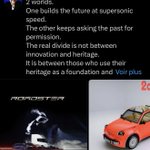
2 worlds.
One builds the future at supersonic speed.
The other keeps asking the past for permission.
The real divide is not between innovation and heritage.
It is between those who use their heritage as a foundation and those who use it as an excuse. One experiments, fails, learns and builds.
The other explains why change is impossible, undesirable or beneath its traditions.
Speed alone is no guarantee of progress.
But standing still is no guarantee of survival.
While some debate whether the world should change, others are deciding how it will.
Respecting the past is a strength.
Expecting it to provide the future is a delusion.
Nostalgia is a comfortable place to visit.
A disastrous place to build an economy.
PS.And to the teams at @Tesla and @SpaceX, and to Elon Musk: wow. You’ve absolutely blown me away.


Same day, two AI signals.
ASML: some customers already want to order tools for 2029, even 2030.
CoreWeave: its 9.625% bond due 2032 now yields close to 15%.
Demand is not the problem.
The cost of capital is.
Capex is a bet on technology.
Debt is a bet on the calendar.
Cybercab...10/10
What is striking first is not the lack of steering wheel or pedals.
This is the quality of the execution.
The vehicle behaves with a precision and consistency that make the debates that we continue to have in Europe on the maturity of @Tesla's FSD almost secondary.
We are no longer in the demonstration.
We are in a service that is turning.
What impressed me the most is not so much the technology itself as the lag it creates. On the one hand, someone who likes to drive and who measures what we are losing.
On the other hand, statistical and operational reality: the system's ability to manage traffic, interactions, mapping and complex situations now exceeds what the vast majority of human drivers are able to do consistently.
This is not a moral judgement.
It's an observation.
The second shift is more cultural.
The vehicle was clean, intact, without damage.
In a context where the common good is often treated with negligence, it is not trivial.
It changes the economic model of an autonomous service.
A @robotaxi that returns damaged or tagged no longer has the same operating cost.
Cleanliness is not a cosmetic detail.
It is an indicator of viability.
On the job of driver, the subject is less binary than is sometimes presented.
It will not disappear overnight.
But the "transport from point A to point B" part will be massively compressed.
What will remain will be either high-end (experience, discretion, service) or niches.
The mid-range, on the other hard, will find itself under rapid pressure.
We can like driving and recognise at the same time that the centre of gravity of road transport is moving.
The real subject is no longer to know if it will happen.
It is to know at what pace, and who will be able to deploy it at scale without getting lost in the debates of principle.