

Full-time swing trader. Those who have a 'why' to live, can bear with almost any 'how'.
Joined August 2022
- Tweets2.2K
- Following192
- Followers1.7K
- Likes3.8K




He kept one number from his wife until 2025.
About $33,000.
That's what Tito Adhikary @GnT_Trades lost in a single day in December 2021, his first year of trading.
Back then he was a Harvard PhD student in cancer research, living on a stipend of around $40,000 a year.
A $4,000 to $5,000 loss that morning snowballed into revenge trading, then trading on tilt.
And that same night, he had a dinner booked to celebrate his girlfriend's new job offer.
When Richard Moglen @RichardMoglen asked him about his biggest losses in this @TraderLion interview from March 2026, Tito told it plainly:
"I was at dinner and I just was not there in the moment."
"Like she thought I lost, I don't know, five grand."
"I didn't tell her that amount until 2025."
"It took a long time, several months for me to recalibrate."
Four years later, he won the 2025 US Investing Championship enhanced growth division with 2,115%, growing $48K into just over $1 million.
"You are your worst enemy. Identify your triggers and remove them."
If this week's red tape has you itching to win it all back, this interview is for you.
Thank you Tito for telling the part most winners leave out, and Richard and @TraderLion for giving the hard years real airtime in a conversation of nearly two and a half hours.
One more week like this, and $SPY could end the year in the red.


Good morning, traders.
The major indexes continue to gap down. $QQQ
If $SPY close this way, it will be the worst weekly close of the year, down 5.10%, and the worst since March 31, 2025 (down 9.07%.)
My plan for today is to sit tight, observe price action, and scan for relative strength.
My recommendation is to stay in cash here. if you want to take a risk, don’t do it with a large position, especially since you don’t want to hold large positions going into the weekend in this market environment.
3
242
Good morning, traders.
The major indexes continue to gap down. $QQQ
If $SPY close this way, it will be the worst weekly close of the year, down 5.10%, and the worst since March 31, 2025 (down 9.07%.)
My plan for today is to sit tight, observe price action, and scan for relative strength.
My recommendation is to stay in cash here. if you want to take a risk, don’t do it with a large position, especially since you don’t want to hold large positions going into the weekend in this market environment.


Ugly price action so far, on the day $ANT IPOs. Super curious to see how it will close.
1
354
Good morning, traders.
The market is gapping up in pre-market, led by software and AI. Tickers like $PANW, $BE , $CRWD are gapping up by as much as their ADR.
My focus today is on finding longs. I will not chase names that already open with a gap larger than their ADR%, or more than 70% of their typical daily move. Instead, I will watch how the market opens during the first 5 minutes. If the market sets a low, I will use that low to initiate longs.
Let's not forget that we are still in a downtrend. Both $SPY and $QQQ are below their 20, 50 and 200 day moving averages. I will act with caution.
Names on my watchlist: $NTSK , $PURR , $FROG , $BB , $CHYM , $LTH, $DUOL , $ELF , $AMD , $SPCX , $TQQQ .
Today is also the $ANT IPO. I will be active when trading opens. If I take a position, it will be a quick day trade targeting 2-3R. I never buy an IPO on the first day of trading with the intent to hold. Historically there is no edge in this, and it is pure speculation while the stock is still in price discovery.
2
7
631
Nothing in trading is set in stone.
There are many nuances to this profession.
Context matters, and small details can change how you read a setup.
1
4
373
The fastest way I know to get better at flat base breakouts is to study hundreds of charts.
Take every winning stock from the current and previous years, those with gains of at least 100%. Mark the support levels and the moment each one broke out.
Then simulate on the chart where you would have entered and where you would have exited.
Also mark the failed breakouts. Why did they fail? What was missing? What were the general indexes doing while that stock was trying to break out?
$DELL

Industry performance tells me where to focus.
It's the last step of my market check before execution.
I look at which industries are performing best, so I can figure out where institutional money is flowing.

5
396
April 1, 2020. Ariel Hernandez @RealSimpleAriel came home from a prison sentence.
On June 1 he started trading full-time.
He funded the account by selling a motorbike and a watch. It came to $30,000.
In his own words, the first leg took that account "from 30K to 3.5 million in 16 months.
A truly inspiring story, and someone I’ve learned a lot from.
This conversation is from August 2025. Then Ariel says something I keep replaying.
"Even for me with 2020 and 21, I learned a bunch of bad habits that took a while to break."
"It was a blessing for anybody who traded during that period, just like it would have been a blessing for anybody who traded during the dot com bubble."
"But that's not your typical."
"If you think about trading as like a 30 or 40 year career..."
"The most amount of money you're ever going to make is the last five year bracket of your career."
"So just be adaptable, right? Never stop studying."
With the Nasdaq down four sessions in a row this week, that long view feels right on time.
Hearing a trader with that record call his own breakout years a source of bad habits... That is a grounded man talking.
All credit to Ariel for putting it on the record, and to @Wordsofrizdom for 75 minutes of conversation worth every one.
Thank you so much. I really appreciate your comment.
I recently shorted $BE , $HUT , $RKLB , $LITE , $RIVN , and $CLMT , all with success.
For some I was using just a simple 5-minute ORB as my tactic. For others (like RIVN) I just waited for the first 30 min chop and then used the HoD as my stop.
It really comes down to the market environment and position sizing much more than the entry, the setup, or anything else.
Don't overthink it.

Hey, great content as always, and congrats on becoming a father! :) Question: For these short setups, what signals your entry? An intraday touch of the daily 10 EMA or a VWAP rejection/cross? And do you place your SL at High of Day or premarket high as you enter?
4
6
887
The man who turned $5,000 into $53 million over twenty years still says blowing up scares him.
Phil Goedeker @Tradestl is chapter five of Market Wizards: The Next Generation by @jackschwager and George Coyle.
The start was rough. His first two accounts, $3,000 each, were both lost in full. The $5,000 that finally worked came from a summer selling furniture for his father.
"Took me two years to become profitable," he says in this conversation.
It's from October 2025, when JJ @vwaptrader1 and Ray @AllxDayxRayx had him on @MarketMakerSins, just before the book came out.
He tells them about shorting DryShips in 2017.
"And I knew it was garbage."
"I lost a million dollars and I thought to myself... I will never do that again, never do that again."
Then he explains what he does today.
"I take paper cut, take paper cut losses."
"How many paper cuts can your finger take before it's amputated? I can take a lot."
"I don't want that amputation cut where I just get stubborn and then you're done."
"I still think about blowing up. It's scary."
According to the chapter, he has had exactly one losing year in twenty, and it cost him about $30,000.
Hats off to Phil for putting the million-dollar mistake on the record, and to JJ and Ray for the long, easy conversation.
I can never impose my will on the market.
@TheOneLanceB says it better than I can in Jack Schwager's newest Market Wizards book:
"The market doesn't care if you have a mortgage payment due. It doesn't care if you want a new car. It doesn't care if you want to set a new firm record. The market demands you size your trades objectively based upon expected value."
4
530
I find leading stocks by scanning for the biggest movers of the last few months.
@Qullamaggie 's advice: "you want to focus on leading stocks. One way to identify those stocks is to scan for the 1% or 2% stocks with the largest upmoves in the past one, three, and six months."
A trade has a much higher probability of working when it's a leading stock in a group with strong momentum.
Personally, I sort my scanner by 1-month combined with 3-month performance. That way I capture the more recent leaders.
In real-life trading, there is no such thing as a perfect flat base breakout.
Many of them will feel uncomfortable, and real-world examples rarely tick every box.
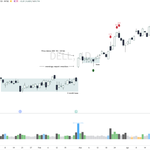
One trade I took was $DELL . It didn't follow all the rules. It was a combination of a flat base breakout and an EP. The price broke out of a two-month base with increased volume, then consolidated for the next 10 days.
I bought that undercut and rode it for about a 30% gain.
nd the whole move was roughly 300%. Who would have known? Haha, easy in hindsight.
Patterns like this form over and over again on hundreds of stocks.

8
672
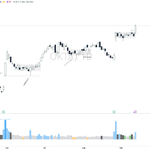
Entering too soon is the most common mistake in flat base breakouts, and I'm guilty of it as well.
Often I'm eager to get into a stock. The market won't serve up these trades on a silver platter. I have to be patient and allow at least 4 weeks for the base to form.
When that rule isn't followed, the price movements are much less significant.
Over time I've noticed that the fastest upward moves are the least sustainable. They're erratic movements that trigger stop-outs for both longs and shorts.
$OKTA

2
501
Anthropic($ANT ) is expected to start trading on Thursday.
A new IPO earns a spot on my watchlist only after it builds a structure.
Once a week, at the end of the week, I check my IPO screener. It looks for listings from the last year where price discovery is still underway: mid-cap, average volume above 1M and positive institutional transactions, a sign that big money is coming in.
I have included in the pictures the filters I use for the IPO screener.
Then I study the post-IPO chart: base, consolidation, breakout. I add only the stocks that are holding up well and have volume.


5
449
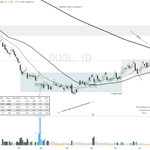
A beaten-down stock has to validate its base before I buy it.
One of my scanners looks for stocks that have been heavily sold off but are beginning to form a base. I never buy from it blindly.
First I want a clear base: tight consolidation, stabilizing volume. Then the first signs of a rebound: higher highs, higher lows, volume at the breakout. I keep my stop tight, because the rebound can be quick, but so can the failure.
$DUOL


I need stability outside the charts to perform well within them.
If my life is chaotic, my trades will reflect that. If my financial situation is unstable, I'll feel pressure with every decision.
Strained relationships affect my focus and emotional control.
Trading is already mentally demanding.
Add personal stress and it becomes exponentially harder to stay disciplined and consistent.
keep a clear routine and structure to your day.
2
8
393