
Emergency Physician - East Texas, Tour Medical Dir - Houston, Dallas Symphonies, Ex-Regional Director Envision, Juilliard-trained Violinist, Medical AI
Lufkin, TX
Joined January 2016
- Tweets3.6K
- Following2.4K
- Followers2.5K
- Likes12K







By its chief technology officer's count, AI wrote 90% of Proton's code in October. An internal Proton document says the company is not on track for its annual revenue target, citing insufficient velocity.
The CTO's AI memo to engineers, published by 404 Media, gives three reasons heavy AI use has not felt like a revolution there.
First, engineers treated AI as a way to write their own code faster. "Your job is to help the LLM write better code faster," he wrote.
Second, speeding up one step moves the bottleneck. Once code is cheap, the wait shifts to automated testing, design, approvals, and code review. He calls AI that speeds up tasks inside existing workflows phase 1, says the company is almost completely stuck there, and calls rebuilding the workflow itself phase 2.
Third, one engineer can change how they work alone. Rebuilding the process for a whole company takes organization and money that Proton had not yet invested.
He also wrote that expertise and accountability stay with the engineer.
Most of what I see in medicine is phase 1. An ambient scribe writes the note faster inside the same visit, the same inbox, and the same discharge process. Emergency medicine learned this lesson with patient flow. A faster front end does not open an inpatient bed.
The same reporting carries a warning. When an employee asked for a few days of security testing before a release, Proton's CEO called it "loser thinking." Employees described being afraid to raise security concerns.


Source: Joseph Cox, "Manifestos, Fear, and 'Loser Thinking' Inside Proton's AI Reckoning," 404 Media, Oct. 29, 2026: 404media.co/manifestos-fear-…
The memo is by CTO Bart Butler, posted to Proton's Slack in September and retyped by 404 Media. The 90% figure is Butler's, from meeting audio 404 Media obtained. The revenue line is from an internal Proton document. The "loser thinking" remark is CEO Andy Yen's, in Proton's security Slack channel in late August. Proton did not dispute the reporting; a spokesperson said some employees are unhappy with the company's direction or misunderstand it, that many are anxious, and that the company has sometimes been too blunt or too slow in explaining itself.


On Oct. 6, Rutgers mathematician Alex Kontorovich was at a math museum gala in New York with a whiskey in one hand, refreshing his phone. OpenAI was posting 722 math manuscripts produced by an unreleased model. Among them was a proof of a quasi-Riemann hypothesis, a result he did not expect to see in his lifetime.
"It was so far outside my model of what was possible," he said on Lex Fridman's podcast this week.
A month earlier, he gave a talk at Princeton on Lean, software that machine-checks every step of a proof. He was sure a Lean proof of Fermat's Last Theorem was at least three years away. Two days later, Anthropic released one: about 13 million lines, written in 11 days by dozens of Claude agents. Anthropic says human mathematical input was limited to occasional high-level instructions from one researcher.
He put the Fermat proof at a million times what he thought these models could do.
OpenAI says its average result took the equivalent of about three hours of ChatGPT Pro thinking. The results ran from number theory to complexity theory, and one model produced all of them.
The world vastly underestimates that breadth. Picture a thousand PhDs in different fields, working in one mind.
Medicine is built the other way. A hospital is a building full of specialists who page each other, because no one physician carries cardiology, nephrology, toxicology, and infectious disease at specialist depth.
MIT's Ankur Moitra raised the doorman fallacy on the same podcast: reducing a complex job to its most visible task. The classic case is the hotel that swaps its doorman for an automatic door and loses the security, the service, and the regulars he knew by name.
In mathematics, the visible task is the proof. In medicine, it is the differential diagnosis and the note. AI is making those cheap first. The rest of the job is choosing the question, hearing what the patient leaves out, and owning the decision at 3 a.m.
Mathematics has a checker. A proof written in Lean is verified step by step. Even so, OpenAI says roughly half its October results went out unconfirmed, and it withdrew three manuscripts the next day over a sign error.
Medicine has no Lean. Its checks are trials, outcome data, and physicians reviewing one patient at a time.
By the end of 2027, I expect a release like this in medicine: hundreds of AI-generated findings at once, and no Lean to check them.

Sources: Lex Fridman Podcast #503, Oct. 26, 2026 (Kontorovich from 1:09 to 1:17, quote at 1:11:14; Moitra on the doorman fallacy at 19:28): lexfridman.com/math-ai-crisi…
OpenAI, "Sharing AI progress in mathematics," Oct. 6, 2026 (average compute per result).
Retraction Watch, Oct. 8, 2026 (722 preprints on 372 problems; three withdrawn Oct. 7 after a sign error; 14 revised; an OpenAI spokesperson said roughly 50% of results were released unconfirmed).
Quanta Magazine, Oct. 19, 2026 (quasi-Riemann result; experts largely agree it is correct, and longer human write-ups are still circulating privately).
Anthropic, "Formalizing Fermat's Last Theorem," Sept. 4, 2026 (about 13 million lines of Lean, 11 days, dozens of Claude agents, checked by Lean down to its standard axioms; Anthropic credits its Prove2Me coordination platform for the agents' progress).
Caveat: the OpenAI manuscripts are preprints, and many results still await full human checking.
Falsifier: if no organization releases 100 or more AI-generated biomedical or clinical research results at once by Dec. 31, 2027, my prediction was wrong.

Kaiser Permanente took in $127.7 billion in 2025, more than the 42 systems at the bottom of Becker's list combined ($123.4 billion).
Becker's ranked 109 U.S. health systems by annual revenue. Together they took in $1.24 trillion.
1. Kaiser Permanente, $127.7B
2. HCA Healthcare, $75.6B
3. CommonSpirit Health, $40.1B
4. Advocate Health, $38.9B
5. UPMC, $33.6B
6. Providence, $29.5B
7. University of California Health, $25.9B
8. Trinity Health, $25.4B
9. Ascension, $25.3B
10. AdventHealth, $23B
11. Mass General Brigham, $22.8B
12. Northwell Health, $22.6B
13. Mayo Clinic, $21.5B
14. Tenet Healthcare, $21.3B
15. UT Health System (Texas), $20.8B
16. Sutter Health, $19.8B
17. Intermountain Health, $18.5B
18. Cleveland Clinic, $18.3B
19. Corewell Health, $17.6B
20. Universal Health Services, $17.4B
21. Baylor Scott & White Health, $17.3B
22. Banner Health, $16B
23. NYC Health + Hospitals, $15.9B
24. Jefferson Health, $15.8B
25. NYU Langone, $15.4B
26. Sentara Health, $14.2B
27. Bon Secours Mercy Health, $14B
28. Henry Ford Health, $13.1B
29. Mount Sinai Health System, $12.8B
30. SSM Health, $12.7B
31. Community Health Systems, $12.5B
32. BJC Health System, $12.1B
33. Novant Health, $11.9B
34. Sanford Health, $11.7B
35. RWJBarnabas Health, $11B
36. Northwestern Medicine, $10.6B
37. Mercy Health (Chesterfield, Mo.), $10.2B
38. Orlando Health, $9.9B
39. Hackensack Meridian Health, $9.76B
40. Christus Health, $9.7B
41. Beth Israel Lahey Health, $9.7B
42. Johns Hopkins Medicine, $9.6B
43. Indiana University Health, $9.5B
44. Stanford Health Care, $9.5B
45. HealthPartners, $9.3B
46. MedStar Health, $9B
47. Montefiore, $8.8B
48. Piedmont Healthcare, $8.8B
49. University of Michigan Health, $8.7B
50. Cedars-Sinai, $8.6B
51. Vanderbilt University Medical Center, $8.5B
52. Yale New Haven Health, $7.6B
53. Prisma Health, $7.4B
54. Adventist Health, $7.4B
55. University Hospitals (Cleveland), $7.3B
56. Wellstar Health System, $7.3B
57. Duke University Health System, $7.2B
58. MultiCare Health System, $7.2B
59. BayCare Health System, $7B
60. Hartford HealthCare, $7B
61. Froedtert ThedaCare Health, $7B
62. Baptist Health South Florida, $7B
63. OhioHealth, $7B
64. Presbyterian Healthcare Services, $6.8B
65. Inova Health System, $6.5B
66. Ardent Health, $6.3B
67. Allina Health, $6B
68. Allegheny Health Network, $5.7B
69. Sharp HealthCare, $5.5B
70. University of Kansas Health System, $5.4B
71. Oregon Health & Science University, $5.4B
72. Baptist Health (Louisville, Ky.), $5.2B
73. University of Chicago Health System, $5.2B
74. OSF HealthCare, $5.1B
75. Norton Healthcare, $5B
76. Scripps Health, $4.8B
77. St. Luke's University Health Network, $4.6B
78. Penn State Health, $4.5B
79. HonorHealth, $4.1B
80. Community Health Network, $3.8B
81. Parkview Health, $3.4B
82. University Health (San Antonio), $3.4B
83. Essentia Health, $3.2B
84. ProMedica, $3.1B
85. Aspirus Health, $3B
86. Tufts Medicine, $3B
87. Legacy Health, $3B
88. Moffitt Cancer Center, $3B
89. Hospital Sisters Health System, $2.9B
90. John Muir Health, $2.5B
91. CoxHealth, $2.4B
92. Deaconess Health System, $2.3B
93. Bronson Healthcare, $2.1B
94. MyMichigan Health, $2B
95. Hawaii Pacific Health, $2B
96. Benefis Health System, $1.9B
97. Valley Health System (Winchester, Va.), $1.6B
98. Catholic Health System (Buffalo, N.Y.), $1.6B
99. Denver Health, $1.6B
100. Centra Health, $1.4B
101. TMC Health, $1.3B
102. Inspira Health, $1.3B
103. Erlanger Health System, $1.2B
104. AtlantiCare Health System, $1.2B
105. Mercyhealth (Rockford, Ill.), $1.1B
106. Penn Highlands Healthcare, $1.1B
107. Palomar Health, $918M
108. Adena Health System, $815M
109. Altru Health System, $764M
Kaiser's figure combines its health plan, its hospitals, and Risant Health.
Epic took in $6.7 billion in 2025. On this list, it would rank 65th.
MUMPS was written at Massachusetts General Hospital 60 years ago. It still runs under some of the largest record systems in medicine. This series asked whether a modern language would serve us better in building and maintaining records that are safe, effective, and efficient.
I could not find a single study that compares MUMPS with a modern alternative on safety, defects, cost, or speed.
The money I could document comes to about $90 billion. Epic, which keeps its charts on a descendant of MUMPS, took in $32 billion from 2019 through 2025. The VA reported $2.3 billion to run VistA from 2015 to 2017. Replacing the three federal MUMPS records carries about $56 billion in estimates and contracts, $48 billion of it the VA's.
The evidence that does exist points in different directions. Epic was KLAS's top-rated record for large and midsize hospitals in 2026. VistA was up 99.9967 percent of the time in 2022, by figures cited at a House hearing. GAO says the VA is replacing it because it is technically complex, costly to maintain, and limited in sharing data. About 70 percent of the VA's MUMPS developers were eligible to retire in 2023. In a 2018 study, the same X-ray order took emergency physicians an average of 64 seconds and 31 clicks at one health system and 24 seconds and 8 clicks at another on the same vendor's record.
None of it isolates the language.
In medicine, we must prove small things to get funded. A new drug needs trials. A new device needs data. For the foundation under all that money, I found none.

How the $90 billion adds up, documented pieces only. Epic revenue: $32.2 billion for 2019 through 2025, as reported by Becker's Hospital Review (Epic is private). VistA: $2.3 billion for fiscal 2015 to 2017 as reported by the VA; GAO found only about $1 billion of it documented (GAO-19-679T). Replacing VistA, CHCS, and RPMS: about $48 billion, the VA's own estimate (Military Times, Sept. 3, 2026); $5.5 billion, the Defense contract award total (GAO-22-104521); up to $2.54 billion, the IHS 10-year contract. Not counted: hospitals' own staff and hardware, Epic before 2019, other VistA years, InterSystems licenses, MEDITECH, and systems abroad.
Not found by three frontier AI passes or the source check: an independent, modern benchmark of MUMPS platforms against other databases on a health record workload, or a controlled study of a language effect on defects, security, cost, or harm.
Other sources: KLAS 2026 Best in KLAS; House VistA hearing, March 7, 2023; GAO-23-106685; Ratwani et al., JAMIA 2018, doi.org/10.1093/jamia/ocy088
Part 6 of 6 in a series on MUMPS and what AI means for the code under our EHRs.

Epic pointed AI at its own code this year. The AI found security flaws its developers had missed.
On Aug. 18, Epic's security chief, Stirling Martin, said the company is a heavy user of Mythos, a restricted Anthropic model. "Despite a codebase that is several 100 million lines large, AI models can easily make observations that our expert developers can't see."
On Sept. 22, CEO Judy Faulkner said Epic was pausing most technology development for another six weeks to focus on security.
Martin later told The New York Times that some MyChart setups could let outsiders view patient records without the access appearing in the logs. I have not found a public description of the flaws, or a report that anyone used them.
Epic's languages include Caché, InterSystems' MUMPS platform. The reports do not say which language held the flaws.
Martin also told customers that patching within 30 days is no longer good enough.

Sources. Martin's Aug. 18 remarks: Becker's Hospital Review, Aug. 21, 2026 (Giles Bruce), and Fierce Healthcare, Sept. 23, 2026 (Heather Landi), which also reports Faulkner's Sept. 22 remarks. MyChart and the logs: Martin to The New York Times, Sept. 30, 2026, as reported by TechCrunch, Oct. 2, 2026 (Zack Whittaker): techcrunch.com/2026/10/02/me…
Languages: Epic's careers page. Mythos: Anthropic's Project Glasswing page (launched April 7, 2026), which says Anthropic does not plan to make the model generally available, and its June 2, 2026 expansion to healthcare.
Per TechCrunch, the model did not say whether the flaws could be used to alter records without detection. An Epic spokesperson told Fierce the development roadmap had not changed. Epic says it "does not have access" to customers' medical data.
Part 5 of a series on MUMPS and what AI means for the code under our EHRs.
Series drafted with Opus 5.5 Max with assist from Grok Heavy, 6.1-SOL, and Gemini 4 Argon.

AI models now read MUMPS well enough to document it.
In 2024, MITRE tested four models on 5,107 lines of VistA's code. Their comments were "highly readable and factual." In early trials, the models "would often alter the code to generate documentation."
In August, InterSystems tested 14 models on 140 tasks in ObjectScript, its descendant of MUMPS, one try per task. Scores ran from 0.515 to 0.851.
In September, it put models inside coding agents that compile and run their own code. DeepSeek V4 Flash scored 0.807 alone and 0.936 to 1.000 in eight agent setups.
InterSystems wrote, ran, and graded both tests.
Before these models, from 2005 to 2014, a contractor, TSRI, converted parts of VistA and the Defense Department's CHCS to Java and reported that "The translated code ran identically to the original code." Both agencies later chose Cerner.
I have not found a MUMPS test like OpenAI's Oct. 19 COBOL test, where every output must match the original exactly.
By the end of 2027, I expect one.

Sources. MITRE: Diggs et al., "Leveraging LLMs for Legacy Code Modernization," arXiv 2411.14971, Nov. 2024. InterSystems ObjectScript LLM Benchmark, run Aug. 17, 2026: github.com/intersystems-comm…
Nicholai Mitchko, ObjectScript Agent Bench, InterSystems Developer Community, Sept. 2, 2026. TSRI's own case studies. OpenAI, "Advancing coding in low-resource programming languages," Oct. 19, 2026.
In September, each setup got one try per task, run-to-run variance was not measured, and InterSystems says those scores "are not comparable to the first article." The 0.936 comes from its results table; its text gives DeepSeek V4 Flash 0.957 to 1.000.
Where this could be wrong: no MUMPS or ObjectScript migration test that requires identical output is published by Dec. 31, 2027.
Part 4 of a series on MUMPS and what AI means for the code under our EHRs.

The VA, the Defense Department, and the Indian Health Service each ran a health record built on MUMPS. All three chose the same replacement: Oracle Health, the former Cerner.
Defense signed in July 2015. Its last site went live in March 2024.
The VA signed in 2018. Seventeen VA sites run the new record, and Anchorage and Cleveland were scheduled for Oct. 24. The plan reaches all 170 medical centers in November 2031.
In August, the VA raised the contract ceiling from $10 billion to over $27 billion. Its own estimate to deploy and sustain the system: about $48 billion.
In 2024, the VA's pharmacy and patient safety leaders told its inspector general the new record "is fundamentally unsafe."
The Indian Health Service went live at its first three sites on Sept. 26.
The VA plans 26 more sites in 2027. I expect fewer.

Sources. Defense: Healthcare IT News on the July 29, 2015 award; health.mil on the last go-live, March 9, 2024. VA: Rep. Maxine Dexter's release, Sept. 2, 2026, on the ceiling; Military Times, Sept. 3, 2026, on the VA's estimate, the 2018 deal, and the 2026 and 2027 schedules: militarytimes.com/news/penta…
VA OIG report 23-01450-114, March 21, 2024. IHS: Nov. 8, 2023 selection of GDIT with Oracle Cerner technology to replace RPMS; Oct. 13, 2026 go-live release.
The $27 billion is a contract ceiling. The $48 billion is the VA's estimate for deployment through 2031 plus sustainment, and Deputy Secretary Paul Lawrence acknowledged it was not independent. Seventeen counts the six original sites plus 11 in 2026.
Where this could be wrong: the VA completes 26 or more site deployments in 2027. Basis for my call: 13 scheduled in 2026, half the 2027 plan.
Part 3 of a series on MUMPS and what AI means for the code under our EHRs.

About 70 percent of the VA's MUMPS developers were eligible to retire, a VA official told Congress in March 2023.
"MUMPS is not taught in computer science classes, and the pool of MUMPS programmers shrinks every year as they retire," said Daniel McCune, then the VA's executive director of software product management.
Rep. Matt Rosendale, then the subcommittee chairman, pushed back: "the numbers do not bear that out." In 2022, 1,129 full-time equivalents worked on VistA, the VA's MUMPS-based record system. Ten years earlier, 1,134.
McCune's reply: the VA's employees "have stayed long beyond what a typical workforce would stay."
The 70 percent "has been creeping up year over year."
Asked when the VA would last use VistA, he called it "an interim solution for an indefinite amount of time."
The VA's current schedule puts the new record system in all 170 medical centers by November 2031.
"Eventually we are going to start to lose them."

Sources. House Veterans' Affairs Subcommittee on Technology Modernization, VistA hearing, March 7, 2023, Serial No. 118-2, printed record of the spoken testimony: congress.gov/118/chrg/CHRG-1…
VA EHR deployment schedule, updated Sept 15, 2026: digital.va.gov/ehr-moderniza…
The 70 percent covers the VA's own MUMPS developers as of March 2023. The FTE counts cover everyone who worked on VistA.
Other witnesses saw it differently. Roger Baker, the VA's former CIO: "Even in saying MUMPS, what you are really saying is expertise about VistA as a large-scale application." Peter Levin of Amida Technology Solutions: "The single biggest problem with VistA, at least in my opinion, has nothing to do with MUMPS or the availability of language competencies of any individual programmer."
I could not find a published count of MUMPS programmers anywhere. If you know of one, I would like to see it.
Part 2 of a series on MUMPS and what AI means for the code under our EHRs.
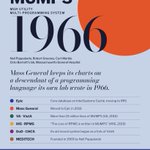
Mass General keeps its charts on a descendant of a programming language its own lab wrote in 1966.
The language is MUMPS, the MGH Utility Multi-Programming System. Neil Pappalardo, Robert Greenes, and Curt Marble built it in Octo Barnett's lab to manage patient records.
Epic's core database runs on InterSystems' Caché, now moving to IRIS. Both descend from MUMPS. Epic's careers page still lists Caché in its stack.
Mass General moved to Epic in 2016.
The VA's VistA held more than 15 million lines of MUMPS, by the VA's own count in 2010.
The Indian Health Service: "The core of RPMS is written in MUMPS," a 2019 HHS assessment found.
The Defense Department's old record system started as a fork of VistA.
InterSystems says its technology touches the health records of 2 out of 3 Americans.
Pappalardo went on to found MEDITECH in 1969. He died in January, at 83.

Sources. Greenes, Pappalardo, Marble, Barnett, Computers and Biomedical Research 1969;2(5):469-485 (MUMPS, developed 1966 to 1967).
NetApp, Epic architecture, Oct 2024: Chronicles moving from InterSystems Caché to IRIS. Epic careers page, accessed Oct 22, 2026.
Forbes, March 4, 2013: Epic and InterSystems "are rooted in an older programming language called MUMPS."
VA CIO Roger Baker, Aug 26, 2010, via Nextgov. HHS/IHS legacy assessment, May 14, 2019. InterSystems federal capability statement. MEDITECH, Jan 30, 2026. Boston Globe, April 5, 2016.
"Touches" is InterSystems' own word and figure. Epic has not published how much of its code is M. Today's platforms, InterSystems IRIS among them, are actively developed and run Python alongside M.
Part 1 of a series on MUMPS and what AI means for the code under our EHRs.
Drafted with Opus 5.5 Max based on input by Astra 6, Argon 4, and Grok-Heavy
Your hospital's traditional Medicare claims still run on COBOL and IBM mainframes.
That's from a CMS planning document. The four systems behind Original Medicare's fee-for-service claims, about 1.2 billion claims and $460 billion a year, "run on COBOL, Assembler Language Code (ALC), and IBM mainframes."
This week OpenAI reported that its newest model can translate COBOL into modern languages and pass hidden tests that demand byte-for-byte identical output.
At the same low setting, success went from 5.4 percent with GPT-5.6 Sol to 86.6 percent with GPT-6.1 Sol, at 61 percent of the cost. At higher effort, 97.9 percent.
Why should doctors and administrators care?
The rules that decide what gets paid live inside that code. CMS says a change takes a 7 to 9 month code cycle today.
Its replacement program, ClaimsCore, aims for hours or days. A proof of concept runs through January 1.
The hard part of these migrations is arithmetic. OpenAI's example: COBOL drops extra decimal digits unless told to round. A rewrite that rounds instead runs without errors and pays different amounts.
Across 1.2 billion claims, a half-cent difference per claim is $6 million a year.
Code migration has a mechanical check: run the old and new versions and compare the output. Models climb fastest on tasks with checks like that.
Billing code can be checked that way. Bedside medicine is checked by patient outcomes, which take years.
The clinical side has its own 1960s language. Epic and the VA's VistA are built on MUMPS, developed at Massachusetts General Hospital in 1966 and 1967.
OpenAI did not test MUMPS. If it follows COBOL, the cost of leaving an EHR falls with it.
My prediction: by the end of 2027, a ClaimsCore vendor says publicly that it used AI to pull Medicare's payment rules out of the COBOL.

Sources. OpenAI, Oct 19, 2026: openai.com/index/low-resourc…
CMS ClaimsCore statement of objectives, a pre-decisional draft published by Washington Technology, June 2026: washingtontechnology.com/med…
MUMPS: Pappalardo, Greenes, and Marble, Massachusetts General Hospital.
OpenAI does not publish the test set or program count, and gives no high-effort score for GPT-5.6 Sol, so the clean comparison is at low effort. OpenAI says production use "still requires expert review and testing against the system's business rules and dependencies." The CMS dates are from a draft and may move. The half cent is an illustration. OpenAI did not test MUMPS.
Where this could be wrong: if Medicare's payment rules live mostly outside the code, in manuals and contractor edits, migration speed stops being the bottleneck.
Drafted Argon 4 and Opus 5.5 Max
