

“Become a saint, and do so quickly.” Saint Pope John Paul II. “Ite Ad Joseph” (Go to Joseph)
Nederland, TX
Joined December 2012
- Tweets2.3K
- Following567
- Followers256
- Likes844






RetiredStatePoliceLT retweeted

The Blessed Virgin Mary was Immaculately Conceived and the only human to be born free from Original Sin. She remained a virgin her entire life. She was 100% sinless during her life. She is the new ark of the covenant. She was taken up body and soul into Heaven. She is the Queen of Heaven & Earth with the highest place in Heaven above all the Angels & Saints. She is our intercessor, our advocate in Heaven to the King. Ave María 🌹


RetiredStatePoliceLT retweeted

If I come across a Fr Mark Beard video
I post the fr Mark Beard video
I will not apologize


RetiredStatePoliceLT retweeted

What St Joseph Taught Me About Fatherhood
For most of my life, I ignored St Joseph. He didn’t say anything (at least verbally) in the Bible and I thought he was just an afterthought.
Boy, was I wrong.
St. Joseph fatherhood shows us a powerful example of what it really means to provide for others, not just with money or material things, but with love, presence, and trust in God.
Read more here:
catholicworldmission.org/pos…

RetiredStatePoliceLT retweeted

All 7 Catholic Sacraments are in Scripture:
💧 Baptism (John 3:5)
🍞 Eucharist (John 6:51)
🙏 Confession (John 20:23)
🕊️ Confirmation (Acts 8:14-17)
💍 Marriage (Matthew 19:6)
✝️ Holy Orders (1 Timothy 4:14)
🩹 Anointing of the Sick (James 5:14-15)
Biblical and Apostolic 🔥💧


RetiredStatePoliceLT retweeted

Why does Mary look younger than Jesus in Michelangelo's Pietà?
The answer is one of the most beautiful in art history...
Mary is holding the body of her 33 year old son, but she looks 20. Critics noticed it the moment the sculpture was unveiled in 1499. The mother of a man who has just been crucified would have been in her late forties or early fifties. Michelangelo had carved her as a girl.
His own biographer, Ascanio Condivi, was the one who finally asked him why. The answer Michelangelo gave is preserved in Condivi's Life of Michelangelo and has been repeated for centuries: "Do you not know that chaste women stay fresh much more than those who are not chaste? How much more in the case of the Virgin, who had never experienced the least lascivious desire that might change her body?"
Most modern critics treat this answer as a half-serious deflection. Michelangelo was famous for his sharp tongue and refused to explain himself to people he considered beneath his intellect.
The deeper answer is older, and it lies inside one of the greatest poems ever written. In the final canto of Dante's Paradiso, Saint Bernard of Clairvaux begins his prayer to the Virgin with one of the most extraordinary lines in Italian literature:
"Vergine madre, figlia del tuo figlio."
"Virgin mother, daughter of your own son."
Michelangelo, who knew Dante by heart, was carving that line into stone. Mary is younger than Jesus because Jesus is older than the universe... because she gave birth to her own creator.
But there is another reading, simpler than either of those, and it is the one I find myself thinking of today. Every mother who has held her child has held them at every age at once. The infant is still inside the toddler. The toddler is still inside the teenager. The young man on her lap, even dead, is also the boy she nursed and the baby she first carried home.
And maybe that's why Michelangelo did not carve Mary as the years had aged her. He carved her as love had kept her: outside of time, outside of grief, holding her son the way she had always held him...
Happy Mother's Day.
-- -- --
If you enjoyed this, I write a weekly newsletter read by over 50,000 people who love rediscovering the beauty of the past. You can join us here:
James-lucas.com/welcome
I write about beauty in all its forms. If you'd like to support my work, a paid subscription is what makes it possible.
RetiredStatePoliceLT retweeted

“In Joseph … heads of the household are blessed with the unsurpassed model of fatherly watchfulness and care.”
-Pope Leo XIV

RetiredStatePoliceLT retweeted

St Joseph The Worker
St. Joseph (1st c.) was born in Bethlehem in Judea and later settled in Nazareth. By Divine command he became the husband of the Virgin Mary and adoptive father to God Incarnate. We know from Scripture and Tradition that St. Joseph was a virtuous man and a carpenter by trade. It was he who was entrusted with the great mission to guard, protect, and provide for the temporal needs of God's most precious gifts, the Blessed Virgin Mary and the Child Jesus, in the role of husband and father within the Holy Family. St. Joseph's mission continues from heaven as the patron saint of the Catholic Church. He is also the patron of many causes including fathers, laborers, and families. His feast days are: St. Joseph the Husband of Mary on March 19th, and St. Joseph the Worker on May 1st. Pope Pius XII instituted the feast of St. Joseph the Worker in 1955 to emphasize the dignity, meaning, and value of human work in the eyes of God, and to give all laborers a model of virtue as well as a heavenly intercessor and protector.
TheCatholicCompany

RetiredStatePoliceLT retweeted

How the Original Apostles Died: Witnesses Who Gave Everything for the Risen Christ ✝️🙏
1. Simon Peter — Crucified upside down in Rome around 64-67 AD under Emperor Nero, at his own request because he felt unworthy to die exactly as Jesus did.
2. Andrew (Peter’s brother) — Crucified on an X-shaped cross (St. Andrew’s Cross) in Patras, Greece, where he preached for two days while hanging.
3. James the Greater (son of Zebedee) — The first apostle martyred; beheaded by King Herod Agrippa I in Jerusalem around 44 AD (Acts 12:1-2).
4. John (brother of James) — The only apostle traditionally believed to have died of natural causes in old age at Ephesus, after surviving exile and persecution.
5. Philip — Preached in Asia Minor and is traditionally said to have been crucified or martyred in Hierapolis.
6. Bartholomew (Nathanael) — Traditionally flayed alive (skinned) and then beheaded or crucified in Armenia or India while spreading the Gospel.
7. Thomas (Didymus) — Preached in India and was speared to death by soldiers for his bold witness to the Risen Christ.
8. Matthew (the tax collector) — Traditionally martyred in Ethiopia or Persia, often described as being stabbed or killed while evangelizing.
9. James the Lesser (son of Alphaeus) — Traditionally thrown from the pinnacle of the Temple in Jerusalem, then stoned or clubbed to death.
(Note: The remaining apostles — Simon the Zealot, Jude/Thaddaeus, and Matthias who replaced Judas — also have strong traditions of martyrdom by crucifixion, clubbing, or other means in distant lands. Judas Iscariot died by suicide after his betrayal.)
These ordinary men, who once fled in fear, became fearless witnesses after encountering the Risen Jesus. Most refused to recant even under torture — a powerful testimony that they truly saw and believed He conquered death.
Their blood became the seed of the Church.
Which apostle’s story inspires you the most, or how does knowing their sacrifices strengthen your own faith today? Share below 👇
#Apostles #Martyrdom #Catholic

RetiredStatePoliceLT retweeted
Jesus Christ is my Savior.
He is the source and summit of every Catholic’s faith.
All praise and glory and honor to Jesus Christ, now and forever, Amen.
God bless you.🙏🏻

RetiredStatePoliceLT retweeted
Human language falls silent before the mystery of the resurrection. Only one word remains HALLELUJAH!
Happy Easter!


RetiredStatePoliceLT retweeted

Reclaim Holy Saturday
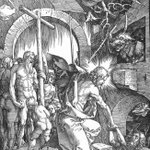
On Holy Saturday, the Early Church contemplated a cosmic triumph: the Harrowing of Hell. This ancient doctrine, rooted in Scripture (1 Peter 3:19-20, Ephesians 4:9), teaches that after His crucifixion, Christ descended into the realm of the dead, shattering the gates of Hell, liberating the righteous souls held captive, and proclaiming victory over Satan, death, and sin. Early Christians, from Ignatius of Antioch to the Cappadocian Fathers, saw this as the decisive moment when Christ’s divine power crushed the demonic stronghold, fulfilling His role as the New Adam who redeems humanity’s fall. The Apostles’ Creed echoes this: “He descended into Hell.”
The Early Church revered Holy Saturday as a day of awe, reflecting on Christ’s conquest over the infernal powers. Liturgies and homilies, like those of Melito of Sardis, vividly depicted Jesus storming Hades, binding the devil, and leading the patriarchs to glory. This wasn’t a mere footnote—it was central to the Paschal mystery, showing Christ’s total dominion over evil.
Yet, the Modern Church often overlooks Holy Saturday, reducing it to a quiet pause before Easter. We’ve lost the fire of this truth: that Christ’s descent was no passive act but a victorious raid on Hell itself. Today’s sermons rarely unpack this, focusing instead on the Cross or Resurrection, sidelining the day when Death was defeated and Satan’s grip broken. Holy Saturday is Christ’s ultimate flex—His divine power trampling demonic sin and freeing souls for eternity.
Let’s reclaim this day. Holy Saturday isn’t just a liturgical gap; it’s the celebration of Christ’s absolute sovereignty over Hell, Death, and the Devil. The Early Church got it. We should too
Christ is King
RetiredStatePoliceLT retweeted

And like every year, start your Holy Saturday with the epic and moving meditation of Saint Epiphanus on what Christ did on this day of silence:
(and smile about the little squashed demon under Jesus' foot)
vatican.va/spirit/documents/…

