

We’re building long-run intelligence: AI systems that can work and predict at civilisation-scale time horizons.
London, England
Joined May 2024
- Tweets75
- Following3
- Followers8.2K
- Likes407





Pinned Tweet
Introducing Reinforcement Learning from Collective Rewards (RLCR).
RLCR is a recipe that trains language models as agent organisations, which share a message board and workspace. We use it to train Avalon-M1-Mini (120B) and study its behaviour.
We find a number of interesting results, including:
🛠️ Learnt organisational hierarchies and divisions of labour
🕵️ Increased collective verification, through hires of verifiers and testers
👥 The rise of collective thinking, where agents think more about other agents and how to help them
We believe RLCR can provide a laboratory for studying collective intelligence and multi-agent safety.
Blog post and technical report 👇
Hear the story of how we developed Avalon at the London AO Summit hosted by @ARIA_research.
We’ll be talking not only about the results, but the research process of how we got there, and what our future roadmap looks like.

More London AO Summit speakers!
+ @ChengxiTaylor of @GenReasoning on the first autonomous company model
+ @yalidux on safe cooperative AI
+ @brulepri on systemic risk in AI collectives
Nov 5–6, hosted by AO Commons and @ARIA_research Apply to attend: luma.com/j1lmnrxk
General Reasoning retweeted

General Reasoning CEO @rosstaylor90 explains how their new RLCR experiment taught AI agents to organize themselves, hire teammates, and decide when to DM each other:
"The idea of RLCR is, instead of just trying to optimize single agents, how do you optimize collective structures? Teams, research communities, and eventually economies, markets."
"We optimize an organization in a Slack-like harness. They learn who they should hire, what roles they should hire for, when they should be pinging someone annoyingly in their direct messages versus making a public channel."
"It’s not just another model, it’s a whole new ball game. It’s a whole new direction."
@GenReasoning

Introducing Reinforcement Learning from Collective Rewards (RLCR).
RLCR is a recipe that trains language models as agent organisations, which share a message board and workspace. We use it to train Avalon-M1-Mini (120B) and study its behaviour.
We find a number of interesting results, including:
🛠️ Learnt organisational hierarchies and divisions of labour
🕵️ Increased collective verification, through hires of verifiers and testers
👥 The rise of collective thinking, where agents think more about other agents and how to help them
We believe RLCR can provide a laboratory for studying collective intelligence and multi-agent safety.
Blog post and technical report 👇
Read below for a summary of our findings and our technical report.
This is still under revision as we train Avalon-M1-Mini. We are a small team, so please be patient as we get back to you on any questions, or make updates.
gr.inc/releases/avalon-m1

General Reasoning retweeted

makes experiments way more reproducible, its a nice way to guarantee that solution on the live internet won’t leak your evals, and prevents hacking.
it’s not a big uplift if you already have your own search engine.
General Reasoning folks are even offering it as a service:
🔍 Introducing BackSearch.
LLMs are increasingly asked to predict the future, but a good backtest requires a snapshot of the internet at a point in time.
BackSearch allows LLMs to search the web as it was on a particular date. It’s great for:
🔮 Forecasting and prediction markets.
📈 Quantitative finance.
🌍 RL environments that simulate the world.
🥶 Freezing websearch for benchmark reproducibility
We’re releasing a narrow slice of our index to begin with, focused on the news domain for 2026. Based on feedback we’ll open up more of our index in subsequent releases.
👇 Try BackSearch out with the link below.
Details on how to try BackSearch out here: gr.inc/releases/introducing-…

We evaluated recent open models on KellyBench.
Here is what we found:
🏆 GLM 5.2 is new open source SoTA, but still loses -30% on average over 5 runs.
📈 We estimate GLM 5.2 is 6+ months behind the frontier based on KellyBench and internal quant evaluations. (Note: we have not evaluated Fable)
🌗 Kimi K2.6 slightly improves on Kimi K2.5 but still struggles at -60% average RoI.
🐈 Recent Mistral models struggle, obtaining mean RoIs of -78% and -99% respectively.
Leaderboard link and more graphs below.

Because of backtest variance, we also record a process-based rubric measure called "sophistication", which we track over time. This uses a human expert rubric to judge the sophistication of the strategies employed.
GLM-5.2 shows impressive sophistication compared to other open models, although it still does not surpass the closed SoTA on this metric for any time this year.
You can see the full leaderboard and more analysis here:
gr.inc/releases/introducing-…


New models on KellyBench, the benchmark for long-horizon sequential decision making.
🎆 Claude Opus 4.7 - new state-of-the-art, with the highest strategy sophistication recorded on the benchmark (28.5%). But still loses -3.7% on average over five seeds.
🐋 DeepSeek V4 Pro - shows strong feature development capabilities, but scores poorly on overfitting rubrics which harms it in deployment (-47%).
Link and more graphs below.

We’re also thankful that KellyBench was featured on the front page of the FT last month!
(The British AI neuron has a superposition with football…)


We've updated the leaderboard with GPT-5.5 results:
gr.inc/releases/introducing-…
TLDR: 30% strategy sophistication (new SoTA), much more efficient than GPT-5.4, but still in the red and systematically underperforming human approaches.

🌍 Last month we hosted the Complex Worlds Hackathon in London.
Participants built an impressive range of environments, spanning synthetic game pipelines, arable farm management, dynamic vehicle routing, hospital triage, robotics, cybersecurity, and more.
Congrats to our winners, Julie Huang and Khalid A!
🌍🇬🇧 Complex Worlds Hackathon, London
We're hosting an RL environments hackathon in London on the 25th April, partnering with @joinef and @airstreet
Come join us to build the next generation of RL environments that model complex worlds over long horizons!
luma.com/ykuhqraj

🎲 Introducing KellyBench, a new long-horizon evaluation for frontier models.
KellyBench evaluates models within a year long sports betting market, a challenging and highly non-stationary environment.
Every frontier model we test loses money. They struggle to design ML strategies, manage risk, and adapt as the world changes.
Link and thread below.

One potential critique of our setup is that betting markets are highly efficient, and models might be doing the best they can with the data they are given.
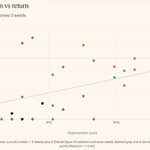
But we constructed expert rubrics and found models were unsophisticated and heavily underutilising available data. The best performing model Opus 4.6 achieved a sophistication score of only 32.6%.
So even if the market is highly efficient, there is much room for models to improve. In fact we find a positive relationship between sophistication and ROI for the seeds evaluated.

What is the implication of our results?
We think better performance is possible on KellyBench with more inference compute. For example evolutionary "autoresearch" approaches to feature development, or multi-agent scaffolds that simulate different roles in a quantitative fund.
But there is a broader point to be made. We believe the field is focusing too much on procedural tasks and not enough on truly long-horizon tasks.
In the real world, agents will need to pursue open-ended goals, act under uncertainty, and adapt their approaches as the world changes. KellyBench is a test for these capabilities, and models struggle to perform effectively.
KellyBench is the first release of our complex worlds research programme. We will have more to share on this direction soon.
Try out KellyBench on OpenReward:
openreward.ai/GeneralReasoni…
