

Where the government's tech-minded executives come to learn.
Washington, DC
Joined June 2017
- Tweets12.9K
- Following2.1K
- Followers2.1K
- Likes962




Drones are only as useful as the network behind them.
“A swarm without C2 resiliency is just a target,” said Lt. Col. Jimmy Payne, J6 director at Special Operations Command Korea, at TechNet Indo-Pacific, as adversaries work to contest satellite and terrestrial networks.
Payne said the goal isn’t just more bandwidth but making sure forces can still communicate and share critical data when links fail.
See why Payne says coalition C2 must be “designed from day one, not a bolt-on after the first shot”: govcio.social/3UpKBOS
Military allies can cut targeting latency "by minutes into seconds” with common data standards, according to Brig. Chris Alder, Australian Army Vice Director for Intelligence at PACOM, speaking at TechNet Indo-Pacific.
To speed up the targeting cycle further, PACOM is turning to agentic AI to automate portions of the process while keeping a human “very firmly on the loop.”
See how PACOM plans to put AI agents to work and keep intelligence tools running at the tactical edge without relying on distant data centers: govcio.social/3WcWCrr

Risk, oversight, accountability: these are the guardrails that decide whether federal AI scales or stalls.
GAO Chief Scientist Sterling Thomas joins State Department Acting CAIO Amy Ritualo*, HUD's Omar Bouaichi, NIST's Craig Schlenoff and Okta's Mallory Sword Glenn at the AI Summit in Tysons, VA, on November 6 to explore how agencies are building governance that protects security and public trust while still clearing the way for innovation.
Don't wait, secure your seat today: govcio.social/4BBqVbg
#AISummit26 | *Pending agency approval

Scaling AI takes more than a successful pilot. It takes the infrastructure, data and workforce to support it at scale.
At the November 6 AI Summit, Marine Corps Maj. Christopher Clark*, Veterans Benefits Administration's Derek Herbert, CBP's Michelle Kerchner* and HP's Leif Olson will discuss how agencies are building the technology foundations needed to move AI from experimentation to everyday operations.
From CBP's enterprise-wide rollout of ChatCBP to the Marine Corps' efforts to prepare its workforce for AI, the panel will explore how agencies are modernizing their systems, improving access to critical data and managing growing computing demands.
Join us to hear what's working, what's challenging and what it takes to make AI operational at scale.
Register now: govcio.social/3WWWXP9
#AISummit26 | *Pending agency approval

“Having powerful cloud tools don’t mean much if getting them takes two years of procurement friction,” DISA J9 hybrid cloud broker Trisha Huffer said at TechNet Indo-Pacific.
J9’s cloud infrastructure-as-code offering, which uses preconfigured and preauthorized templates, has supported more than 60 DOW deployments and reduced migration schedules by an average of seven months.
Read what DISA J9 has planned for fiscal 2027, including the launch of JWCC Unified Cloud Management: govcio.social/47PcGlH

The Pentagon is folding 31+ learning management systems, about $659M in spending, into one platform, and one training record that follows personnel for their entire careers.
The project has moved at “light speed,” said Sarah Nather, deputy director of DOW’s IT Portfolio Management Office, at TechNet Indo-Pacific, with most of the department slated to begin onboarding in early January, two years ahead of the original 2028 plan.
Read how DOW got there and what’s next for AI-powered training recommendations: govcio.social/47O737q

Modernization isn't just about deploying new technology. It's about making sure that technology improves the experience for users and strengthens the mission.
In this GovCIO Media & Research #GovFocus, CBP Chief Digital Transformation Officer James McCament explains why customer experience and mission assurance should go hand in hand. For agencies, he says, success means designing around both internal and external users and measuring whether modernization actually returns capacity to the mission.
Watch the full discussion with McCament, CBP's Janet Pence and Maximus' Edwin Bodensiek: govcio.social/4ySxTq2
Superintelligence at sea isn’t one-size-fits-all. Every Navy ship, aircraft and submarine is its own edge device.
At TechNet Indo-Pacific, U.S. Pacific Fleet N6’s Richard Williams said SI has to be tailored to specific mission sets rather than letting the technology shape mission doctrine. Ben Needles, CTO for INDOPACOM’s J2 Directorate, said that tailoring happens by shaping training data and model capabilities to fit designated roles. “If I’m doing targeting, I don’t need to quote Socrates,” he said.
Read how Navy and INDOPACOM leaders say mission-tailored models are creating an SI acquisition challenge at the edge: govcio.social/47Nstl6

As adversaries increasingly use AI to launch attacks, how are federal agencies protecting the AI systems operating across their own networks?
At the November 6 AI Summit, Marine Corps Maj. Michael Donovan, Kiteworks’ Tim Freestone, GAO’s Nick Marinos and CBP’s Edward Mays will examine both sides of the AI security challenge, from emerging threats and vulnerabilities to the strategies and technologies agencies are using to defend their systems.
Hear how agencies are securing AI across complex, distributed environments, the trends shaping federal AI security and the solutions helping them stay ahead of evolving threats.
Tickets are running low! Secure your seat now: govcio.social/4BQxHdJ
#AISummit26

Super intelligence is raising cyber risk and defensive potential at the same time.
“From an SI perspective, it’s hard to not be both a little alarmed by the risk that we’re all under, but also greatly encouraged by the ability for that new technology to really shape our information networks,” said Brig. Gen. Francisco Dominguez, DISA’s operations vice director for the J6 directorate, at TechNet Indo-Pacific.
As SI speeds up both attacks and defenses, Dominguez said collaboration across government, industry, allies and partners matters more, and keeping pace will take more flexibility.
Read how DISA and Pacific Fleet leaders see SI’s impact on readiness: govcio.social/3WUDGhh

A year after the Genesis Mission launched, DOE is moving from vision to execution. CIO Dawn Zimmer joins us at the November 6 AI Summit for a fireside chat on where the mission stands today and where it's headed, including:
🔹 How DOE's Office of the CIO is using AI to support the Genesis Mission, from helping review project proposals to enabling the workforce
🔹 New projects, partnerships and what's coming in the next round of funding
🔹 Securing the infrastructure behind the American Science Cloud in a tough cyber environment
🔹 Building secure collaboration environments for partners across government, the national labs and industry
🔹 The long-term vision and how specialized projects across science, health and energy fit together
Don't miss this conversation on one of the most ambitious AI initiatives in government.
Register: govcio.social/4irkUVW
#AISummit26 #GenesisMission #AI #SI #DOE #FederalIT #GovTech

The Marine Corps is embedding cyber specialists directly in facility operations as the Pentagon calls on installations to prepare to operate independently for 90 days after a cyberattack.
Under the Unified Controls Resilience Network (UniCRN), cybersecurity personnel work alongside facilities controls specialists to protect the OT systems behind installations’ power, water, fuel and HVAC. Facility-related control systems program manager Jimmy Mahoney said at TechNet Indo-Pacific that the “marriage of cyber and controls” is what makes the model work.
Read how this approach grew out of Camp Lejeune and how an OT test bed lets teams simulate attacks before they touch live systems: govcio.social/4A1fKaq
#TechNetIndoPacific2026

AI skepticism is one of the biggest barriers standing between federal agencies and mission-ready AI. Closing that gap starts with leaders building a culture of adoption that gives teams the confidence to use the tools effectively.
Hear from Maj. Christopher Thobaben, Natalie Buda Smith and Nino Scimemi on this GovFocus panel as they discuss the leadership, governance and security strategies agencies need to move forward with confidence.
Watch the full discussion: govcio.social/4ix0PxM

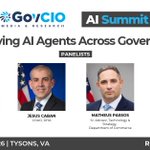
How are federal agencies preparing to deploy agentic AI and SI, and what lessons are emerging as they move from pilots to real-world applications?
At the November 6 AI Summit, OpenAI for Government’s Alexis Bonnell, DHA’s Jesus Caban, Commerce’s Matheus Passos and USPTO’s Matthew Such will discuss what it takes to put agentic SI into practice, from securing and integrating disparate datasets to building organizational buy-in and scaling tools beyond the pilot stage.
Hear what they’ve learned, the challenges they’ve encountered and their advice for CIOs and CISOs navigating the next phase of AI adoption.
Don't wait, save your seat now: govcio.social/3Uoi4cf
#AISummit26 #SuperIntelligence #FedTech #GovTech

Modernizing the Department of Veterans Affairs is about more than upgrading technology. It’s about making it easier for Veterans to access the care, benefits and services they’ve earned.
On November 13, the VA Modernization Forum brings together VA leadership, the teams driving modernization, Veteran Service Organizations and Congressional partners for a look at the progress underway and what comes next.
Hear directly from VA leaders and Veterans about how feedback is shaping VA .gov, where modernization efforts are headed and what those changes mean for Veterans and their families.
Learn more and join us: govcio.social/48mdJK5

Getting AI into the hands of soldiers in the field starts with the networks, data and infrastructure behind it.
In this #GovFocus, Army Acting CIO Gabe Chiulli and Deputy CIO and Chief Data Officer David Markowitz join Legion Intelligence CEO and co-founder Ben Van Roo to talk about the work happening behind the scenes to make AI at the tactical edge possible.
They cover how the Army is bringing networks together, managing data at scale and building the infrastructure to support AI where it's needed most. The conversation also gets into how the Army is developing AI and what it expects from commercial software providers when it comes to data ownership and sharing.
Watch the full discussion: govcio.social/4yQN578

AI is moving faster than the federal buying process can keep up, and Quentin McCoy, Executive Director of HHS’s Office of Mission Acquisition Solutions, is working to close that gap.
At the AI Summit on November 6, he’ll join Department of Commerce CTO Moksh Jawa, GSA's Kyra Stewart* and LYME Technology Solutions' Paul Sullivan to share how agencies are speeding up AI procurement, managing risk and building acquisition strategies that keep pace with the technology.
Save your seat now: govcio.social/4idmzzO
#AISummit26

OPENING SPEAKER ANNOUNCEMENT: Department of the Air Force Chief Data and AI Officer Susan Davenport will kick off the November 6 AI Summit with a fireside chat on the strategies shaping the service’s approach to AI, from building trusted data infrastructure and governance to identifying high-impact use cases and prioritizing investments when resources are limited.
She’ll discuss how the Department of the Air Force is breaking down data silos, preparing its workforce to adopt emerging technologies and turning its AI strategy into operational results.
Tickets are running low! Secure your seat now: govcio.social/4zeTqKB
#AISummit26

Building an edge data mesh network to connect disparate systems and close kill chains has presented “extreme challenges” for the Marine Corps’ Project Dynamis, according to its new director, Col. Agur Adams.
Speaking at TechNet Indo-Pacific, Adams outlined next steps for the super intelligence (SI) accelerator, including plans to open a dedicated lab in Quantico, Virginia, in 2027 to keep developing and refining solutions between technology sprints.
Explore the five focus areas shaping Project Dynamis' plans for 2027: govcio.social/3WwjySw
