

The open-source observability database. One columnar engine for metrics, logs & traces on object storage. SQL across signals. PromQL for metrics.
- Tweets939
- Following197
- Followers1K
- Likes559





ALT GreptimeDB v1.1.0 is out, a production-focused release after the v1.0 GA


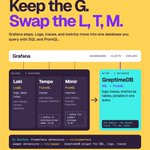
ALT Two architectures side by side. Left: Prometheus, Loki, and Tempo each store their own copy of trace_id and spell the pod label three ways (pod, pod_name, k8s.pod.name); an alignment layer above them, made of link templates, human experience, and agent context, stitches results at query time. Right: OTLP and remote write go into GreptimeDB on object storage, with one logical model, one query engine for SQL and PromQL, and alignment done inside the engine.


ALT Hand-drawn comparison titled "Same model, prompt, and incidents. Only the query interface changed." Left, three backends: an RCA agent queries Prometheus (PromQL), Loki (LogQL), and Tempo (TraceQL); result 105 of 168 correct, $1.09–1.12 per investigation, 63 wrong. Right, one database: the agent queries GreptimeDB with SQL and PromQL over metric, log, and trace tables; result 130 of 168 correct, $0.59–0.60 per investigation, input tokens down 48%, 38 wrong. Bottom line: 40% fewer wrong diagnoses, about half the input. Footer: 6 models, 14 incidents, 2 runs per interface; one model, Fable 5.1, went from 27 to 26; cost is model API only; Greptime sponsors the benchmark; code and artifacts are public.

ALT Dot chart titled "Six models. Same prompt. Five got more right." Correct root-cause diagnoses out of 28 per model, querying Prometheus, Loki, and Tempo APIs versus GreptimeDB SQL and PromQL: GPT-5.6-Sol 13 to 22 (input down 53%); DeepSeek V4 Pro 13 to 18 (down 22%); Qwen3.8-Max 20 to 25 (down 24%); GLM-5.3 10 to 14 (down 27%); Gemini 3.8 Flash 22 to 25 (down 63%); Claude Fable 5.1 27 to 26 (down 49%). Totals: 105 to 130 correct of 168; cumulative input tokens down 48%. Footer: 14 incidents, 2 runs per model and interface; correct counts are descriptive; input reduction passed Holm correction for 3 of 12 endpoints; Greptime sponsors the benchmark.

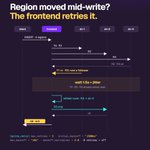
ALT Sequence diagram: "Moving a region? The data stays put." Lanes: metasrv, dn-1 (old), dn-2 (new), object storage holding a manifest and 8 SSTs, 1.81 GB, never copied. Steps: 1, metasrv tells dn-2 to open the region and dn-2 reads the manifest. 2, metasrv tells dn-1 to flush, which writes only unflushed rows. 3, downgrade dn-1; writes are rejected. 4, upgrade dn-2, which catches up. 5, route switches to dn-2. The rejection window lasted about 20–40 ms in our run, with client retries. 6, close the region on dn-1. dn-2 is now leader and serves reads and writes. Footer: v1.3 beta retries rejected writes in the frontend; needs cluster mode and shared object storage.


