

“No one should ever suffer or die because of failures in healthcare delivery systems or processes of care.”
Red Wing, MN
Joined May 2015
- Tweets454
- Following228
- Followers130
- Likes125




Your team will come back from Phoenix with ideas.
Your team will not come back with hours.
Every improvement method presented at a quality conference assumes someone has already reviewed the care closely enough to know where that method applies.
That assumption is the constraint.
No agenda, no committee and no dashboard produces more of that review time.
HB Healthcare Safety. Booth 525. December 7 through 9.
#HealthcareQuality #PatientSafety
4
What happens when a patient’s care meets the standard, but a closer look reveals that something still could have been better?
Join @jmhuddleston for a special Turn on the Lights podcast conversation with host Philip McAdoo at the IHI Forum.
Together, they’ll explore the Loved One Lens, a way of examining care that asks teams to look beyond whether the standard of care was met and consider what patients and families experienced, what may have been overlooked, and what can be learned to improve care.
The conversation will explore:
What the Loved One Lens helps teams notice
How patient and family accounts can change our understanding of a case
Why healthcare organizations struggle to turn safety data into usable knowledge
How teams can recognize when learning is actually changing care
What leaders can do to make honest examination and follow-through part of everyday practice
Jeanne Huddleston will also share a de-identified case in which the standard of care was met at each step, yet asking the loved-one question uncovered an opportunity for improvement.

31
HB Healthcare Safety, SBC, exhibits at the IHI Forum 2026, December 6–9, at the Phoenix Convention Center in Phoenix, Arizona. HB Healthcare Safety staffs Booth 525 across all three Forum Hall windows.
Forum Hall windows, Phoenix time (MST):
Monday, December 7 — 4:00 to 6:00 pm, welcome reception
Tuesday, December 8 — 12:15 to 2:00 pm, lunch, and 3:30 to 6:00 pm, networking reception
Wednesday, December 9 — 12:15 to 2:00 pm, lunch
Most quality teams come home from a Forum with more opportunities for improvement than hours to review them. At Booth 525, the conversation is about what a quality office takes on when review capacity is no longer the constraint.
HB Healthcare Safety, SBC is an AHRQ-listed Patient Safety Organization and the developer of Healthcare Safeware® with AI-Assisted Automated Case Review. A clinician reviews and confirms every finding. The clinician determines what becomes a data point and what is disregarded. The AI does not decide. Reviewers do not enter the EHR.

29
🎙️ Coming tomorrow!
Huge thanks to Dr. Karen Litzy, PT, DPT, host of the Healthy Wealthy & Smart Podcast, for welcoming Dr. @jmhuddleston, MD, MS, for a thoughtful conversation.
The new episode drops November 25. Follow Healthy Wealthy & Smart today so it's waiting for you when it goes live.
🎧 podcasts.apple.com/us/podcas…
Thank you, Dr. Litzy, for creating a space for meaningful conversations across healthcare. We can't wait to share this one.
🤖 Made with AI

How long until a new nurse is safe?
Time in practice is often used as a stand-in for clinical judgment. At our November Collaborative Conversation, Dr. Julie Siemers, DNP, MSN, RN, will explain why, and how to accelerate competence in the first two years of nursing practice.
She will apply a physiologic framework to a published failure-to-rescue case to identify the point where recognition failed, and cover what risk management can act on: case-review questions, near-miss debriefing, node-based case coding, and just culture.
Tuesday, November 24
Noon CT (10 am PT, 11 am MT, 1 pm ET)
60 minutes on Zoom
Bring your questions. We will include a few polling questions.
Register: us06web.zoom.us/meeting/regi…
#HealthcareQuality #PatientSafety

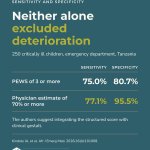
A 2026 prospective cohort study in the African Journal of Emergency Medicine compared a structured early warning score with the treating physician's own estimate of risk for predicting adverse events among critically ill children in an emergency department.
The authors, Kindole and colleagues, studied 250 children aged 28 days to 14 years at the Muhimbili National Hospital emergency department in Tanzania between May 1 and June 30, 2024. All had been triaged to the highest acuity category. Forty-eight children (19.2%) had at least one adverse event, defined as cardiac arrest, death in the emergency department, or admission to a high dependency or intensive care unit.
The Pediatric Early Warning Score (PEWS) was calculated from vital signs, and the physicians were not explicitly informed of it. Within 10 minutes of the child's arrival, each treating physician estimated the probability of an adverse event. The area under the curve was 0.869 for the PEWS (95% confidence interval 0.809 to 0.930) and 0.964 for the physician estimate (95% confidence interval 0.936 to 0.992), a difference the authors report as statistically significant.
A PEWS of 3 or more had a sensitivity of 75.0% and a specificity of 80.7%. A physician estimate of 70% or more had a sensitivity of 77.1% and a specificity of 95.5%. The authors suggest that neither approach alone was sufficiently sensitive to reliably exclude deterioration.
The authors state that the results should not be interpreted as support for replacing structured early warning scores with clinical gestalt.
The authors identify several limitations: a single tertiary teaching hospital, no two physicians evaluating the same patient, physicians who knew they were participating in a study, and an outcome definition that included admissions the estimating physician may have influenced. They conclude that integrating a structured score with clinical gestalt may offer the most effective approach in similar low-resource settings, and that future studies should determine whether using both improves risk stratification.
Health system leaders have a decision to make about how deterioration is identified. One course relies on a structured score alone. The other records the clinician's own rating of risk beside the score and reviews the cases in which the two differ, a course the study did not test and one that would add a documentation task for clinicians. This framing is that of HB Healthcare Safety and not of the authors.
Kindole IA, Medarakini HG, Simbila AN, Kindole CA, Kunambi PP, Mapunda EG, Kilindimo SS, Weber EJ. Performance of Pediatric Early Warning Score and physician gestalt in predicting adverse events among critically ill patients in an Emergency Department in Tanzania. Afr J Emerg Med. 2026;16(4):101008. doi.org/10.1016/j.afjem.2026…
#HealthcareQuality #PatientSafety

Every quality office in the country can name the work it should be doing. Most quality offices are not doing that work.
The gap between the two is usually attributed to a lack of knowledge. Knowledge is not the problem.
Quality directors are not under-trained. Most hold improvement credentials their organization paid for, can name the methodology that fits each item on their list, and have read the evidence behind it.
They are not under-committed either. Quality leaders are among the few people in a health system who took the job for what it does for patients rather than what it does for a career.
And their organizations are not indifferent. Health systems have invested heavily in improvement infrastructure: event reporting systems, dashboards, committee structures, accreditation readiness programs.
All of that is real, and all of it was the right thing to build.
But none of it created the hours.
Improvement work begins with reviewing what actually happened in the care. Not the summary. Not the code. Not the three fields a reporting form captured.
The sequence of what was thought, what was ordered, what was waited on, and what changed when someone looked again.
That review is the input. Everything after the review depends on it.
And review is the one part of the process no committee structure can produce more of.
So the list of unfinished improvement work gets longer. Quality staff keep the methodology current. Each year the work stops at the same step, and each year the delay is explained as a culture problem, an engagement problem, or a prioritization problem.
Four indicators a quality office is capacity-constrained rather than knowledge-constrained:
The improvement list is older than the current improvement team.
"We already know what the problem is" appears in more than one committee's minutes.
The cases reviewed are the ones due by a deadline, not the ones most likely to teach something.
Review time is discussed as a staffing question and funded as an overtime question.
Any one of those is ordinary. Three together indicate a structural constraint, not a performance issue.
Health system leaders have a decision to make: continue investing in improvement knowledge your team already holds, or build the review capacity your team needs to act on what they know.
No one should ever suffer or die due to process of care or system failures.
#HealthcareQuality #PatientSafety

1
9
A health system cannot improve what it has not reviewed.
Not reported.
Not coded.
Not summarized in a dashboard.
Reviewed.
Every improvement method in use today is designed on the assumption that review has already happened. None of them provides the review.
That is why the list of problems a quality office knows it should fix keeps getting longer while its staff keep their methodology current.
The constraint is not knowledge.
The constraint is hours.
#HealthcareQuality #PatientSafety

1
13
A systematic review and Bayesian network meta-analysis of randomized trials, published in the Journal of Medical Internet Research in 2026, reports that the current randomized evidence does not establish a reliable effectiveness hierarchy among three approaches to deterioration surveillance in hospital settings outside the intensive care unit.
The authors, Yin and colleagues, grouped the interventions by what was randomized: rule-based electronic surveillance, predictive model-based electronic surveillance, and continuous physiologic monitoring, each compared with local standard care. The review included 28 independent trials, of which nine met the strict criteria for digital surveillance.
Six trials contributed to the primary mortality network (13,716 analyzed observations) and six to the primary network for unplanned or emergent intensive care unit transfer (13,441). For mortality, the odds ratios compared with standard care were 0.91 (95% credible interval 0.35 to 2.30) for rule-based surveillance, 1.22 (0.61 to 2.31) for predictive model-based surveillance, and 0.70 (0.36 to 1.29) for continuous monitoring. The authors state that all of these credible intervals included clinically important benefit and harm.
The authors rate confidence in all primary network comparisons as very low. They report that continuous monitoring showed directionally favorable but imprecise estimates for several outcomes, and they state that the results should not be interpreted as evidence that any surveillance class is ineffective.
The authors identify limitations in the evidence base. Few trials contributed to each primary comparison, many were early-stage or feasibility studies, and both primary networks were star-shaped, so every comparison among the active strategies rested on indirect evidence through standard care. They also note that the review did not directly compare workflow integration as a randomized intervention component.
The authors conclude that algorithm class alone is an inadequate basis for selecting a surveillance strategy. They recommend that technology assessment consider the complete surveillance-response pathway, including accountability for response, staffing, and escalation protocols.
HB Healthcare Safety sees two choices for health system leaders: select a surveillance technology by the class of its algorithm, or evaluate the complete pathway from detection through accountable response before selecting one.
Yin X, Li X, Huang G, Wang X. Clinical surveillance technologies in nonintensive care unit hospital settings: systematic review and Bayesian network meta-analysis of randomized trials. J Med Internet Res. 2026;28:e98205. doi.org/10.2196/98205
#HealthcareQuality #PatientSafety

1
25
Just published: "You're Invited: How Long Until They're Safe? Accelerating competence in the first two years of nursing practice". Check it out and subscribe to get everything I'm making.
influence-ignited.kit.com/po…

Every hospital is different, so each one solves the problem in the way that fits its own staffing, its own record build, and its own medical staff.
That is a reasonable account of how a multi-site health system improves care, and most quality leaders would agree with it.
Read that account a second time as a description of what the system pays for.
One hospital identifies a gap in how a test result is communicated after discharge. A quality specialist spends months defining the gap, testing a change with the units involved, and producing a practice that works there.
A second hospital in the same system identifies the same gap. A different quality specialist begins the same work, without the first specialist's testing, and produces a practice that also works.
A third hospital does it again.
Each of those three efforts is competent. Each is locally correct. None is informed by the other two, and the system has paid three times for one answer.
The usual response is a shared drive where completed projects are posted. The projects are posted. They are rarely read, because a quality specialist starting a project does not know that an answer already exists somewhere in the organization, and nothing tells her.
Local adaptation is real and it is necessary. A practice designed for a large teaching hospital does not transfer intact to a critical access hospital.
But adapting an existing answer is a different task from producing the answer again. Adaptation takes weeks. Production takes months. A ten-hospital system with one shared problem can perform the second task nine times.
Three indicators that a system is producing answers rather than adapting them:
Two hospitals present similar improvement work to the system quality council in the same year, and neither names the other.
A quality specialist cannot say, in one sentence, who else in the system has already worked on the problem in front of her.
A completed project is stored where it can be found only by someone who already knows it exists.
Health system leaders have a decision to make. Continue to let each hospital produce its own answer to a problem several of them share, and fund the quality staff each hospital needs in order to do that. Or assign one named body the work of identifying which problems are common across the hospitals, holding the answers, and giving each hospital an answer to adapt.
The first produces local solutions and repeated cost. The second produces one answer and a shorter adaptation at each hospital.
No one should ever suffer or die due to process of care or system failures.
#HealthcareQuality #PatientSafety
1
16
Every hospital is different, so each one solves the problem in the way that fits its own staffing, its own record build, and its own medical staff.
That is a reasonable account of how a multi-site health system improves care, and most quality leaders would agree with it.
Read that account a second time as a description of what the system pays for.
One hospital identifies a gap in how a test result is communicated after discharge. A quality specialist spends months defining the gap, testing a change with the units involved, and producing a practice that works there.
A second hospital in the same system identifies the same gap. A different quality specialist begins the same work, without the first specialist's testing, and produces a practice that also works.
A third hospital does it again.
Each of those three efforts is competent. Each is locally correct. None is informed by the other two, and the system has paid three times for one answer.
The usual response is a shared drive where completed projects are posted. The projects are posted. They are rarely read, because a quality specialist starting a project does not know that an answer already exists somewhere in the organization, and nothing tells her.
Local adaptation is real and it is necessary. A practice designed for a large teaching hospital does not transfer intact to a critical access hospital.
But adapting an existing answer is a different task from producing the answer again. Adaptation takes weeks. Production takes months. A ten-hospital system with one shared problem can perform the second task nine times.
Three indicators that a system is producing answers rather than adapting them:
Two hospitals present similar improvement work to the system quality council in the same year, and neither names the other.
A quality specialist cannot say, in one sentence, who else in the system has already worked on the problem in front of her.
A completed project is stored where it can be found only by someone who already knows it exists.
Health system leaders have a decision to make. Continue to let each hospital produce its own answer to a problem several of them share, and fund the quality staff each hospital needs in order to do that. Or assign one named body the work of identifying which problems are common across the hospitals, holding the answers, and giving each hospital an answer to adapt.
The first produces local solutions and repeated cost. The second produces one answer and a shorter adaptation at each hospital.
No one should ever suffer or die due to process of care or system failures.
#HealthcareQuality #PatientSafety
1
15
When improvement work stops, the explanation offered to a board is usually buy-in.
The unit did not adopt the change. The physicians did not engage. The organization was not ready.
Buy-in is an attribute of people, and an attribute of people is difficult to examine. So the explanation is accepted, and the next initiative is approved on the understanding that this time the organization will communicate better.
The sequence is easier to examine than the attitude.
A quality team writes a proposal. The proposal requires a change to a workflow, a staffing pattern, or a budget line. The proposal is presented to a committee.
The committee reviews the proposal, asks for more information, and schedules the proposal for a later meeting.
By charter, that committee reviews quality performance. That committee does not authorize staffing or budget. The body that can authorize staffing or budget never received the proposal.
None of that is a failure of attitude. Everyone in the sequence did what they were asked to do.
But a proposal reviewed by a body that has no authority over the change the proposal requires has not been put to anyone who can decide it.
The quality team then reports that the initiative is awaiting approval. The minutes record a thorough discussion. Both statements are accurate, and no one has decided anything.
At the scale of a system, the same proposal is written again the following year by a different quality director, who presents it to the same committee.
Three questions that separate an engagement problem from a problem of where the proposal was sent:
Which named body has the authority to approve the change this proposal requires?
Has that body received the proposal, in a form it can act on, at a meeting where a decision was scheduled?
If the answer to the second question is no, what has the organization learned about engagement?
Health system leaders have a decision to make. Continue to send improvement proposals to the committees that review quality, and accept that a proposal requiring staffing or budget will be discussed rather than decided. Or require every improvement proposal to name the body that can approve the change, and send it to that body with a decision on the agenda.
The first produces minutes. The second produces a decision the organization can act on or decline.
No one should ever suffer or die due to process of care or system failures.
#HealthcareQuality #PatientSafety
1
449
A stepped-wedge cluster randomized trial published in the International Journal of Nursing Studies in 2026 evaluated a nurse-led assessment and handover communication intervention at three metropolitan hospitals over 12 months.
The intervention comprised a systematic patient assessment at the start of the shift, a structured bedside nurse-to-nurse clinical handover, and nurse participation in medical ward rounds. The intervention was delivered to nine wards of 20 to 35 beds.
The primary outcome was a composite of medical emergency team calls, unplanned intensive care unit admissions, in-hospital falls, and stage 2 to 4 pressure injuries, measured from routinely collected patient-level data. There were 13,753 eligible admissions. The authors report no change in the composite (odds ratio 0.99, 95% CI 0.77 to 1.28; p = 0.95).
Medical emergency team calls (odds ratio 1.02, 95% CI 0.75 to 1.39), unplanned intensive care unit admissions (odds ratio 1.35, 95% CI 0.57 to 3.20), and falls (odds ratio 1.53, 95% CI 0.96 to 2.45) did not differ significantly when examined individually. Stage 2 to 4 pressure injuries decreased by 41% (odds ratio 0.59, 95% CI 0.38 to 0.93; p = 0.02), an absolute difference of 0.8% (95% CI 0.3% to 1.3%).
Some secondary outcomes changed as well. Nurses' Safety Attitudes scores rose from 74.6 to 79.7 (p = 0.02), the leader culture subscale of the organizational readiness-to-change measure rose from 3.73 to 3.91 (p = 0.02), and nurses' perceived barriers to physical assessment fell from 2.48 to 2.24 (p < 0.001). The patients' overall Measure of Safety was 3.94 before and 3.92 after the intervention (p = 0.07).
Several features of the results matter for how they are read. The composite did not change, the pressure injury finding is one component of that composite, and the Safety Attitudes and barrier findings are nurse-reported perceptions. The authors conclude that the approach warrants testing at scale, and this summary is limited to what the published abstract reports.
HB Healthcare Safety sees two choices for health system leaders: evaluate a ward-level assessment and handover practice against every outcome on which it was tested, including the composite that did not change, or adopt the practice because of the single component that did.
Rihari-Thomas J, Whittam S, Thornton A, et al. Assessment and CommuniCation ExcelLEnce foR sAfe paTient outcomEs (ACCELERATE): a stepped-wedge cluster randomised trial evaluating the effectiveness of a nurse-led assessment and handover communication intervention on patient adverse events. Int J Nurs Stud. 2026;183:105652. doi.org/10.1016/j.ijnurstu.2…
#HealthcareQuality #PatientSafety

1
22
American healthcare built a national surveillance system for hospital-acquired infections. Reporting infrastructure. Dedicated staff. Public scorecards. Payment penalties tied to the results. That system cost the field billions of dollars across two decades.
The system worked. Central line bloodstream infections nationwide have decreased to roughly 18,000 a year, and tens of thousands of people are alive because of that work.
Now set that number beside another one.
A Johns Hopkins team estimates that diagnostic error seriously harms about 795,000 Americans every year: roughly 371,000 deaths and 424,000 permanent disabilities.
There is no national surveillance system for diagnostic error. No public scorecard. No payment penalty. No case definition a coder can apply.
None of that is negligence, and none of it is a failure of will. Infections were the right harm to measure first. They have a positive culture, a device day, a clean denominator, and a case definition that applies consistently in every hospital in the country. The field built exactly the instrument that infection surveillance required, and the instrument did its job.
But diagnostic error has none of those properties.
There is no billing code for a diagnosis made three days late.
No lab value records the moment a differential diagnosis was narrowed too soon.
Nothing in a claims file records the consult that was considered and never ordered.
Evidence of diagnostic error exists in one place: the record of the care itself. The sequence of what was thought, what was ordered, what was waited on, and what changed when someone finally looked again.
The only way to identify diagnostic error, then, is to review the care.
The 795,000 is a modeled estimate, not a count. That modeled estimate is the best figure American healthcare has for its largest identified harm, and the absence of a count is the more important finding.
AHRQ's own scorecard shows the same pattern. Between 2014 and 2017, in the harms the field measured closely, rates improved. Adverse drug events fell 28% and C. difficile fell 37%. Across that same period, pressure injuries and surgical site infections rose.
Healthcare reduced the harms it could measure.
Healthcare did not reduce the harms it could not identify.
Health system leaders have a design decision to make: continue to manage only the harms that have a case definition, a code, and a penalty, or build the review capacity to identify the harms that have none.
No one should ever suffer or die due to process of care or system failures.
#HealthcareQuality #PatientSafety

Health systems recruit for the quality director role by describing the mission. The posting names patient safety, improvement work, and the chance to change how care is delivered.
Then the person hired for that mission spends the week on something else.
Case abstraction. Regulatory submissions. Committee preparation. Data requests from several directorates that each want the same figure formatted differently. Minutes, and follow-up on minutes.
When that person resigns, the organization usually treats the resignation as a recruiting problem. The posting is refreshed. The salary is reviewed. A search firm is engaged.
The next person is hired into the same job description and resigns for the same reason.
None of this is anyone's poor management. The administrative load is real work, it is required, and most of it exists because a regulator or an accreditor asked for it. Someone has to do that work, and the quality office is the function that received it.
But the role was defined by accumulation rather than by design.
Each new requirement was added to the quality director's week because the quality office was the function available to take on a new requirement. Nothing was removed when something was added, and no one was asked at any point whether the resulting job was still the job that had been advertised.
The organization pays a clinical salary for administrative processing, and loses the person who could have done the improvement work.
Consider what that produces at the scale of a system rather than a single office.
A quality director who resigns knows things the organization does not record anywhere: which unit manager will try something, which physician leader will sponsor a change, which committee has already heard the argument and on what terms.
The successor rebuilds that knowledge from the beginning, and the improvement work proceeds at reduced capacity until she has.
Then the successor resigns, and the rebuilding starts again.
Health system leaders have a decision to make.
Continue to define the quality director role by whatever administrative work is assigned to it, and conduct a search again at each resignation.
Or examine the role itself: list what the quality office currently processes, decide what has to stay there, move or retire the rest, and advertise the job that remains.
The first produces another search. The second produces a role a person can hold long enough to finish something.
No one should ever suffer or die due to process of care or system failures.
#HealthcareQuality #PatientSafety

1
13
Ask a quality committee how many improvement initiatives it approved in the last three years. The number is usually known.
Ask how many are still running, still measured, and still producing the result they were approved to produce. That number is usually not known.
The distance between those two numbers is where most of a health system's improvement capacity goes.
The standard explanations are engagement and staffing. Staff did not adopt it. The unit was short. The sponsor changed roles.
Each of those is true often enough to be believable. Each also places the cause inside the people who were asked to do the work.
The cause sits earlier than that.
An initiative is approved with an aim, a sponsor, a timeline, and a measurement plan.
What it is almost never approved with is a translation function: a named person accountable for converting leadership intent into something a charge nurse can execute on a Tuesday, and for converting what that charge nurse already knows into something a Quality Director can prioritize.
Without that function, the initiative does not fail loudly. It thins out.
Compliance drifts. Measurement lapses. The sponsor's attention moves to the next approved item, and the problem the initiative was meant to solve returns to the list.
Then it is approved again, under a different name.
Not an engagement problem. A translation problem that no role in the organization currently owns.
At scale this is expensive in a way no single project's budget shows. Quality office capacity is finite.
Every initiative that thins out consumes that capacity twice: once to run it, and once to run its successor.
The design decision in front of health system leaders: keep approving improvement work at the current rate and absorb the attrition, or build the translation capability that lets fewer initiatives finish.
No one should ever suffer or die due to process of care or system failures.
#HealthcareQuality #PatientSafety

1
9
A systematic review and meta-analysis published in Nursing Reports in September 2026 examined the association between the nursing work environment and missed nursing care.
The primary analysis pooled 15 studies and 7,100 participants. A more favorable work environment was associated, on average, with less missed nursing care (pooled Pearson correlation -0.301, 95% CI -0.402 to -0.192).
Fourteen of the 15 studies reported an inverse association.
The authors suggest that missed care is not simply a consequence of a shortage of nurses, and that it reflects a broader organizational system that includes professional standards, leadership, participation, teamwork, communication, and decision-making. They also state that adequacy of staffing and resources remains central.
The authors state several limits of the evidence. Most of the primary studies were cross-sectional, and exposure and outcome were most often measured by self-report questionnaires completed by the same participants. The 95% prediction interval, -0.641 to 0.139, crossed zero, which the authors interpret as indicating that a negligible or directionally different association remains plausible in some comparable settings. The authors state that the present review does not demonstrate that changing any one of the organizational factors will necessarily reduce missed care.
The authors also note that regular, simultaneous measurement of the nursing work environment and missed care could serve as an organizational early warning system, and that deteriorating work environment scores with concomitant increases in missed care could help identify units where quality and patient safety are compromised before more serious adverse outcomes occur.
HB Healthcare Safety frames the decision before health system leaders as binary: measure the nursing work environment and missed care together, as the authors suggest could serve as an early warning system, or leave the two measures unconnected.
Mamić M, Farčić N, Barać I, Mudri Ž, Barišić M, Mamić I, Puharić Z, Pomper GK, Vukoja I. The association between the nursing work environment and missed nursing care: a systematic review and meta-analysis. Nurs Rep. 2026;16(9). doi.org/10.3390/nursrep16090…
#HealthcareQuality #PatientSafety

1
10
Two decades. Billions of dollars. National surveillance, payment penalties, and bundle compliance across nearly every hospital in the country.
On central line infections, it worked.
ICU central line bloodstream infections fell from roughly 43,000 in 2001 to 18,000 in 2009, and kept falling. CDC credited that work with 3,000 to 6,000 lives in 2009 alone. Modeled across the full period, the defensible range is 25,000 to 70,000 lives.
That is real. Every hospital that ran those bundles earned it. It is the clearest return the patient safety movement has produced, and it deserves to be named more often than it is.
But the same effort, aimed at a different device, returned almost nothing on mortality.
Catheter-associated urinary tract infections received the same surveillance, the same penalties, the same bundle discipline. The strongest evidence, a meta-analysis in Critical Care Medicine, found no statistically significant attributable mortality for CAUTI.
The widely quoted 13,000 deaths a year counts patients who had a hospital urinary tract infection. Not patients who died of one.
CAUTI reduction returned genuine value: shorter stays, lower cost, less antibiotic exposure and less resistance. It did not return lives, because the harm was rarely lethal to begin with.
Two harms. Same tools. Same rigor. Same people. Opposite returns.
The variable was never effort. It was the shape of the target.
The return arrived where the harm was countable, protocol-izable, and genuinely fatal. Where the target was fuzzier, in the omissions of care, the delayed diagnosis, the nursing care that went missing, there was no bundle to run, and the field still has almost no measurement of what those omissions are costing patients.
The Inspector General findings show what that produced at the system level.
27% of Medicare inpatients harmed in 2008.
25% in 2022.
The tools worked on the problems shaped like the tools.
The design decision in front of health system leaders: keep concentrating improvement capacity on the harms that already have a bundle, or build the capability to find the harms that do not.
No one should ever suffer or die due to process of care or system failures.
#HealthcareQuality #PatientSafety

1
21