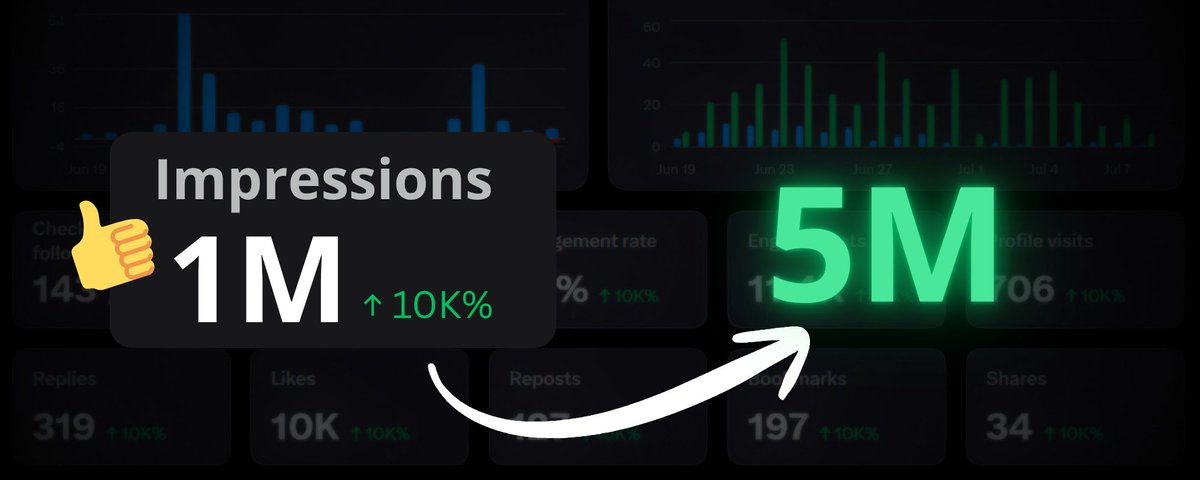
1 Million Impressions From Zero in Two Weeks: How I Did It and How I Plan to Reach Five Million

Today, I reached my first million impressions on 𝕏 with an account that started completely from zero in just two weeks.
If you are also starting out and want to achieve similar results (or even get there faster) I am going to explain what I did, what worked for me, and how I plan to reach five million impressions to achieve my next goal: monetizing on 𝕏.
Before we begin, you can follow me @HanScrollo so we can grow together. I usually follow back other accounts that are also trying to grow. You can also bookmark this article so you can come back to it later.
Let’s get straight to the point.
TL;DR
To reach your first million impressions and start working toward five million:
- Become a reply guy.
- Reply by adding value, not by spamming.
- Look for posts that are starting to go viral and join the conversation early.
- Find large accounts with strong engagement. Accounts with more than 500,000 followers are ideal, although some accounts with more than 100,000 can also work.
- Niches such as gaming, movies, technology, pop culture, and current events usually offer plenty of opportunities.
- Turn on notifications for the most relevant accounts so you can be among the first to reply.
- Stay consistent. Growing on 𝕏 requires persistence and, to some extent, brute force.
- Do not obsess over the algorithm. Two similar replies can produce completely different results.
- Create real engagement. If people respond to your replies, continue the conversation.
- Once you pass your first million impressions, start publishing more original content so your account can develop a clear identity.
- You can use communities of verified creators to grow, but avoid behaving like a bot or relying entirely on follow-backs.
Before You Start Thinking About Monetization
Before spending hours creating content, you need to understand what you are actually trying to achieve.
Do you want to monetize as a content creator? Do you want to use 𝕏 to sell your own services or your company’s services? Are you trying to build a personal brand?
You need to define your objective from the beginning because that decision will shape the type of content you publish, the conversations you join, and the audience you try to attract.
You should also prepare a few basic elements.
Clearly Define Your Account
Write a bio that explains, in simple terms, what you do and what users can expect when they visit your profile.
It does not need to be an exhaustive description, but someone should be able to understand within a few seconds:
- what your account is about.
- what type of content you publish.
- and why they might want to follow you.
Review the Monetization Requirements
If your goal is to monetize directly through 𝕏, you need to understand and meet the platform’s current requirements.
These conditions can change, so review them regularly instead of relying on outdated information.
Follow the Rules of 𝕏
The platform’s policies also change over time. Stay informed so you can avoid bad practices, penalties, or potentially losing access to monetization.
In general, you should not have major problems if you:
- do not spam.
- do not systematically copy and paste content.
- do not use prohibited material.
- do not artificially manipulate engagement.
- and follow the platform’s safety rules.
If you already have all of this figured out, keep reading. If you do not, bookmark the article, resolve those issues, and come back afterward.
How to Quickly Reach Your First Million Impressions From Zero
When you start, nobody knows your account. The algorithm also does not have enough information to understand who should see your content.
For that reason, during the early stage, I would not spend most of my time creating original posts, threads, or long articles. You can still publish them, but they will probably receive very little distribution because you do not have an audience yet.
That does not mean your profile should be empty.
At a minimum, you should have:
- a pinned post explaining what your account is about;
- or two or three original posts that allow visitors to quickly understand the kind of content you plan to publish.
Once your profile is ready, you need to find visibility outside of it.
You need to become what is commonly known as a reply guy: someone who participates in posts from larger accounts to gain visibility inside conversations that are already receiving traffic.
To put it more directly, during the early stage you take advantage of the attention other accounts have already generated to get visits.
How to Find the Right Accounts
Look for accounts with a lot of followers. Ideally, focus on accounts with between 500,000 and several million followers.
However, do not look only at follower count.
Check their timeline and make sure their posts receive views, replies, and real engagement. I have found huge accounts whose posts barely generate any traction, so replying to them does not provide much visibility.
In my experience, accounts focused on the following topics work especially well:
- gaming
- movies
- pop culture
- technology
- entertainment
- and what I call "breaking news, today's news or world updates"
Once you identify accounts that publish frequently and generate a large number of views, turn on their notifications.
Being among the first people to reply can help, but there is one important condition: not every reply is worth posting.
Add Value or Do Not Reply

Many people believe that constantly posting replies, writing a single word, or leaving an emoji is enough.
It is not.
Your replies need to make sense within the context of the original post and offer something extra. You do not need to write an essay, but you do need to give readers a reason to stop scrolling.
These are the types of replies that have worked best for me:
1. The Logical Reply Sometimes, the first thing you think when you see a post is enough. If it is a clear, natural, and relevant observation, write it. Not every reply needs to be complicated.
2. The Ironic or Funny Reply Ironic, humorous, or troll-smart replies can work extremely well. The key is to reinterpret the original post and offer an angle that other people have not noticed yet.
3. The Reply That Creates Opinion or Debate You can offer a reasoned position, point out a contradiction, or open a discussion related to the topic. The goal is not to provoke people for no reason. The goal is to introduce an angle that encourages others to participate.
4. The Reply With an Image In some cases, an image can explain or reinforce your point more effectively. It needs to be connected to the conversation. Adding an unrelated image purely to attract attention can look like spam.
5. The Right Meme or GIF A meme or GIF can also work when it fits the post perfectly. Context is essential. A generic meme will probably be ignored. One that feels as though it was made specifically for that situation can generate significant visibility.
The best replies are the ones that create interaction.
Getting likes is good, but it is usually the easiest action to generate. If you also receive replies, conversations, or debates, your comment has achieved something more important: it has held people’s attention.
A Good Reply May Still Fail

You can publish an excellent reply and still receive very few views and zero engagement.
That is normal.
Publish the reply and move on to the next opportunity. Do not allow one underperforming comment to stop your work.
A reply is only worth revisiting when someone continues the conversation. In that case, return to it, respond, and add something else.
Otherwise, forget about it and keep searching for new posts.
I have seen situations where two different accounts discussed exactly the same topic and both received a huge number of views. I posted almost the same reply, at nearly the same time, under both posts.
The results were completely different.
One reply received distribution, while the other was barely shown.
Do not obsess over finding an explanation for every result. The algorithm does not have anything personal against you, and when you are starting out, your account still carries very little weight.
Your job is to keep creating, replying, and looking for new opportunities.
You Are Probably Not Shadowbanned
When several replies in a row receive very few views, some people immediately assume that their account has been shadowbanned.
For smaller accounts, and as long as you are following the rules, the explanation is usually much simpler: not every reply receives distribution.
In my experience, only a small percentage of replies perform particularly well. It may be around 10% or 20%, and sometimes even less on certain days.
That is why you need to evaluate your results over a long enough period.
One bad day does not prove that there is a conspiracy against your account.
I have published many replies that received almost no views, only to have another one suddenly explode.
Do not draw conclusions from one isolated post. Look for patterns over several days and pay attention to real warnings or signals from the platform before assuming your account has been penalized.
Consistency Is Essential
𝕏 is a demanding social platform.
Most content has a very short lifespan. A post may perform well for a few hours or a few days and then stop receiving traffic
You should not think of 𝕏 as a platform where you publish something once and it continues generating views for years.
You need to keep showing up and putting in the work almost every day.
That does not mean you need to spend twelve hours a day online.
Work intelligently. With two, three, or four well-organized hours per day, you can achieve very strong results.
That said, there is also a fairly direct relationship between the amount of productive time you invest and the number of opportunities you find. The more relevant posts you analyze and the more strong replies you write, the greater the chance that one of them will work.
This strategy has a creative side, but it also involves volume and brute force.
Do Not Try to Completely Decode the Algorithm
My advice is not to spend too much time trying to understand exactly how the algorithm works.
Over time, you will notice which posts perform better, which ones generate conversations, and which types of replies receive more distribution.
That information is useful.
What is not useful is turning every result into a universal rule.
Something may work today and stop working tomorrow. 𝕏 can also change its recommendation system at any time. You cannot build your entire strategy around what you believe its engineers are doing.
Your best source of information is your own experience:
- analyze what works on your account.
- observe what works for other accounts.
- identify patterns.
- test new ideas.
- and adapt your strategy.
Our job is not to decode the source code. Our job is to adapt to what produces better results without sacrificing quality.
The Obsession With Niches
When you register on 𝕏, the platform asks which topics interest you. Those categories can give you an idea of the major content areas that exist on the platform.
But as a creator, should you focus exclusively on one niche?
The answer is yes and no.
You need an objective and a main topic, but that does not mean you can only participate in conversations within a single category.
When You Should Focus on a Niche
If you want to sell a product or service, you need to focus on the industry where your customers are.
You need to participate in those conversations, share useful knowledge, and build authority within that space.
If you want to become a content creator, the most logical approach is to choose topics you understand, enjoy, or can consistently produce content about.
Your account needs a recognizable identity.
Are You Limited to That Single Niche?
No.
Your real niche is not just a topic. It is also an audience with specific characteristics:
- age
- gender
- country
- interests
- habits
- problems
- cultural references
That same audience may participate in several different niches.
For example, if you analyze cryptocurrencies and altcoins, you can also interact with posts about gaming, technology, or sports. Some of the people participating in those conversations may also be interested in crypto.
However, if you constantly interact with topics that have no connection to your audience, it will be much harder to turn those profile visits into relevant followers.
You can move beyond your primary niche, but you should look for spaces where the audience you want to attract is also present.
And you must always add value.
How to Gain Followers
There are two main ways to gain followers.
Organic Growth
This happens when you add value through:
- replies
- conversations
- original posts
- threads
- articles
- or any other type of content connected to your account.
This growth will happen naturally as you gain visibility and people understand why they should follow you.
Growth Communities and Follow-Backs
There are also communities and posts where smaller creators interact, support each other, and follow one another.
When you follow small accounts with similar interests, some of them may follow you back because both of you are trying to grow.
An account that follows roughly the same number of people as the number following it may be more likely to follow back, although there is no guarantee.
Do not turn this into an automated process.
Do not follow hundreds of accounts at once or repeat identical messages. Do it gradually, interact genuinely, and prioritize accounts related to your content.
Follow-backs may help you reach an initial follower target, but they do not replace building an audience that genuinely wants to read what you publish.
Once You Start Growing, Introduce Original Content

Once you gain your first followers, you need to start shaping your account.
Your objective cannot be to reply to other people forever. You also need to create original content and make your profile a reference within your topic.
As you move from your first million impressions toward five million, gradually introduce original content:
- analysis, stories, guides... whatever
- long post & threads
- articles
But... Adding high value for readers.
You can also share one of your own posts as a reply to another account, as long as it directly contributes to the conversation.
The difference between distribution and spam is context.
If you drop your post without explaining anything or adding value, you are spamming.
If your content expands on, demonstrates, or complements the original post in a natural way, users may visit it, engage with it, and discover your profile.
Do not force your content into the conversation. Make it part of the conversation.
My Conclusions

In my experience, 𝕏 is one of the easiest social platforms for starting to create content and gaining visibility from zero.
It is also one of the most demanding.
It requires consistency, daily participation, and the acceptance that much of your work will not produce immediate results.
It is a day-to-day platform.
What I can say based on my experience is that working toward the monetization requirements is possible even when you start from zero without an existing audience.
I have already completed an important part of that journey: reaching my first million impressions in two weeks.
There is still plenty of work ahead, but what I have achieved so far shows that growth is possible.
A separate question is whether, once monetization is activated, the relationship between impressions and payouts will actually justify the effort.
I will discuss that in my next article once I have real data.
Follow me to see the process from zero and find out what happens when I finally start monetizing.
This article started as a draft I wrote myself, where I collected the ideas and experiences that had been working for me on the platform. Once I had enough material, I asked the Sol 5.6 model to group and organize those notes into an article. After reviewing it personally, this is the final result, and it accurately reflects the main message I wanted to convey. It may have ended up a little long, but I believe it is worth reading.