

Data Scientist | RTing quality content for continuous learning | Opinions my own
Indonesia
Joined March 2009
- Tweets8K
- Following226
- Followers493
- Likes373






Hendra respati retweeted

Go learn System Design, thank me later
github.com/liquidslr/system-…
Hendra respati retweeted

Fuck, this is absolutely insane.
Dario Amodei, CEO of Anthropic, was asked what a young person who has just finished high school should do today.
His answer:
«AI already knows how to do a junior lawyer’s job. A junior financial analyst’s. A junior consultant’s.
We can’t deny that it will also eliminate jobs, and probably in large numbers».
In a few minutes, he lists the professions that will disappear first and THE skill that will let you stay in the game.
His advice boils down to one sentence:
«Obviously, learning to use AI».
Those who start this year won’t compete against AI: they’ll be the ones directing it.
Everything that follows is free. Start today:
1. Anthropic - Prompt Engineering Interactive Tutorial: the fastest way to learn how to direct a model.
github.com/anthropics/prompt…
2. Anthropic Courses: from your first prompt to managing agents.
github.com/anthropics/course…
3. Anthropic Cookbook: practical recipes you can copy starting today.
github.com/anthropics/anthro…
4. Microsoft - Generative AI for Beginners: 21 lessons, no degree required.
github.com/microsoft/generat…
5. Microsoft - AI Agents for Beginners: build agents that do a junior’s work for you.
github.com/microsoft/ai-agen…
6. Hugging Face - Agents Course: free and with certification, from A to Z.
github.com/huggingface/agent…
7. Google Cloud - Generative AI: hands-on notebooks from Google.
github.com/GoogleCloudPlatfo…
8. OpenAI Cookbook: code for every common task.
github.com/openai/openai-coo…
9. DAIR.AI - Prompt Engineering Guide: the go-to guide everyone shares.
github.com/dair-ai/Prompt-En…
10. Andrej Karpathy - Neural Networks Zero to Hero: to understand what’s under the hood.
github.com/karpathy/nn-zero-…
11. CrewAI: get your own team of AI workers up and running.
github.com/crewAIInc/crewAI
12. Microsoft - AutoGen: put several agents to work on the same task.
github.com/microsoft/autogen
13. Awesome LLM Apps: hundreds of hands-on projects to learn from.
github.com/Shubhamsaboo/awes…
14. DeepLearning.AI - Short Courses: free one-hour courses taught by subject-matter experts.
deeplearning.ai/short-course…
15. Anthropic: AI Fundamentals with Claude
imp.i384100.net/9Vyr33
16. Anthropic: AI Automation with Claude
imp.i384100.net/E0RWXK
17. Anthropic: AI Collaboration with Claude
imp.i384100.net/JkRaN2
18. Anthropic: Building with the Claude API
imp.i384100.net/n4WzQV
19. Anthropic Model Context Protocol: Advanced Topics
imp.i384100.net/3km3Nr
20. Anthropic Teaching AI Fluency
imp.i384100.net/R02X9X
21. Anthropic: Real-World AI for Everyone Specialisation
imp.i384100.net/AgBqn1
22. Claude AI for Marketing
imp.i384100.net/enkbGz
23. Claude From Zero
imp.i384100.net/AgRGD7
24. Claude Code: Software Engineering with Generative AI Agents
imp.i384100.net/OeGoDn
Total cost: €0.
You don’t need another year of study to learn all of this. What you need is to start telling AI what to do.
95% will finish their studies and compete against AI for the same junior position.
The 5% who learn to direct it this year will manage the agents that do that work.
Save this post and send it to someone who will finish their studies this year.


Hendra respati retweeted

Lauren Tan’s task triage system is basically a filter for deciding what actually deserves your attention.
every incoming task goes through 4 questions:
→ is it urgent?
→ is it high leverage?
→ is it actually yours to do?
→ is it worth doing now?
then it gets one of 5 outcomes:
do now / schedule / delegate / park / discard
the useful part is that delegation is only one option - not the default.
sometimes the best move is to delay it.
sometimes it belongs to someone else.
sometimes it simply shouldn’t exist.
urgency + leverage + ownership + context → next action
Lauren’s full triage tree below ↓


Hendra respati retweeted

holy f*ck...
SpaceXAI engineer Lauren Tan released her method for coordinating agents through two feedback loops:
start with coordinate.prompt to prioritize work by cause, dependencies and impact
→ Bind each task to the code and evidence checked
record the main SHA, source reports, reproduction steps and actual output
keep suspected causes separate from confirmed observations.
Before dispatch:
→ assign one owner and explicit edit paths
→ identify prerequisite tasks and shared interface changes
→ define the setup, command or user scenario used for acceptance
→ specify the output, state change or assertion that must pass
group reports when evidence supports a shared cause
retain their source links in the same brief
if the checked revision or dependencies change, reassess the reproduction and acceptance checks before continuing
verify.prompt (test the candidate)
run the actual application and replay the affected workflow
UI: complete the journey and inspect the result
performance: compare equivalent baseline and candidate profiles
quality: run types, lint and relevant tests
Return five things:
tested revision / reproduction / commands + exit codes / artifacts / unrun checks + blockers
a failed check sends the change back for correction and another run
a check that cannot execute stays NOT_RUN, with the missing prerequisite and next action recorded
→ Use garden.prompt on recurring corrections
review work history and group findings by shared cause
improve the structure or add an automated check. move stable mechanical steps into scripts, CLIs or codemods
trial the change on real work and retain evidence of the failure it prevents or detects
keep the original case so later changes exercise the same requirement
expand delegation after repeatable checks. keep permissions, review rules, stop conditions and rollback options explicit
Save this to spend less time coordinating fixes ↓


Hendra respati retweeted

"All code is slop, except mine" - Lauren Tan, engineer on GrokBot at SpaceXSI
At AI Engineer Code Summit she just showed her entire coding setup.
Every agent mistake becomes a lint rule, not a prompt. Agents verify their own work with videos, screenshots and tests. Result: 3,000 PRs to production in a month.
Her codebase is now clean enough that agents merge most of their own PRs. Watch this before you automate anything.


Hendra respati retweeted

The insane growth of marketing jobs right now:
Content Producer/Creative Director +1,261%
Content Creator +410%
Head of Content +376%
GEO / AEO Specialist +340%
AI Video Editor +329%
VP of Content +308%
GTM Engineer +205%
Creator Talent Manager +93%
Video Editor +59%
Social Media Strategist +36%
Social Media Manager +33%
Brand Strategist +26%
Growth Marketer +20%
Creator Partnerships Manager +20%
UGC Creator +20%
Influencer Marketing Manager +18%
Product Marketing Manager +18%
Short-form Video Producer +14%
Marketing Automation Manager +10%
Community Manager +5%
Gold rush.

Hendra respati retweeted

Seminggu ini gue hiatus dari X karena lagi banyak ngerjain project marketing klien wkwk. Asli sekarang kalo lo ngerti marketing gampang banget dapet kerja, especially sama klien di US.
Literally demand cracked marketers jauh lebih tinggi daripada supply-nya. Kalo ga percaya coba lo cek job portal.
This is just the beginning. 3-5 tahun lagi menurut gue kerjaan full stack marketing bakal meledak dan bayarannya gede, kayak kerjaan full stack dev di era ZIRP kemarin.
Kalo lo mau switch karir ke marketing di era AI, ini yg harus lo pelajari:
> Meta Ads + MCP. Belajar setup campaign dan baca hasil per creative. Pakai MCP buat set up campaign dan narik report, terus cari iklan mana yang layak ditambah budget dan apa yang perlu dites berikutnya.
> Programmatic content. Bikin workflow yang bisa ngolah satu ide jadi post teks, video pendek, dan carousel. Pakai workflow itu buat ngetes beberapa angle biar bisa scale. Pelajarin UGC, explainer, song ads.
> Data analytics. Belajar pasang tracking dari klik sampai pembelian. Kalau penjualan seret, lo harus bisa bedain masalahnya di iklan, landing page, atau checkout.
> Marketing end-to-end. Ambil satu produk. Riset siapa yg mau beli, susun offer, bikin creative, jalanin campaign, lalu ukur berapa penjualan yang masuk dan berapa biaya buat dapet satu customer.
Coba praktekin buat produk lo sendiri. Atau kalo lo males handle product, lakukan ini untuk produk affiliate. Hasilnya lo jadiin case study buat modal apply kerja dan interview.
Good luck!


Hendra respati retweeted

Dulu pas mulai join Sayurbox teamnya masih kecil (sekitar 9 orang). Engineering culturenya cukup lawas waktu itu
⌛ Deploy sebulan sekali
🫡 Pas deploy harus ceremony besar. PM, engineer, QA, devops ngumpul
🌒 Terus upacara ini dilakukan jam 10 malem, biar pas traffic kecil
📝 Ga ada code review jadi engineer juga ga jadi makin pinter
🤔 Kerjaannya sebelum dikoding ga dikomunikasikan dan didokumentasikan jadi banyak questionable architecture choices
At that moment aku tau aku harus menculik expert, ASAP. Can’t build a culture from nothing. Harus mulai dari orang yang pernah kerja di kumpeni yang culturenya bagus. Kumpeni yang culture engineeringnya arguably better than most unicorns back then. Di sana aku menculik orang2 ex-Sale Stock, @achmadmahardi dan @husniadil
Disana kita ngajarin cara kerja remotely yang efektif dan efisien
🔀 Async communication
📚 RFC engineering document sebelum ngoding
🪵Trunk-based development
🛠️ CI/CD
🔄 Misahin release dan deployment
🚦 Feature flags, gradual releases
🎛 Observability
Kita mulai culture infiltration-nya dari team kecil dulu (isi 3 orang). Dari team yang isinya junior2 - karena senior seringnya bebal dan ga mau diubah (apalagi team India)
Ketika junior mulai kerasan dengan cara kerja yang baru, lama2 yang senior jadi kena peer pressure untuk ngikut cara kerja yang baru. Lalu semua team lama2 jadi mengadopsi cara kerja baru. Dan kita sebagai leader pun mulai mendapatkan track record untuk bisa mengubah team menjadi ke arah yang lebih baik. Start accumulating social capital
Key takeaways:
1. Sebagai leader kita bisa mendikte dan mengkultuskan sebuah value dan culture. Tapi ga akan terjadi kalau kita sendiri dan team tidak mempraktekkan itu. Value menjadi culture ketika dipraktekkan, bukan ketika dibacotkan
2. Ketika join kumpeni. salah satu cara biar bisa mengubah culture yang udah ada membawa orang2 yang breathe and execute cultures yang mau kita eksekusi
3. Start small, dan start dari orang2 yang mudah diubah. Biasanya ini artinya start dari yang junior dulu. Tapi even better kalo ada senior yang masih bisa diajarin, karena mereka influencenya biasanya lebih besar sehingga kulturnya lebih gampang tersebar

@salestockindonesia beralih ke #GoogleCloud untuk membantu mengoptimalkan teknologi mereka.
CTO Garindra Prahandono, berbagi bahwa dengan pindah ke GCP, mereka kini lebih efisien dalam biaya dan infrastruktur serta struktur organisasi pun lebih simpel.
#GoogleCloudSummit


Hendra respati retweeted

Meta.
Google.
Microsoft.
These companies have spent years engineering faster vector-search systems.
A basic nearest-neighbor query computes the distance between the query and every stored vector.
Its cost grows linearly with the size of the database and becomes impractical across millions of candidates.
Every vector index reduces this computation differently, using clustering, graph traversal, compression, or a combination of these methods.
Here are five common approaches:
1. Flat index
A Flat index compares the query with every stored vector, selects the K smallest distances, and returns them.
It performs an exact search, so it is useful when accuracy matters and the dataset is small enough to scan.
The query cost grows linearly with the number of stored vectors.
2. IVF
IVF divides the vector space into clusters. Each stored vector is assigned to its nearest cluster centroid.
At query time, the database finds the closest centroids and searches only their clusters.
A probe parameter controls how many clusters it searches, and increasing it usually improves recall but also increases latency.
3. HNSW
HNSW stores vectors in a multilayer graph.
The upper layers contain fewer nodes and allow large jumps through the graph. Lower layers contain more nodes and support a finer search.
A query starts at the top, moves toward closer nodes, and descends through the layers. HNSW often provides low latency and high recall, but the graph requires extra memory.
4. IVF-PQ
IVF-PQ combines clustering with product quantization.
IVF limits the search to a few relevant clusters. Product quantization splits each vector into smaller parts and stores compact codes for them.
Comparing these codes is cheaper than comparing full-precision vectors. This reduces memory use and query cost, with some loss in recall.
5. ScaNN
ScaNN partitions the dataset and stores quantized vector representations.
During search, it selects relevant partitions, scores compressed candidates, and recalculates more accurate distances for the strongest candidates.
This makes it suitable for large datasets where throughput matters.
The choice depends on the system constraints.
- Flat prioritizes exact results.
- HNSW trades memory for speed.
- IVF provides direct control over the amount of search work.
- IVF-PQ and ScaNN reduce the memory and compute required for large collections.
Choosing an index requires deciding what your system can afford to trade.
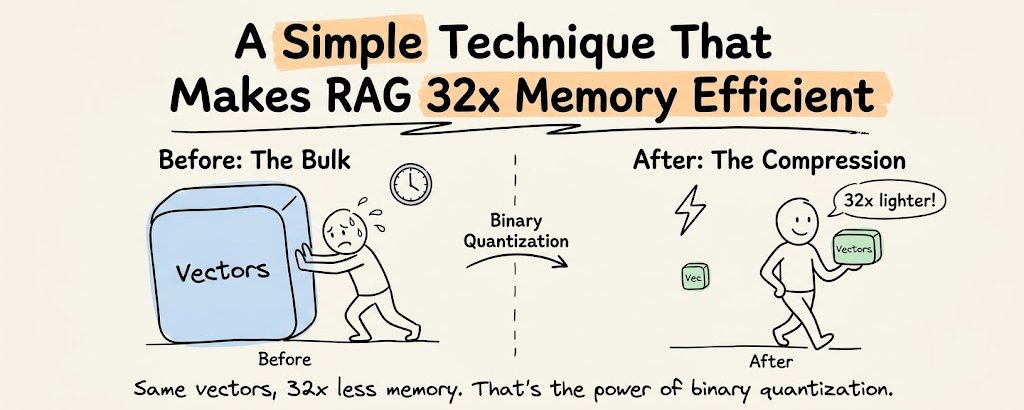
For a concrete example, I previously explained how binary quantization can make RAG search 32x more memory-efficient while querying over 36 million vectors in under 30 ms.
Read it below.

Hendra respati retweeted
This might be the most useful paper on AI agents this year.
A team at Wavestone AI Lab took apart Claude Code, Codex and 9 more and found the 7-part blueprint every good agent is built on.
Their definition: an agent is a model plus a harness. All 11 agents build the harness from the same 7 parts. Only the size changes.
> Loop: Mini-SWE-Agent is a plain while loop. OpenHands logs every event so a run can be replayed
> LLM layer: one prompt template on one side, 29 provider profiles on the other
> Tools: some agents only have bash, the biggest has 43 typed tools loaded on demand
> Memory: from keep-the-whole-history to notes the agent maintains across sessions
> Safety: from a simple step limit to policy rules plus a reviewer model plus an OS sandbox
> Orchestration: Aider skips sub-agents on purpose, others fork them with their own context
> Extensions: hooks, skills and MCP. SKILL.md is in 9 of 11, MCP in 8
The paper ends with a 90-line harness covering all 7 parts, a solid starting point for your own.
Key pages:
> p.4: the 7-part map
> p.12: the 3 loop types, with Claude Code and Codex as examples
> p.53: why none of them use frameworks or embeddings
> p.67: 18 design recommendations
> p.71: the 90-line harness you can copy


Hendra respati retweeted

🚨NEW Whitepaper on AI Agents by OpenAI
The maker of ChatGPT shares how it builds AI Agents.
Get the 34-page white paper here:

Hendra respati retweeted

I don't understand why everyone isn't doing this yet. Anthropic released a guide for Claude that makes work much more efficient while burning a fraction of the tokens
Main Idea: Agent Teams in Claude Code
Instead of burning the expensive Opus 5.5 context on every line of code, tasks are delegated across an autonomous swarm:
Architect (Opus 5.5, high effort): Plans the structure and handles final PR merges
Developers (Sonnet 5.5, medium effort): Write code inside isolated git worktree environments (UI/UX, backend)
Adversary / Critic (Fable 5.1): Steps in at contract boundaries, recurring test failures, and pre-PR audits to catch vulnerabilities
Script Layer (Jev): Handles mechanical tasks (opening files, CLI invocations) in 16ms without involving LLMs
Launch the team via terminal:
claude --teammates ux,backend,adversary
Configure my Claude Code workspace for autonomous agent teams:
In ~/.claude/teams, generate missing roles: set workers to Sonnet (medium effort) in separate git worktree branches, and the adversary to Fable
In ~/.claude/settings.json, set CLAUDE_CODE_EXPERIMENTAL_AGENT_TEAMS=1 and lock the main session to effortLevel: high
Initialize tasks.json with file-level locking for direct peer coordination
In CLAUDE.md, add a rule requiring an adversary review before opening a PR.
Show configuration diffs before applying edits
> code.claude.com/docs/en/advi…


Hendra respati retweeted

Uber publicó cómo armó su infraestructura de MCP y hay varias ideas muy buenas acá.
imaginate una empresa con miles de servicios internos y muchos equipos conectando agentes a esos sistemas por su cuenta.
cuando eso empieza a crecer, terminás con tooling fragmentado, infra duplicada, distintas formas de exponer tools y poca consistencia en seguridad, discovery y operación.
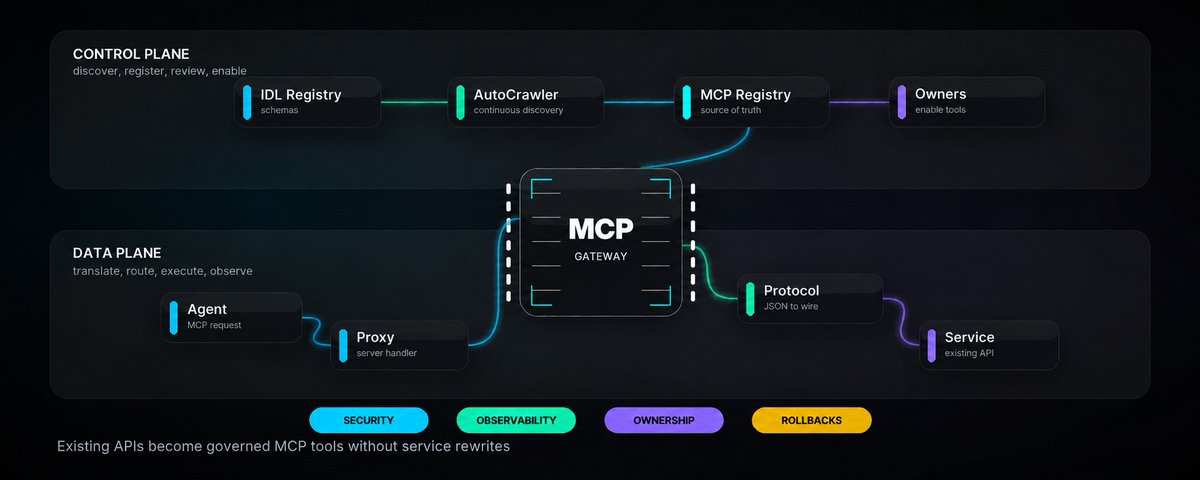
por eso Uber hizo un MCP Gateway: una capa central entre los agentes y sus servicios internos.
el agente habla MCP y el gateway se encarga de routing, permisos, ejecución y de traducir las llamadas a HTTP, gRPC o TChannel según corresponda.
como Uber ya tenía miles de APIs internas, también hicieron AutoCrawler: recorre sus definiciones, detecta métodos y schemas y genera MCP tools automáticamente. incluso usan un LLM para mejorar las descripciones.
hoy tienen +800 MCP servers y +5000 tools. y ahí aparece otro problema: no podés cargar todas esas definiciones en el contexto del modelo.
para eso crearon Omni MCP. en vez de pasarle miles de tools al agente, este va descubriendo qué server necesita, qué tools tiene disponibles, carga el schema de la correcta y recién ahí ejecuta.
me parece un muy buen ejemplo de cómo cambia la arquitectura cuando los agentes pasan de usar unas pocas tools a trabajar con miles.
terminás necesitando algo muy parecido a un API Gateway para agentes.


Hendra respati retweeted
Dosa paling besar tech industry adalah meyakinkan orang2 bahwa di platform marketplace itu yang penting adalah technya, bukan isi dan operationalnya
Terus orang2 pada bilang "tinggal bikin app" as if tenant, marketing, operation work are not important
There's no tech winter. It was just tech bubble bursting
Hendra respati retweeted
🚚 Jadi Gogo bikin 400+ commit per hari itu ngapain sih?
💩 And is that shit commits?
💾 Tiap save file di-commit?
📊 Emang ada hasilnya?
Awal 2025, semua orang masih pada pake Cursor/Windsurf. AI ngoding, kita review. Kita liatin itu kode satu-satu. Apapun yang masuk ke main branch kita perhatiin. Di sini kita kerja kaya mid level/senior engineer, jagain kerjaan intern dan junior engineer sambil kadang2 masih ngulik dikit2 untuk bagian2 yang kritikal yang kita ga terlalu percaya bisa dikerjain sama junior atau intern
Lalu akhir 2025, ketika Claude 4.5 rilis. Claude Code mulai mendapatkan traction yang signifikan. Di sini role kita berubah menjadi senior/staff engineer. Coding udah jadi kayak bernapas. We don't even think about it. Coding is just a means to an end. We start thinking in systems, not in code
Lalu awal 2026 muncul harness engineering, loop engineering, and eventually graph engineering. Di sini kita mulai kerja kaya TLM, engineering manager, then senior engineering manager. Ngurusin team of agents directly. Nyuruh mereka bikin fitur, nyuruh mereka refactor sampe beres, nyuruh mereka migrasi
Sekarang aku personally sedang kerja kaya Engineering Director
- We decide what metrics are important. Latency? Cost? Activation? User registration?
- Toolsnya apa aja? Ada feature flag? Boleh deploy terus2an atau sehari sekali? CI/CD?
- Kita bolehin gerakin metricsnya gmn? TDD cukup kah? Eksperimen ke end-user boleh ga?
- Guardrailnya apa? Apa yang ga boleh dilakukan? Testing ke user production boleh ga? Testing ke internal user boleh semua ga? Atau CEOnya bangsat jadi release ke semua internal user kecuali CEO?
- Kalo ada yang rusak policynya gmn? Revert? Kalo ada yang rusak, kita telen biar user experience enak atau kita bikin error merah gede-gede biar kita bisa cepet fix? Bagian produk mana yang error itu kritikal dan bagian mana yang kalo error yowis ae
- Gimana push product dari 80% jadi 99%? AI bisa bikin produk yang 80% bagus dengan cepat. UI-nya bagus. Bisa buat pamer, bagus buat demo, bikin orang pede "gw bisa 2 minggu u masa butuh 2 tahun?" Tapi bisnis butuh reliability, butuh hasil bagus yang konsisten, butuh governance. Dan kita ga bisa langsung dari 80% ke 99%. Butuh iterasi. Butuh beresin printilan edge cases kecil2 tapi buanyak yang baru ketahuan ketika produknya dah jalan di production. Butuh pikirin metrics2 baru yang mungkin sebelumnya ga kepikiran pas masih development. Butuh pikirin mana use case untuk semua orang, mana yang spesifik problem beberapa orang tertentu
Sehingga what matters now?
- Metrics understanding. Business metrics, product metrics, engineering metrics
- Figuring out levers and metrics that actually move the business. Just like in the Good to Great book
- Unblock Modern Engineering Practices. Observability, decouple deployment and release, feature flag, lead time to deployment, CI/CD
- Policies bergantung industri, organisasi, fase kumpeni lagi dmn, risk appetite dari management
- Be flexible on the approach and implementation. Be strict on results, metrics, verification
Kerja seperti Engineering Director
Apakah ada evolusinya? VP of Engineering dan CTO level?
Jujur, blom tau. VP + CTO itu set process, culture, hiring process, hiring bar, promotions, reward and punishment, technology standard, technology investment. Apakah AI butuh itu? So far sih ngga ya
Tapi mungkin nanti, eventually, tugas kita bukan bikin agent, tapi hire agent yang udah jadi dan sudah well-fine-tuned with strong domain expertise. Sehingga tugas kita set up organisasinya yang cocok dengan bisnis kita
Jadi jawabannya dari pertanyaan di awal:
🚚 400 commit per hari itu biasa, karena aku mengoperasikan AI-ku sebagai kumpulan product squad. I am the engineering director, not the manager, not the tech lead
💩 Ngga, tiap commit adalah satu full fitur atau eksperimen
💾 Ngga. Tiap hari aku biasanya punya 12 sesi. Per sesi spawn 1 agent, yang biasanya spawn 10-15 subagents. Masing2 subagents either dia riset, check grounding, menghasilkan sesuatu (coding, artifact), atau verifikasi (test result, screenshot, video)
📊 Iya semua sesi itu ada metricsnya ⬇️
- Cost saving (pindah dari Claude ke Deepseek. LLM cost dari $60k/month jadi $1500/month)
- Latency (dari 60sec jadi 3sec TTFT)
- Reliability (dari 60% jadi 99% delivered)
- Engagement (dari 20% jadi 50% user onboarded)
- Conversion (dari 0.8% jadi 2% converted jadi paying user)
Dan ini berlaku untuk fungsi di luar engineering juga. We can be our own marketing director, operations director, finance director. Tapi ga yakin apakah udah di level CMO, COO, CFO atau belum. I don't think so


Hendra respati retweeted

Ex-Google Jeff Dean just released 1-hour lecture on full AI engineering: LLM → prompts → agent teams → graphs from 0% to 100%:
0% → 1:45 - LLM from scratch - that made Google
30% → 17:22 - how to actually use AI models
65% → 30:03 - prompt engineering
100% → 52:35 - one human coordinating 100 agents
this is 27 years of AI in Google compressed into one hour, by the person who lived it
watch it today - then read how to build graphs in the article below ↓

