

Associate Prof @NortheasternCOE @NUnetsi & @nu_policyschool | Sociotechnical Systems, Computational Social sciences, Human-AI Networks | PhD @Berkeley_EECS
Boston, MA
Joined July 2018
- Tweets177
- Following138
- Followers224
- Likes523



1/4 Much work on LLM agents, including our own, examines human bounded rationality and strategic behavior through individual or one-shot decisions. Using these agents as human proxies in complex systems requires testing sequential interactions, different roles, and feedback.

📢Can AI agents recreate the dynamics of human groups? Hongan Zhu and @HeydariSys show that guiding agents with descriptions of how people make decisions in a supply-chain game helps agents reproduce collective human behavior. nature.com/articles/s43588-0…
🔓rdcu.be/AwpD6zA4S1Aa

3/4 We translated a human-calibrated behavioral model into qualitative guidance for LLM agents—“cognitive grounding.” This improved collective trajectory fit across all seven models and generally shifted inferred decision parameters toward human estimates.
1
3
24
Babak Heydari retweeted

📢Can AI agents recreate the dynamics of human groups? Hongan Zhu and @HeydariSys show that guiding agents with descriptions of how people make decisions in a supply-chain game helps agents reproduce collective human behavior. nature.com/articles/s43588-0…
🔓rdcu.be/AwpD6zA4S1Aa
A common claim is that #taste is what humans keep once AI can do the research. But taste is a snapshot of what a field values, and snapshots can be learned. What stays human is the process that changes them.
I explore this in my first Substack post:
open.substack.com/pub/babakh…
4
128
Mathematics is turning Automathic.

We’re releasing a broad range of new mathematical results produced by an internal frontier model.
We’ve been consulting with the independent Advisory Group on Mathematics and Artificial Intelligence at the Institute for Advanced Study, and we have drawn on their advice and public recommendations to inform how we release these results.
github.com/openai/math

1/ It's been quiet here, but not in the MAGICS lab.
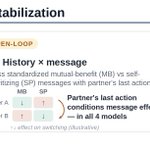
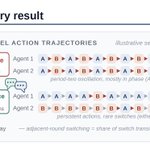
Time to change that, starting with a new work: can one non-binding sentence stabilize how LLM agents behave in repeated games? We combine game-theoretic experiments with mechanistic interpretability to see whether, and why. 🧵

4/ Mechanisms: in Qwen, messages reduce action uncertainty and drift between rounds. In all four models, a partner's recent behavior shapes how messages land. Inside the models, removing a late-layer direction during play raises switching (Qwen, layer 22: 6% → 70%).

1
2
48
5/ A fun one to work on with Nunzio Lorè and Hongan Zhu @zhuhongan , one outgoing and one incoming PhD student at Northeastern's MAGICS Lab. "Cheap Talk Stabilizes Strategic Interaction in LLM Agents"
arxiv.org/abs/2609.16270

1
18
Amazing how one (now-retracted) MIT PhD paper wrote the whole “AI makes professionals superhuman” script. A few months ago all researchers wanted its secret sauce; now we’re back to Grandma’s rule: if it’s too good to be true, it probably isn’t.

With the retraction of the MIT paper, we now have no clear experimental evidence that LLMs act as a multiplier for high performers (even though that would still seem to make sense).
Lots of evidence that low performers get a big performance boost, though, across many studies.
5
428
Is #causality meaningful without some form of #agency?
Yes, we can still have mechanisms, but causation without a conceivable intervention becomes essentially void!
1
2
154
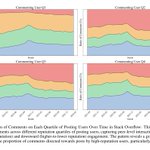
Decline of StackOverflow is more nuanced than it seems.
The sharp activity drop in knowledge-sharing platforms has sparked concerns re the sustainability of GenAI. If LLMs depend on human-generated data but reduce content generation, are we hitting the so-called "peak data"? 1/n


Considering the exploration/exploitation trade-offs in knowledge ecosystems: GenAI has taken over the exploitation side—transfer of existing knowledge; But the exploration side, where expertise deepens, and new knowledge emerges, remains active. 4/n
papers.ssrn.com/sol3/papers.…
4
67
Babak Heydari retweeted

Getting realer... Amazon knows that The Pointillistic City is a book and it's on its way! Next up, physical copies...
amazon.com/dp/0262550806/
