
Maps and charts about Hungarian politics and society. Edited by Hungarian data/political scientists living abroad. 🇳🇱🇪🇸
Barcelona - Leiden
Joined April 2025
- Tweets62
- Following17
- Followers208
- Likes21






Pinned Tweet
With less than #3weeks to go until the election 🗳️ a new Medián poll suggests the gap has widened.
📊 Among certain voters with a party preference, the opposition party leads by 23 percentage points (58-35). Among voters with a party preference, the lead is 20 points (56-36) and among the general population it is 16 points (46-30).
This is the largest lead measured in recent polls. By contrast, an early March poll by 21-Kutatóközpont found smaller gaps of: 14 (53-39), 10 (51-41), and 8 (38-30).
Which result is closer to reality remains uncertain. However, if Medián's figures are even roughly close to the final result, it would represent a dramatic loss for @PM_ViktorOrban and a decisive victory for the opposition.

1
4
117
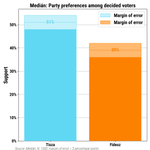
With less than #7weeks to go until the election 🗳️, a new poll today by Medián shows a 20 point lead for the opposition party Tisza in front, of @PM_OrbanViktor’s party, amongst decided voters with a party preference 📊. An 8-point increase in the gap when compared to Medián’s previous poll from January.
The gap among the general population is 11 points (42-31) and among voters with a preference it is 13 (51-38). The reason the gap is much wider among decided likely voters is that opposition voters are more mobilized, with 97% of Tisza favouring respondents saying they will vote compared to only 85% of the supporters of Fidesz.
Whether other pollsters will find similar results and a similar widening gap is to be seen.
The results for now suggest two things:
1️⃣ With the official campaign underway, the opposition party seems to be in a much better spot, and it has not only managed to keep its lead but also to widen it.
2️⃣ The governing party has reserves if it is able to fully mobilize its own supporters. Still, the fact that they are behind in both the general population and among voters with a preference suggests that these reserves are limited.

2
127
With #8weeks to go until the election 🗳️, this week we contrast two pollsters who both find static trends among the electorate, just with leads for two different parties.
📊 Nézőpont found a 6-point lead for @PM_ViktorOrban's party. The pollster, who is often referred to as being close to the government, publishes a result that they call the ‘most likely party list result’. In this, it attempts to identify latent supporters who have not (yet) decided which party to back by comparing them to similar decided respondents. The aim is to better approximate the final result by accounting for voters who have either not yet decided or who do not wish to share who they support.
📊By contrast, IDEA found a 10-point lead for the opposition party Tisza among decided voters (the same result as we also reported from a month ago). A result that is much closer to other (non-government-aligned) pollsters.
The two examples show the wide polarization gap among polling in Hungary 🇭🇺, possibly one of the widest seen so far. The high politicization and polarization of polls makes interpretting results and getting a clear picture of the race rather difficult. Who is correct will be revealed in two months.


116
#10weeks to go until the election🗳️: Hungary's 🇭🇺 mixed electoral system features 106 individual electoral districts (ED). These districts, however, have been criticised for favouring @PM_ViktorOrban's party. One reason for this is malapportionment: the number of registered voters in the districts is highly unequal.
The graph 📊 shows a negative correlation in the 2024 EP results, mapped to the ED map that will be used for the 2026 election: districts where @PM_ViktorOrban's Fidesz party performed better have fewer registered voters. This means that votes cast in the smaller districts, where Fidesz performed better, carry more weight.
The Hungarian system has a rather large threshold that allows EDs to differ by 20% from the average in the number of registered voters, differences that, as the graph shows, are one of the mechanisms in how the current electoral system favours Fidesz.

1
2
230
With #12weeks to go until the election, Hungary will soon enter the official campaign period, even if de facto the campaign has been underway for a long time.
Last week, two new polls came out, showing similar results: an about 10-point lead for the opposition party ahead of @PM_ViktorOrban's party among decided voters. Both polls also showed a small, within the margin of error, growth in the gap between the two leading parties.
Among decided voters, Median found a 12-point gap, with Tisza at 51% and Fidesz at 39%. Their last result in November featured a 10-point gap with 50% vs 40%.
Similarly, IDEA found a gap of 10 points with 48% vs 38%. Their last result in December had 47% vs 39%, showing a similar 2-point increase in the gap.
Overall polling trends in the last couple of months show rather static results, and suggest that the slight growth that @PM_ViktorOrban's party experienced during the second half of autumn has not continued.


With #13weeks to go until the election, Péter Magyar, the opposition candidate, remains ahead of @PM_ViktorOrban in the betting markets (55-44). The gap was wider over the holidays, and has narrowed slightly since.
Market volumes have continued to rise. The gap between the combined volume of the two main candidates and that of the marginal candidates has narrowed since our last update, indicating increased trading activity for the main candidates.
Following the conference of @PM_ViktorOrban party yesterday, the candidates of the two main parties for the individual districts are now known. With the election fast approaching, the pace of the campaign is likely to only accelerate further.
@HungarianSunday will continue to provide weekly short analysis in the remaining weeks of the campaign.


151
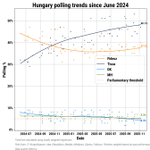
📊 With #21weeks to go until the next election, here is an updated graph of aggregated poll results.
Following two tense and eventful weeks in Hungarian 🇭🇺 politics, marked by the theft and leakage of the private data of 200,000 people who downloaded Tisza's mobile app, and by @PM_ViktorOrban's visit to the US 🇺🇸, aggregated results show some evidence of tightening.
The next weeks will be critical in the campaign, as Tisza's candidates are finalized through an internal primary system 🗳️. A process that brings inherent risks by increasing the party's exposure, but if done successfully, it could give a chance to regain momentum.
❓ How the next weeks will impact the support of the competing parties is not yet clear, but we will do our best to keep you updated!

3
226
It is only #22weeks until crucial election day in Hungary. @PM_ViktorOrban has much more voters older than 65 years than among those younger than 40. No matter if Fidesz could win the elections in 5 months or not, in 2030, they will have potentially -300k supporters, just because of demographics.
His challenger @magyarpeterMP is 3 times more popular among young voters, so time is not on the side of Fidesz and Orbán....


With #24weeks to go till the next election, on Thursday, October 23rd, Hungary commemorated the 1956 Hungarian Revolution. A crucial day in Hungary that commemorates one of the most important moments in the country’s history, it is also a politically important day. Both campaign sides have been preparing their events for weeks, with the governing party led by @PM_ViktorOrban staging their “Peace March” and the opposition led by @magyarpeterMP staging the “National March”. The two sides compete in many things, such as the speeches and the atmosphere. But one certain point of competition is which event had the most attendees.
It is difficult to get accurate and comparable estimates of attendance numbers, with competing estimates floating around. Here we report the estimates of sociologist Andrea Szabo, collected with the help of a team of university students. She estimates that @PM_ViktorOrban's event had roughly 92 thousand attendees, and the opposition 169 thousand. While exact numbers are difficult to estimate, the assertion by @PM_ViktorOrban that his event had twice the attendees is almost certainly false; rather, it seems that the opposite was true: Tisza’s event had around 1.7-1.8 times more attendees.
📊 facebook.com/photo/?fbid=251…


205
There are "no plans" for US President @DonaldTrump to meet Russia's Vladimir Putin "in the immediate future", despite @PM_ViktorOrban built his entire campaigning strategy on a soon-to-be Budapest meeting, announced by Trump, a few days earlier.
Next year election in Hungary is also a race of competing narratives: foreign policy agenda (supported by Orbán) and domestic issues (backed by @PeterMagyar_MP )
polymarket.com/event/where-w…

1
1
236

A potentially concerning sight for Tisza?
📊 With #25weeks until the next election, we look at another result from the poll we covered in our last post. Compared to last June, 4 percentage points fewer respondents now believe the opposition will win next year’s election. At the same time, 2 percentage points more think that @PM_OrbanViktor is heading for another victory.
A crucial difference in the last 2 years of Hungarian politics, compared to the pre-2024 era, has been that opposition voters started to believe that it might be possible to defeat @PM_OrbanViktor’s Fidesz party. This (cautious) optimism is a threat to the governing party, at the same time as it is an invaluable resource for the opposition.
This is a concerning result for Tisza. Taken together with the results we covered last week, it suggests that while Fidesz’s intensified campaign efforts might not have been very successful in boosting their overall support, they may have been more successful in making opposition voters more pessimistic.

New polling released today by 21 Research Center shows opposition leader Péter Magyar with an 18-point lead among certain voters with a party preference.
@PM_ViktorOrban's Fidesz party stands at 35%, while the opposition party Tisza is at 53%.
Compared to the pollster's last polling from August, the gap widened within the margin of error from 16 percentage points to 18.
#Hungary #Politics #Polling

21Kutató was the one, predicted 44% Fidesz in its final research, published on election day (2024.06.09.). As we are all aware: Fidesz ended up at 44,8%. Thanks for visiting us and sharing your troll comments: telex.hu/belfold/2024/06/09/…

1
157
❓ Is this the last big chance of @PM_ViktorOrban to win?
It is only #31weeks left until next election in Hungary and the recent polls show a massive generational cleavage between young and old Hungarians. While among those, older than 65, the support of @PM_ViktorOrban is twofold, compared to @magyarpeterMP, people under the age of 40 are 3 times more likely to be anti-Orbán.
Based on our projection, by the elections of 2030, 450k elderly (now 65+) voters will pass away, while 480k new young voters will be eligible to vote.
Appr. 200k core Fidesz supporter will be missing while 250k core anti-Fidesz will step in to vote.

With #26weeks to go till the next election, here is another look at the @Polymarket betting odds on who will be the next PM of Hungary. The predicted chances have remained rather static in the last month, after some narrowing at the end of summer. Today the opposition leader Péter Magyar is 11 percentage points ahead of @PM_ViktorOrban.
Market volumes have also stayed consistent. Much of the market volume and trading continues to focus on bets (against) the two unlikely candidates, László Toroczkai and Klára Dobrev, both with predicted chances below 1%.
In the following weeks we will continue tracking how the betting markets evolve as the campaign keeps heating up.


1
163
With #27weeks to go until the next election 🗳️, it already feels as if the campaign is in full swing in Hungary. Over the past 90 days @PM_ViktorOrban's Fidesz party, along with aligned media organisations and proxies, have significantly outspent all opposition groups 💸.
Large part of this spending is driven by new digital campaign initiatives: the "Digital Civic Circles" and a "Fight Club", Fidesz's answer to recent bans on political advertising across many online platforms.
Yet, as Fidesz strategy becomes increasingly digital, the party faces growing challenges offline, as opposition leader Peter Magyar's continues his campaign tour across the country.


‼️ Just look at the diagram to understand, why paid political social media ads is a key political instrument for @PM_ViktorOrban and his ruling Fidesz party. While Czechia entered the final days of its heated general election campaign, in Hungary, Fidesz alone spent 6 times more money on Facebook than Czechia as a whole!
Please also note that paid political contents are still live on both YouTube and Facebook in spite of the official ban.
Find the link to our full article on @dwnews in comments.
