

Institute of Paleobiology of Polish Academy of Sciences / Instytut Paleobiologii Polskiej Akademii Nauk
- Tweets317
- Following95
- Followers490
- Likes469




ALT Basalt boulder with a thick crustose coralline algal biocrust at Tachero, Tenerife (top), and a cross-section through the biocrust containing fragments of the coral Cladocora ?debilis (bottom; arrows).

ALT Figure: A) Sea urchin Prionocidaris baculosa. B) Main load-bearing directions in the spine, determined using structural optimization. C) Stress distribution and regions important for load bearing, correlated with different microstructural types.


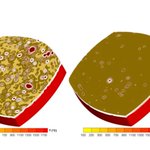
ALT Model termiczny powierzchni Ziemi. Po lewej ok. 4,49 mld lat temu, widoczna silnie zbombardowana uderzeniami i rozgrzana powierzchnia naszej planety; po prawej ok. 4,3 mld lat temu: wysokie temperatury pod powierzchnią (kolor czerwony) i chłodne na powierzchni (brązowy).

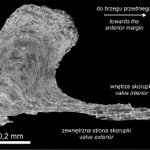
ALT The photograph shows a longitudinal section through a single valve of the brachiopod. The shell is long but thin, less than a tenth of a millimetre thick. It is composed of fibrous calcite crystals, which are visible in the section as long, irregular polygons.

ALT Life reconstruction of Tanystropheus (author: Marcin Ambrozik).

ALT Givetian terebratulide Cimicinoides sp. from Mount Józefka. The shell is 11.5 mm long and 10.9 mm wide. Note the punctate (finely perforated) shell structure.

ALT Na fotografii: prof. Mirosława Ostrowska, Wiceprezes PAN i dr hab. Przemysław Gorzelak, nowy dyrektor Instytutu Paleobiologii im. Romana Kozłowskiego PAN (fot. Aneta Karwowska, PAN).

ALT Reconstruction of a shallow-marine ecosystem from the Early Triassic of the Dolomites featuring a saurosphargid marine reptile (artist: Davide Bonadonna).

ALT Reconstruction of adult and newborn individuals of the Middle Triassic ichthyosaur Besanosaurus leptorhynchus from Italy (artist: Fabio Manucci)

ALT Insect wing preserved in the rock and a schematic reconstruction of the insect itself

ALT The phylogeny of ornithischian dinosaurs
![The illustration presents a flat, irregular fossil bone fragment and a natural mold of its surface. The bone in dorsal view is mostly smooth but it bears an outline of the broken off base of the pelvis, approximating the shape of the letter “W”. In ventral view the surface is more rough and exhibits narrow furrows once delineating areas of polygonal horny scutes – the scutes themselves are not preserved. The bone is light brown. The natural mold shows a better preserved natural outline of the edge of the plate, including characteristic, paired, triangular posterior processes.]](https://pbs.twimg.com/media/HQkZOaAW8AAcl-d.jpg?name=orig)
ALT The illustration presents a flat, irregular fossil bone fragment and a natural mold of its surface. The bone in dorsal view is mostly smooth but it bears an outline of the broken off base of the pelvis, approximating the shape of the letter “W”. In ventral view the surface is more rough and exhibits narrow furrows once delineating areas of polygonal horny scutes – the scutes themselves are not preserved. The bone is light brown. The natural mold shows a better preserved natural outline of the edge of the plate, including characteristic, paired, triangular posterior processes.]

ALT Figure: Left: Reconciliation of the Neogastropoda fossil record with its phylogenetic tree, rooted in the earliest record of Buccinoidea. Right: Apical view of the newly discovered species showing the arrangement of varices and the method used to measure their spacing. Numbers indicate the sequence of varix formation during shell growth.

ALT Figure: Crown of an Oligocene crinoid from Oregon.