

Making religion part of the solution to global challenges by promoting mutual recognition and respect between Judaism and other religions. 🕎 ✝️ ☪️ 🪯 🕉️ 🛐 🔯
Worldwide
Joined March 2024
- Tweets2.2K
- Following201
- Followers151
- Likes2K






Pinned Tweet
Going to the UAE now says something about what we believe interfaith partnership is for: not a fair-weather pursuit, but a foundation for the future we want to share.
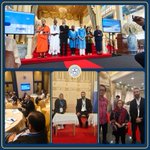
Last week, JIC and @TheMinistryofR2 led 30+ interfaith leaders to Abu Dhabi for the Third International Dialogue of Civilizations and Tolerance Conference.
@Dralnoaimi of @manaraccd captured what this visit was really about: "The Abraham Accords are meant to create connections among people, communities, and nations." At JIC, our work is built on exactly that premise. This delegation was one expression of that responsibility.
Stay with us this week for the full story from the delegation.


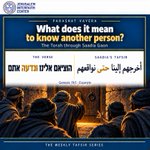
How does the Torah talk about intimacy, and how does it talk about violence, using the very same verb?
In this week’s portion, Vayera, the people of Sodom surround Lot’s house and demand he hand over his guests, in fact angels, “that we may know them” (Genesis 19:5). The same verb, “to know,” appears earlier in Genesis to describe Adam and Eve’s union that led to Cain’s birth. One use is tender. The other, aimed at strangers under someone else’s roof, is a demand rooted in violence and domination.

Rabbi Saadia Gaon’s Arabic translation does not let that ambiguity stand. In Genesis 4, he renders “knew” as wāqaʿa, an explicit term for sexual relations. In the Sodom verse, he goes further: rather than a flat “and” connecting the demand to “know them,” he chooses the Arabic ḥattā, “so that,” making clear the men’s purpose from the start. There is no ambiguity left in his Arabic for what was being demanded, or why.
That precision matters. Saadia is not softening a difficult text. He is refusing to let a biblical euphemism obscure an act of violence, insisting his readers understand exactly what the Torah is condemning.
We are grateful to Rabbi Yom Tov Gindi of Kfar Chabad, whose modern edition of the Tafsir in Arabic script made this series possible
Delegates from Russia and Ukraine sat in the same room this week. So did delegates from Iran and Israel.
The Jerusalem Interfaith Center joined the Fourth Tokyo Peace Process, a gathering built specifically around the conflicts most forums are too cautious to name directly: Russia and Ukraine, the Middle East, Haiti, Myanmar, Sudan. Rabbi Dr. @arilavi represented the center among religious leaders from Russia, Ukraine, Iran, Israel, Palestine, Saudi Arabia, and Egypt.

The gathering’s goal was not political agreement, and it was something narrower and harder to sustain. It was about keeping lines of communication open between communities even while their countries remain at war, and refusing to let religion be used as a weapon in conflicts it did not start.
Participants committed to concrete steps to sustain relationships across conflict lines under real pressure, promoting dialogue within communities as well as between them, and creating more space for women and young people in peace work that has too often excluded both.
“Tolerance means I’m willing to bear the pain of you.”
Speaking with @i24NEWS_EN, Rabbi Dr. Yakov Nagen explains why the Jewish-Muslim Declaration of Fraternity in Faith, signed at the G20 Interfaith Forum in Salt Lake City, calls for co-elevation.
It means seeing one another’s deepest identity and facing every challenge together.
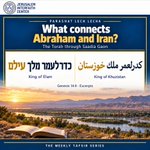
Rabbi Saadia Gaon’s Tafsir places the Bible’s “first world war” on a map you’d recognize.
In this week’s portion, Lech Lecha, “Chedorlaomer, king of Elam” leads four kings against five, and Saadia translates his title as king of Khuzistan, in modern Iran, home to the very Shushan of the Purim story.
He does this throughout his translation, trading obscure ancient names for places his readers could actually locate, turning the Bible’s geography into something you can trace on a real map.

Last week, the Jerusalem Interfaith Center’s president stood on stage in Salt Lake City to help launch something years in the making. By Friday, its CEO was in a smaller room helping put it into practice.
At the G20 Interfaith Forum, Rabbi Dr. Yakov Nagen joined Imam Dr. Talib Shareef to formally present the Jewish-Muslim Declaration of Fraternity in Faith, a project the two launched together at last year’s forum in Cape Town. The next day, Rabbi Dr. Aharon Ariel Lavi represented the center in a “Faith in Action” breakout session on the Abrahamic family, built directly on that declaration.


Between the two rabbis, the center’s work this week carried the same thread: real differences between faiths should sharpen fraternity, not weaken it, and the strength to engage across difference comes from a secure sense of one’s own identity, not from blurring it.
Jewish, Christian, and Muslim participants in the breakout session studied texts on love of God and love of neighbor together, drawing from the Hebrew Bible, the New Testament, the Talmud, the Quran, and the Hadith.

In our weekly series exploring Rabbi Saadia Gaon's groundbreaking Arabic translation of the Torah, this week we look at Parashat Noach and one of its most charged words: "hamas" (חָמָס).
The verse states plainly: "The earth became corrupt before God, and the earth was filled with 'hamas'" (Genesis 6:11), the sin that brought the Flood.
This is not the modern Arabic "Hamas" (حماس), the acronym for the Islamic Resistance Movement, which also independently means "enthusiasm" or "zeal." The biblical hamas is a different word entirely, and Saadia Gaon's translation shows us its real meaning.

Rather than searching for an Arabic word that merely sounds like the Hebrew, Saadia chose "zulman" (ظُلْمًا), from the root ẓ-l-m, meaning injustice, wrongdoing, or oppression, the same root that gives the Quran its recurring term for wrongdoers, "al-zalimun." For Saadia's Arabic-speaking Jewish readers, steeped in that linguistic and cultural world, the word carried real moral weight.
His choice tells us something important: the hamas of Noah's generation was not simply physical violence. It was the collapse of justice between people, exploitation and harm that corrupted the basic fabric of human relationships.
We are grateful to Rabbi Yom Tov Gindi of Kfar Chabad, whose modern edition of the Tafsir in Arabic script made this entire project possible.
This week, we took our work on faith-based partnership directly into the room where it gets tested: a forum of religious leaders from Buddhist, Muslim, Christian, and other traditions, meeting in Thailand to build cooperation that outlasts a single conference.
Rabbi Dr. Aharon Ariel Lavi represented the center at the the PaRD Annual Forum in Wat Saket for three days of sessions that moved past statements of shared values into the actual mechanics of partnership, transparency, coordinated meetings, how an international coalition governs and transitions itself over time.
This is the center’s conviction in practice: durable relationships between faiths are not built in ceremonies, they are built in rooms like this one, discussion by discussion, session by session.

We are launching a new weekly series alongside our Quran commentary: the Torah read through Rabbi Saadia Gaon's thousand-year-old Arabic translation, the Tafsir.
Week one, Parshat Beresheet: humanity placed in Eden "to work it and to preserve it."
Saadia's Arabic renders "to work it" with the root behind fallah, farmer, specifically agricultural, not generic.
The point: never a passive guardian of creation, never an unlimited exploiter either, both responsibilities, together.

Three years ago today, Hamas launched the deadliest attack on Jewish life since the Holocaust. We hold this day, and everyone it took, in solemnity.
October 7 took Jews, Muslims, Christians, Druze, Bedouin citizens, and foreign workers alike, and in the years since, the work of rebuilding trust between the communities of this land has had to continue anyway.
We remember those murdered, those still held, and those still healing.

Rabbi Dr. Yakov Nagen, President of the Jerusalem Interfaith Center, and Rabbi Dr. Aharon Ariel Lavi, CEO, were honored this week at the Ambassadors' Club of Israel's "Voices from the Field" event marking six years of the Abraham Accords, alongside the teams at ViaCity, the Israel-Morocco Chamber of Commerce, WeAreMENA, and Women Champions for Change.
Grateful for the recognition, and for everyone in that room who kept building these ties through years the headlines called impossible. 🇮🇱🇲🇦
Read more here from @Jerusalem_Post: jpost.com/middle-east/abraha…

A Persian king helped end Jewish exile twenty-five hundred years ago. A few weeks ago in Jerusalem, that history came full circle, when the Jerusalem Interfaith Center hosted a delegation with Iranian opposition leaders. Rabbi Dr. Aharon Ariel Lavi, CEO of JIC, called it practical work, not hasbara, built around a recurring idea: Cyrus once helped end our exile, today many Iranians live in exile from the country they want to rebuild, and Jewish experience can help the same way.
Rabbi Shlomo Dov Rosen, Head of the Yakar Community in Jerusalem, closed with a blessing: may you find your way back to the place that's rightfully yours, and build a society on your own ancient values.
Real leadership in interfaith work is rarely loud.
Pastor Larry Huch built a platform most religious leaders never reach, then used it to challenge his own tradition's teaching on replacement theology, telling his own congregation that centuries of doctrine had damaged Christianity's relationship with the Jewish people.
Rabbi @yakovnagen calls it a rare kind of courage: being wrong in public, correcting course, and still saying so on Sunday mornings.
Grateful for leaders doing that work.
At a Jerusalem Interfaith Center delegation a few weeks back, Rev. @Foad_Khorshidi, Co-Founder and COO of The Cyrus Fund and Project Aftab, delivered remarks connecting today's Iranian-Israeli friendship to something far older than strategy.
He pointed to the Cyrus Cylinder, created in 539 BCE, as the record of an ancient covenant, and to the Book of Esther, where the queen of Persia was herself a Jewish woman who refused to stay silent while her people faced destruction. Rev. Khorshidi called on Iranians and Israelis to write a new chapter together, a Purim 2.0, turning history's darkest chapters into a shared celebration.
Jewish tradition holds that in the messianic era, nearly every holiday will fall away except two, and Yom Kippur is one of them, linked to Purim through a teaching almost as old as the holidays themselves, Yom Kippurim, a day like Purim.
We hope that day comes soon, and that it finds Iranians and Israelis already living the friendship Rev. Khorshidi described. And in the meantime, gmar hatima and a meanginful fast for all celebrating 🇮🇱🇮🇷
Israel and Morocco agreed today to upgrade diplomatic relations, elevating their missions to full embassies and appointing ambassadors for the first time, following a trilateral summit in New York with FM @gidonsaar, FM Nasser Bourita @Marocdiplo_EN, and @USAmbUN @michaelgwaltz
Coming in time for the 6 year anniversary of the signing of the Abraham Accords, direct flights, investment agreements, and high-level visits are next.
Jews and Muslims are partners.
Extremists who weaponize religion are the problem.
Days like this show what religion can be instead. 🇮🇱🇲🇦
